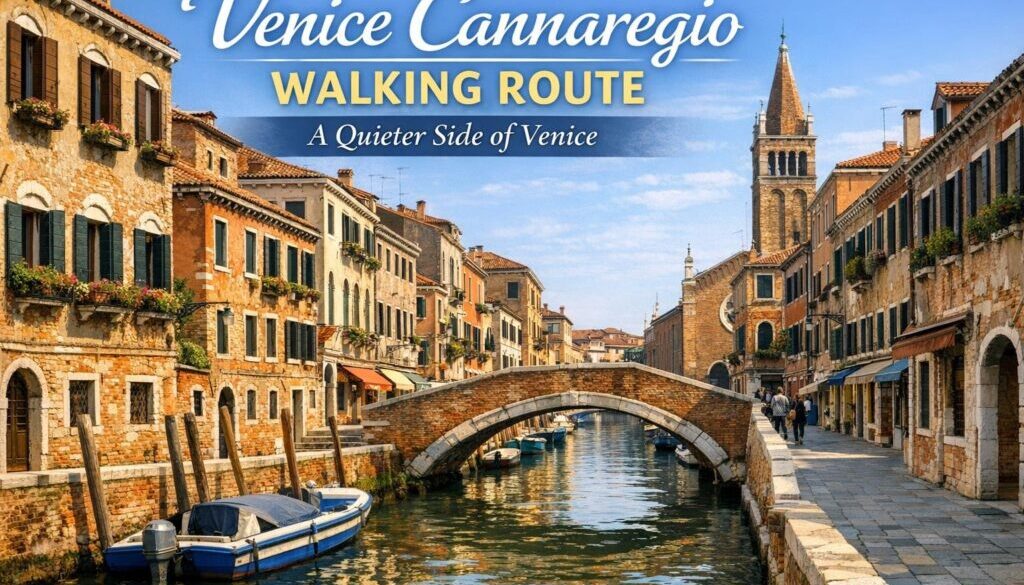
For travellers who want a quieter, more residential side of Venice, the Venice Cannaregio walking route is one of the city’s most rewarding ways to explore. Cannaregio sits in the northern part of Venice and feels noticeably calmer than the high-traffic zones around San Marco and Rialto, while still offering canals, history, and the kind of everyday atmosphere that makes Venice feel lived in rather than staged.
This route works especially well if you want to arrive, walk, stop for a coffee or cicchetti, and see a more local-feeling slice of the city without trying to cover everything. Venice is compact, but it is also a maze of bridges, lanes, and waterside turns. A Cannaregio walk gives you structure without taking away the pleasure of getting a little lost.
Quick Answer
The best way to experience the Venice Cannaregio walking route is on foot, starting near Santa Lucia station and following the canals and quieter side streets toward the Jewish Ghetto, the Strada Nova area, and optional waterside detours. It is a flexible route that suits a half-day wander or a slower full-day exploration.
Because Venice is car-free in its historic centre, walking is not just the best way to see Cannaregio; it is the natural way to move through it. For a broader look at how independent travellers can experience cities at their own pace, Walkables’ self-guided walking tours are designed for exactly this kind of travel: curious, flexible, and unhurried.
Before you set out, it is worth checking practical conditions that can affect any Venice visit, especially if you are coming for a day trip. The official Venice access contribution site explains the current day-tripper rules, while the city’s transport operator provides useful context on getting around by waterbus through ACTV and AVM public transport.
Why Cannaregio Is a Quieter Side of Venice
Cannaregio is one of Venice’s six historic sestieri, and it has long been known as a more residential district than the city’s headline-grabbing centre. You still get all the classic Venetian ingredients here—narrow lanes, bridges, canals, and elegant façades—but the pace feels different. There is more room to look around, fewer distractions, and a better sense of how people actually live in the city.
That makes Cannaregio especially appealing for visitors who enjoy walking for atmosphere rather than ticking off major landmarks. It is also a useful place to begin if you are arriving by train, since Venice Santa Lucia station sits on the edge of the district. From there, the city opens up quickly, and the walk can unfold naturally without a rigid timetable.
For a broader sense of Venice’s heritage landscape, UNESCO’s overview of Venice and its Lagoon is a useful reference point. It helps explain why this city feels so distinctive on foot: it is a place shaped by water, history, and careful movement between small spaces.
Venice Cannaregio Walking Route Overview
The Venice Cannaregio walking route is best treated as a flexible loop or point-to-point wander rather than a fixed sightseeing march. A practical starting point is around Santa Lucia station, which gives you immediate access to the district and makes the route easy to combine with arrival or departure plans. From there, you can move deeper into Cannaregio, following canal-side paths and quieter lanes toward the Jewish Ghetto and surrounding streets.
This is not a route that needs to be rushed. In fact, Cannaregio rewards a slower pace. You will get the most from it if you allow time for detours, small pauses, and spontaneous turns into lanes that catch your attention.
It is a strong fit for:
- First-time Venice visitors who want a gentler introduction to the city
- Repeat visitors looking beyond the busiest tourist core
- Couples and solo travellers who enjoy walking at their own pace
- Short-stay travellers who want one memorable district rather than a rushed checklist
Best starting point
Santa Lucia station is the most straightforward starting point for many travellers. It is easy to reach, easy to orient from, and sits close enough to the historic centre to make the transition into walking feel immediate. If you are arriving with luggage, it is also a sensible place to pause, regroup, and begin with a lighter day bag once you are ready to explore.
Route style: slow, flexible, self-guided
This route works best as a self-guided walk. The beauty of Cannaregio is not in forcing a perfect sequence of stops, but in letting the district reveal itself through movement. One lane leads to another, canal views open unexpectedly, and the quieter streets give you time to notice details that busy areas tend to blur past.
If you like that style of travel, this is exactly the kind of experience where audio storytelling can add depth without taking over the pace of the day. A self-guided format lets you move when you want, stop when you want, and avoid the feeling of keeping up with a group.
Who this walk is best for
The Venice Cannaregio walking route is especially good for travellers who prefer atmosphere to adrenaline. If your ideal sightseeing day includes a few strong landmarks, a canal-side wander, and time to simply absorb the place, Cannaregio will suit you well. It is also a sensible choice if you want to avoid the more intense foot traffic around Venice’s busiest sightseeing corridors.
Ready to Explore Venice?
Discover Venice at your own pace with a Walkables self-guided audio walking tour.
Suggested Highlights Along the Way
A good Venice Cannaregio walking route does not need dozens of stops. A few well-chosen areas are enough to give the walk shape and character.
Venice Santa Lucia station area
The station area is the practical gateway into Cannaregio. It is where many visitors first step out into Venice, and it sets the tone quickly: water instead of roads, foot traffic instead of cars, and the sense that the city’s geography works on its own terms.
Cannaregio canals and residential lanes
Once you move away from the station, the route can slip into quieter streets and canalside paths. This is where Cannaregio begins to feel distinct. You are still in Venice, but the atmosphere is more relaxed and less dominated by crowds. It is a good area to walk slowly and pay attention to façades, laundry lines, bridges, and the rhythm of everyday life.
Jewish Ghetto
The Jewish Ghetto is one of Cannaregio’s most important historic areas and a meaningful stop on any route through the district. Its cultural significance gives the walk more depth, and it is one of the places where it becomes easiest to understand how Venice’s history has been shaped by different communities over time.
If you want to add more context to your visit, Viator can be useful for browsing supporting experiences in Venice. You can browse tours and activities that complement a self-guided walk, especially if you want a specialist-led museum, food, or city experience before or after exploring on your own. Walkables may receive a commission if you book through this link.
Strada Nova corridor
The Strada Nova corridor is one of the more direct arteries through this part of Venice. It can feel busier than the side streets, but it is useful for orientation and movement. If your walk is based on a gentle loop, Strada Nova can help connect one section of Cannaregio to another without making the route feel too complicated.
Optional detours toward Fondamenta della Misericordia and Fondamenta degli Ormesini
These waterside areas can be excellent optional additions if you have more time. They help extend the route into places where you can linger by the canal, pause for a drink, or simply enjoy the shift in pace. Optional detours like these are what make a Cannaregio walk feel personal rather than prescriptive.
How to Get Around Cannaregio
The simplest answer is: walk as much as you can, and use vaporetto only when it helps you save time or energy. Venice is built for walking, but its scale and water-based geography make transport choices important. Cannaregio is one of the best districts for blending the two.
ACTV and AVM’s official transport information at avm.avmspa.it/en is a useful place to check the basics before you go, especially if you plan to connect your walk with waterbus travel. Service details can change, and Venice’s transport network is one of those systems where current information matters more than general advice.
Because Venice’s lanes are compact and often visually similar, offline maps are a smart backup even if you are using a strong mobile connection. A live map is helpful, but in Venice a downloaded map can be the difference between relaxed wandering and constant screen-checking.
💡 Walkables Travel Tip
In Venice, it is often better to use your map to confirm your direction at major turns rather than checking it every minute. That keeps the experience more enjoyable and helps you notice the city instead of only following the screen.
If you are comparing transport options or want extra context for your route, Google Maps can help you view the location on Google Maps before you set out. It is not perfect for every Venetian lane, but it is still a useful planning tool.
Practical Planning Tips for Australian Travellers
For Australian travellers, Venice is usually straightforward to visit for short tourism stays under Schengen rules, but it is still worth checking passport validity, travel insurance, and any current entry requirements before you go. Smartraveller’s Italy advice is the best place to start: read the latest guidance for Italy.
If you are planning a walking-heavy day in Venice, travel insurance is worth having even for a short trip. It is not just about major issues; it also gives peace of mind if a missed connection, a minor injury, or a disrupted day changes your plans.
Payments are generally easy in Venice, with cards widely accepted, but it is still sensible to carry some euros for smaller purchases or places where card terminals are less convenient. If you are managing spending overseas, you may also want to learn more about Wise for travel payments and international transfers. Walkables may receive a commission if you sign up through this link.
What to Know Before You Go
A Venice walking route is most enjoyable when you understand a few local realities in advance. The first is the access contribution system for day-trippers. Venice’s official site explains the current rules, dates, and exemptions, and it is important to check these close to travel because they can change.
The second is water. Venice can experience high water, or acqua alta, particularly in the cooler months. That does not mean you should avoid walking Cannaregio, but it does mean you should pay attention to current local conditions and build flexibility into your day.
The third is timing. Cannaregio is often at its best when you are not trying to race through it. Early morning and later in the day can feel especially calm, but the exact mood depends on season, weather, and how many visitors are in town.
For current heritage and city context, the official Venice tourism portal at veneziaunica.it/en is a useful companion source. It is one of the best places to check local updates alongside transport information and visitor guidance.
Want to Discover More on Foot?
Explore Walkables self-guided audio experiences and discover destinations at your own pace.
Connectivity for a Venice Walking Route
Good navigation matters in Venice, and connectivity is part of that. If you rely on maps, translations, bookings, or transport updates, consider how you will stay online before you arrive. Italy has strong mobile coverage in populated areas, but Venice’s dense historic layout can affect signal quality in some places, so offline maps are still worth having.
If you are comparing options for travel connectivity, it helps to think about whether you want to use an Australian roaming plan, a travel eSIM, or a local SIM. The right choice depends on how long you are staying and how much data you expect to use for maps and message apps rather than streaming or heavy browsing.
For a route like this, the goal is not constant connectivity. It is dependable access when you need it, plus a backup plan if your signal drops in a narrow lane or under a bridge.
A Self-Guided Audio Walk Fits Cannaregio Perfectly
Cannaregio is one of those places that rewards context. A beautiful street or canal becomes more meaningful when you know why it matters, how it fits into Venice’s history, or what makes one area feel different from the next. That is where a self-guided audio experience makes sense.
Instead of rushing from one fixed stop to the next, you can let the route breathe. Pause by a canal, follow a side street, linger near the Ghetto, or stop for a drink when the mood feels right. A self-guided format supports the way many travellers actually want to explore Venice: independently, but with good storytelling in the background.
That is also why Walkables’ cruise port guides and cruise companion guides can be useful for travellers combining city time with a wider Italy itinerary. If Venice is part of a port stop or cruise journey, those resources can help you make the most of a limited window without feeling rushed.
In Cannaregio, that approach feels especially natural. The district’s quieter streets, water edges, and historical layers are best experienced when you are not treating the walk as a checklist.
Final Thoughts
The Venice Cannaregio walking route is a smart choice if you want a more relaxed, more local-feeling experience of the city without giving up the classic beauty that makes Venice so memorable. It is easy to begin near Santa Lucia station, simple to shape around your time, and rich enough in atmosphere to feel worthwhile even if you only have a few hours.
For travellers who prefer to move at their own pace, Cannaregio offers a better rhythm than Venice’s busiest corridors. You still get canals, history, and the sense of being somewhere unmistakably Venetian—but with more breathing room.
If you are planning a longer stay, or if you simply want more context while exploring on foot, a self-guided audio approach is one of the best ways to experience it. Press play, slow down, and let Cannaregio show itself one turn at a time.
For more inspiration on independent city exploration, Walkables can help you turn a simple walk into a richer experience—especially in places like Venice, where the journey is often the destination.