
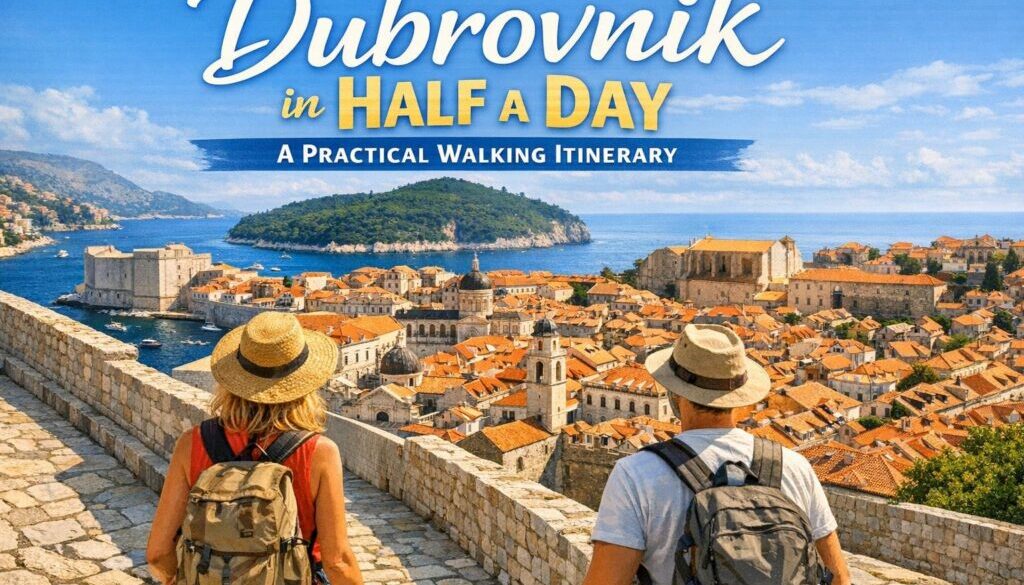
Dubrovnik in half a day is absolutely doable if you keep your focus tight: the Old Town, a few key landmarks, and one smart decision about the City Walls. The historic centre is compact, pedestrian-friendly, and built for walking, which makes it one of Europe’s better cities for a short, self-guided visit. The trick is not trying to do everything.
For most travellers, the best half-day approach is a loop through the Old Town that covers the main gates, Stradun, a few important squares and churches, and then leaves room for either a café stop or the City Walls if you decide the timing works. If you want to understand the city rather than just pass through it, this is the right way to see Dubrovnik in half a day.
Dubrovnik’s UNESCO-listed Old City is the obvious centrepiece of any short visit, and the narrow stone streets are easy to explore on foot once you accept that stairs and crowds are part of the experience. For a broader destination overview, the UNESCO listing for the Old City of Dubrovnik is a useful reference before you go. If you want help planning similar independent walks elsewhere, Walkables also offers self-guided walking tours designed for travellers who prefer to explore at their own pace.
Quick Answer
If you have only half a day in Dubrovnik, concentrate on the Old Town, walk Stradun and the main squares, and treat the City Walls as an optional add-on rather than a must-do. That gives you the best balance of sightseeing, pacing, and time control.
Dubrovnik in half a day: what’s realistic?
Dubrovnik works well for a short visit because the main sights sit inside a very compact historic core. That means you can cover a meaningful amount of ground without needing transport between attractions. In practical terms, a half-day usually gives you enough time for a solid walking route, a brief pause, and perhaps one paid attraction if you move efficiently.
The question is not whether you can see Dubrovnik in half a day. You can. The real question is what kind of visit you want. If you try to combine the Old Town, museums, a long lunch, and the City Walls, the day will feel rushed. If you accept that one short visit should be about the essentials, Dubrovnik becomes far more enjoyable.
Why the Old Town is the right focus
The Old Town is where the city’s most recognisable architecture, squares, gates, and stone lanes are concentrated. It is the area most travellers picture when they think of Dubrovnik, and it is also the easiest place to experience without wasting time. You do not need to over-plan the route; the layout itself does a lot of the work.
That said, walking in the Old Town is not flat or effortless. Expect steps, polished stone surfaces, and some slow-moving sections where cruise-day crowds gather. Good shoes matter more than distance.
What you can comfortably fit into 3–5 hours
In a typical half-day window, you can usually manage:
- an entry into the Old Town through one of the main gates
- a walk along Stradun
- time in one or two main squares
- a look at the city’s key churches and palaces from the outside
- an optional section of the City Walls
- a short coffee or refreshment stop
What usually falls away is anything that requires lingering: multiple museums, long meals, or a detailed interior-focused itinerary. If you want to check opening information before your visit, the Dubrovnik Tourist Board and the official City Walls website are the best starting points.
Ready to Explore Dubrovnik?
Discover Dubrovnik at your own pace with a Walkables self-guided audio walking tour.
A practical walking itinerary for Dubrovnik
This itinerary is built for travellers who want to see the main highlights without sprinting between them. It assumes you are starting from the Old Town and want a route that feels sensible, not exhausting.
Start at one of the main gates
Enter the Old Town through a main gate and give yourself a moment to orient. Dubrovnik is at its best when you let the streets unfold naturally rather than treating it like a checklist. The first impression is part of the experience: limestone paving, defensive walls, and tightly packed lanes that open into brighter squares.
If you are navigating on foot, it helps to view the location on Google Maps before you arrive, then switch to an offline map once you are inside the walls. GPS can become less precise in narrow lanes.
Walk Stradun from end to end
Stradun is the city’s main pedestrian spine and the simplest way to get your bearings. It links the two ends of the Old Town and gives you a sense of how the city is structured. Even if you do nothing else, this walk gives you the atmosphere and scale of Dubrovnik in a few concentrated minutes.
From Stradun, branch into side streets only as time allows. The side lanes are part of the pleasure here, but they are easy to overdo if you are watching the clock.
Pause at the main squares and landmarks
Depending on your pace, this is the moment to spend a little time around the best-known landmarks. The aim is not to visit everything inside, but to absorb the city’s civic and religious heart from the outside and, if time allows, step into one or two interiors that interest you most.
For a short visit, choose quality over quantity. A few places well seen are better than racing past a long list. If you want to add local context through an organised activity after your walk, you can also browse tours and activities through Walkables’ affiliate partner. Walkables may receive a commission if you make a booking through this link.
Optional detour to the City Walls
If your timing is good and you want one signature Dubrovnik experience, the City Walls are the obvious optional add-on. They are iconic, but they are also time-consuming, so they only work if you have been realistic about the rest of the day.
The official City Walls site notes the attraction is one of Dubrovnik’s key highlights, and the walls are generally best treated as a separate walking experience rather than something to squeeze in casually. In a half-day itinerary, the walls are worth it if you are happy to keep the rest of the visit simple. If you prefer a slower Old Town wander, skip them and save the energy for the streets themselves.
The City Walls official site is the most reliable place to check current access details before you go.
Finish with a short break
Once you have covered the main highlights, leave space for a coffee, a gelato, or simply a seat in a square. That pause matters. Dubrovnik can feel busy even when the walking is short, and a few quiet minutes often make the visit feel more complete than one extra landmark would.
💡 Walkables Travel Tip
For Dubrovnik in half a day, start early if you can. You will usually get quieter streets, softer light, and an easier rhythm before the busiest part of the day builds inside the Old Town.
What to prioritise if your time is limited
If your half-day is very tight, keep your priorities simple. Focus on the parts of the Old Town that tell you the most about Dubrovnik quickly.
Essential sights to see
- the main gate and first entry into the Old Town
- Stradun
- one or two main squares
- the city’s defensive walls from outside, even if you do not walk them
- a scenic lane or two off the main street
That combination gives you a clear sense of place without overcommitting.
What to skip if you’re short on time
If you are under pressure, it is usually better to skip:
- multiple museums
- extended lunch
- shopping detours
- any attraction with a long queue
- the temptation to “just look at one more street” until the schedule disappears
Half-day visits reward discipline. Dubrovnik is worth lingering over, but not at the expense of missing your ferry, transfer, or next booking.
Want to Discover More on Foot?
Explore Walkables self-guided audio experiences and enjoy destinations at your own pace.
City Walls: should you include them?
This is the big decision for any short visit. The City Walls are one of Dubrovnik’s defining experiences, but they can take enough time that they reshape the whole day. That does not make them a bad choice. It just means they should be a conscious one.
How much time they take
According to official Dubrovnik tourism information, the walls are a major attraction, and current visitor guidance should always be checked on the official site before you go. For a half-day itinerary, think of the walls as a meaningful time commitment rather than a quick detour. Crowd levels and walking pace matter, so exact timing is always approximate.
When they’re worth it
The walls are worth prioritising if:
- it is your first time in Dubrovnik
- you have a clear 3–5 hour window
- you are comfortable walking in the heat or sun
- you are happy to keep the rest of the itinerary compact
They are also a strong choice if you prefer one standout experience over several smaller ones.
When to leave them for another visit
Leave the walls for another day if:
- you are arriving in peak cruise traffic
- you dislike queues or crowded viewpoints
- you want to spend more time in the streets and squares
- you need a gentler pace
For many travellers, the Old Town itself is enough to make the visit worthwhile. That is especially true if you only have a half-day.
Practical tips for walking Dubrovnik
A short visit goes much more smoothly when you plan for the practical side of the Old Town. This is not a difficult place to walk, but it is a place where small details matter.
Crowds, heat, and stairs
Dubrovnik can be busy, especially when cruise passengers arrive. The narrow streets compress foot traffic quickly, which can slow you down even on short routes. Heat also builds up on the stone surfaces, particularly in warmer months.
Comfortable shoes are essential. If you are sensitive to stairs, allow a little extra time. The Old Town is walkable, but not flat in the way some travellers expect.
Cash, cards, and euros
Croatia uses the euro, and cards are widely accepted in tourist areas, though cash can still be useful for smaller purchases. If you need to manage travel spending across currencies, you may want to learn more about Wise. Walkables may receive a commission if you sign up through this referral link.
Mobile data, offline maps, and navigation
For a half-day walk, reliable navigation matters more than most people expect. The Old Town’s lanes can confuse live positioning, so it is sensible to download offline maps before you arrive. Australian travellers should also remember that EU roaming rules do not automatically apply to Australian plans, so a travel eSIM or roaming add-on may be worth considering if you want easy access to maps and messaging.
If you are preparing your phone before the trip, check that your device supports eSIM and that it is unlocked. Apple, Google, and Samsung all publish current compatibility guidance on their official support pages.
Accessibility considerations
Dubrovnik’s historic core includes steps, slopes, and uneven stone surfaces, so it may not suit every mobility need. If accessibility is important to your visit, factor in extra time and check the specific attraction pages before committing to a route. A short route through the flatter parts of the Old Town is usually the safest approach.
For official local planning information, the Croatian National Tourist Board is also worth consulting alongside the Dubrovnik tourism site.
Entry and travel notes for Australian travellers
If you are visiting from Australia, the practical entry side is worth checking before you travel. Croatia is in the Schengen Area, so Australian travellers are subject to the usual short-stay rules, including the 90 days in any 180-day period limit. The most reliable source for current advice is Smartraveller’s Croatia page.
ETIAS is planned for visa-exempt travellers, including Australians, but it is not currently operational. That detail changes periodically in online searches, so it is worth checking the official EU ETIAS page rather than relying on older articles. For context on Schengen entry rules, the EU’s Schengen guidance is the clearest reference.
For a short stop in Dubrovnik, these entry notes matter because many visitors are arriving on a cruise, from another European destination, or on a tight itinerary where every hour counts.
Make the walk easier with a self-guided audio tour
Dubrovnik is well suited to a self-guided audio walk because the Old Town is compact, the key sights are close together, and the story of the city becomes richer when you understand what you are seeing as you move. Instead of stopping to read every plaque or join a large group, you can keep walking and still get context.
That is exactly where a self-guided audio experience adds value. It lets you follow the route at your own speed, pause when something catches your eye, and keep the day efficient without making it feel rushed. If you are visiting Dubrovnik in half a day, that balance is often ideal.
For travellers who want to compare additional experiences around the city, the approved Viator affiliate link can also help you find things to do beyond the walk itself.
For a deeper travel-planning approach, it can also help to think in terms of scenes rather than a rigid schedule: Scene 1 for arrival and orientation, Scene 2 for the main streets and squares, Scene 3 for the optional wall walk, and Scene 4 for a calm finish. That structure suits Dubrovnik’s rhythm very well.
If you are deciding whether a guided experience or independent pacing suits you better, Walkables’ cruise companion guides and cruise port guides are also designed for travellers who want clarity without losing flexibility.
Quick Answer
Yes, Dubrovnik is realistic to explore in half a day. Keep your route centred on the Old Town, choose the City Walls only if time allows, and use offline maps or a self-guided audio walk to make the most of a short stop.
Dubrovnik in half a day works best when you treat it as a focused walking experience rather than a race through every attraction. The Old Town gives you history, atmosphere, and enough variety to feel satisfying even if your time is limited. If you plan well, walk lightly, and keep the route flexible, you can see the city’s essentials without feeling hurried.
And that is the real value of a short Dubrovnik visit: not how much you fit in, but how well you experience what matters most.