null
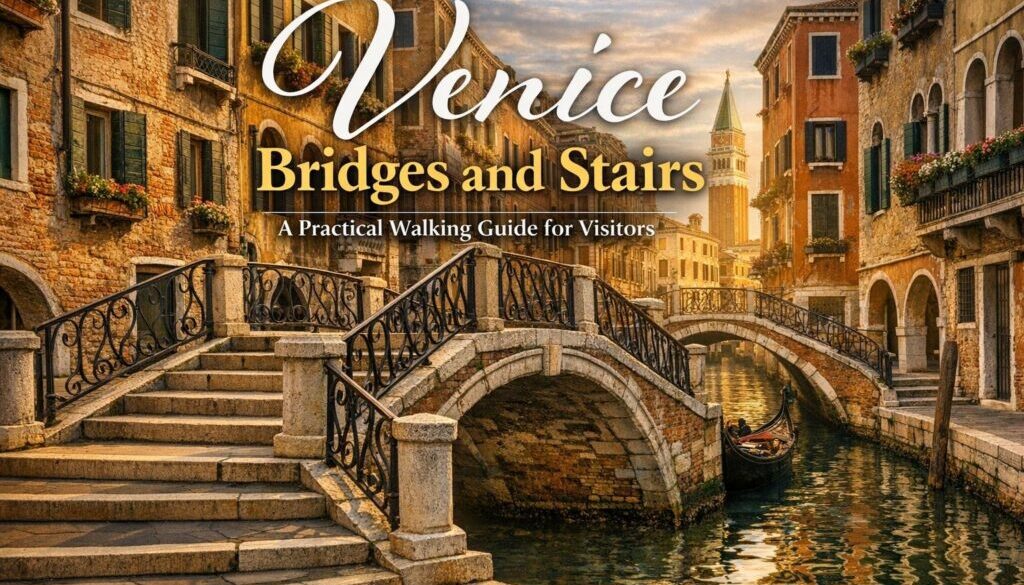
Walking is the best way to experience Venice, but it is not a flat, direct city. The reality of Venice bridges and stairs is that they shape almost every route you take. Distances can look short on a map and still feel slower once you factor in bridge crossings, detours, crowds and occasional route changes. If you plan for that from the start, Venice becomes much easier — and far more enjoyable — to explore on foot.
This guide explains what to expect at street level, how to plan realistic walking routes, when to consider vaporetto alternatives, and why offline maps and light packing matter. It is designed for travellers who want to move confidently through Venice without turning the city into a logistical puzzle.
Quick Answer
Yes, Venice is highly walkable, but Venice bridges and stairs are unavoidable. Expect slower routes, extra steps, and occasional detours. For most visitors, the best approach is to walk, allow extra time, and use live or offline navigation to adapt as needed.
Venice at street level: what walking is really like
Venice rewards people who are happy to wander, pause and adjust their route. The historic centre is built across islands, so bridges are part of ordinary movement rather than a special feature to seek out. That means you will regularly encounter stairs, short ascents, descents and changes in direction as you move from one canal-side lane to another.
For many visitors, that is part of the charm. It also means that a walk which looks straightforward in a planning app can be more physically involved than expected. The best way to think about Venice bridges and stairs is not as an obstacle, but as the basic rhythm of the city.
Why bridges and stairs are part of the experience
Because Venice is crossed by canals, pedestrians cannot always follow the most direct line between two points. A route may require you to cross one or more bridges, then loop through narrow streets before crossing again. That is normal here, and it is one reason the city feels so distinctive on foot.
If you want a broader sense of how independent exploration works in Venice and other cities, Walkables offers self-guided walking tours designed for travellers who prefer to discover places at their own pace.
Why Venice routes rarely feel direct
Even when your destination is close, the pedestrian network is constrained by canals, one-way flows in busy areas, and the need to use the bridges that connect each section of the city. As a result, walking time can be longer than a quick glance at the map suggests.
That is why it helps to mentally replace “short distance” with “short on paper.” In Venice, the route matters as much as the destination.
How to plan a Venice walking route
Good route planning makes a big difference in Venice. You do not need a complicated itinerary, but you do need a little flexibility. A sensible plan should assume that you will walk more slowly than you would in a grid-based city and that the most obvious line on the map may not be the most comfortable one.
Expect longer walking times than maps suggest
Allow extra time for every walk, especially if you are arriving with luggage, travelling with children, or trying to get somewhere on a fixed schedule. A route that looks simple may involve several bridge crossings, small backtracks and moments where you stop to orient yourself.
That buffer also helps if you decide to linger somewhere unexpectedly — which happens often in Venice. One of the pleasures of the city is that the best moments are frequently the ones you did not plan.
Use offline maps and live navigation
Mobile navigation is useful in Venice, but it should not be your only tool. Narrow streets, water edges and occasional route changes can make a single app less reliable than you would like. Download offline maps before you arrive and keep live navigation available when you have a strong signal.
For official city context and updates, it is worth checking the local authorities through the City of Venice and the official tourism and transport portal at Venezia Unica.
Build in buffer time for detours and crowds
Venice can feel busier in the obvious routes between major sights, and that can affect how quickly you move. If a bridge or lane feels congested, it is usually better to pause and let the flow settle than to force your way through. A slower pace often leads to a better walk anyway.
Ready to Explore Venice?
Discover Venice at your own pace with a Walkables self-guided audio walking tour.
Accessibility considerations
Accessibility is one of the most important planning points for Venice. The city can be manageable for many walkers, but step-free movement is limited in parts of the historic centre. That means travellers with mobility considerations may need to plan more carefully than they would in other European cities.
In some cases, it may be better to combine walking with water transport rather than trying to walk every segment. That is especially true if your route would otherwise involve repeated bridges or long detours.
Step-free travel is limited in parts of Venice
Not every route is equally easy, and not every crossing is equally comfortable. Some bridges may have ramps or gentler gradients, while others will simply require stairs. Official city and transport resources are the best place to check current conditions before you rely on a particular route.
When to consider alternative routes or water transport
If you are carrying heavy bags, travelling with limited mobility, or moving between parts of the city with little time to spare, vaporetto routes can reduce strain. They will not remove all walking, but they can simplify the most physically demanding sections.
If you are combining sightseeing with extra experiences, you can also browse tours and activities for ideas that suit your time in Venice. Walkables may receive a commission if you purchase through this link.
Check official city and transport resources before you go
Venice’s conditions and rules can change, including access arrangements and transport details. Before your trip, check official notices from the city and the public transport operator rather than relying on old forum posts or outdated blog advice.
For public transport context, the operator’s site is useful: ACTV.
💡 Walkables Travel Tip
If you are staying in Venice with luggage, plan the last part of your journey as carefully as the first. A short route with several bridges can feel much longer when you are rolling a suitcase.
What to wear and carry
Good footwear matters more in Venice than in many flat city breaks. You are not just walking streets; you are climbing and descending repeatedly, sometimes over surfaces that can be uneven or slippery when wet. The right shoes and a light bag make the experience noticeably smoother.
Best shoes for bridges, stairs and slippery surfaces
Choose comfortable walking shoes with enough grip for stairs and changing surfaces. Avoid anything that feels unstable on steps. If you expect to be out for most of the day, comfort is more important than style, even in a city as elegant as Venice.
How to handle luggage in Venice
Light packing pays off here. Wheeled luggage is workable, but it is less convenient when you need to lift it over bridges, carry it up stairs, or manoeuvre it through narrow pedestrian lanes. If you can reduce the number of bags, do it.
This is one of the practical moments where independent travel habits really help. A flexible packing strategy also pairs well with cruise companion guides when Venice is part of a wider trip and you want to keep moving without the friction of rigid group timing.
Why light packing matters
The less you carry, the more freely you can move. That matters not only for bridges and stairs, but also for unexpected route changes, temporary crowding and the simple pleasure of deciding to take a different path.
Seasonal factors that can affect your walk
Venice is not a city where walking conditions stay fixed throughout the year. Water levels, weather and local events can influence which routes feel easiest on a given day. That is one more reason to keep your schedule flexible.
Acqua alta and temporary route changes
Acqua alta, or high water, can temporarily affect walking routes and may require raised walkways in some areas. Conditions can change quickly, so it is sensible to check local alerts before heading out, especially if your plans depend on crossing several areas on foot.
For practical travel advice and broader trip preparation, Australian travellers may also want to consult Smartraveller before departure.
Why route conditions can change quickly
Even outside periods of high water, bridge works, crowded walkways or local events can change how a route feels. Venice rewards travellers who are willing to adapt rather than stick rigidly to one path.
Connectivity and navigation
Reliable mobile data is genuinely useful in Venice. Not because you need to be permanently online, but because navigation, route changes and map checks are much easier when you can look things up quickly. In a city with many turns and few straight lines, that matters.
Why reliable mobile data matters in Venice
A stable data connection helps with maps, messaging and live updates. It also makes it easier to compare routes if one lane is blocked, busy or simply less practical than the alternative. In a place where walking directions can change from one block to the next, having data is more than a convenience.
Roaming, eSIMs and offline maps
Australian travellers often choose between roaming packs, travel eSIMs and local SIM options. The best choice depends on your device, trip length and how much data you expect to use. For most visitors, a combination of offline maps and some live data is the most practical approach.
If you are comparing travel-money tools as part of your trip planning, you may also want to learn more about Wise for international payments. Walkables may receive a commission if you sign up through this link.
Keep a backup navigation option
Do not rely on just one app. Download maps in advance, keep a battery pack handy, and make sure you know your hotel name and nearest landmarks. If your signal drops, you will still be able to orient yourself.
Want to Discover More on Foot?
Explore Walkables self-guided audio experiences and discover destinations at your own pace.
Practical travel tips for Australians visiting Venice
For Australian travellers, the best Venice strategy is simple: prepare for walking, confirm current official information before you go, and leave enough time for the city to unfold slowly. That approach makes the bridges and stairs part of the experience rather than a frustration.
Check official Italy travel advice before departure
It is sensible to review official advice before any international trip, especially if you are planning a busy itinerary or connecting Venice with other parts of Italy.
Compare roaming options before you leave
Because roaming products change often, check your carrier’s current plans before departure rather than assuming your usual deal will work the same way overseas. Reliable navigation is worth planning for in a city like Venice.
Why a self-guided walking format works well in Venice
Venice is an ideal city for self-guided exploration because the pace is part of the pleasure. You can stop for a view, adjust your route, pause on a bridge, or decide not to rush to the next landmark. That flexibility is especially valuable when bridges and stairs make direct movement less predictable.
Flexibility for bridges, pauses and detours
A self-guided format lets you absorb the city without the pressure of keeping up with a group. If you want to linger by a canal, take a longer scenic detour, or simply rest before the next crossing, you can do that.
That is where walking formats feel especially natural in Venice. You are not just getting from A to B; you are moving through a city designed to be experienced slowly.
How audio guidance can improve the experience
Audio can add context without locking you into a rigid schedule. You can Press Play when you are ready, then continue at your own pace. For travellers who like independent discovery, that is often the most comfortable way to explore a city with as many route variables as Venice.
For another useful way to plan what to do once you are there, you can also view the location on Google Maps before you set out and compare your walking options more easily.
If you want to add more structure to your day, it can help to pair a walking route with a few planned stops rather than trying to cover everything at once. Venice is more rewarding when you allow it space.
The essential point is that Venice bridges and stairs are not a flaw in the city. They are part of how it works. Once you accept that, you can plan better, walk more comfortably and enjoy the city in the way it is meant to be experienced: slowly, on foot, and with room to wander.
Whether you are in Venice for a short stay or building it into a longer Italy itinerary, the most practical approach is the simplest one: pack light, navigate smartly, check official updates, and keep your plans flexible enough to follow the city’s rhythm.
Before you go, it is worth comparing useful planning tools and experiences, including local ideas on browse tours and activities and the latest city guidance from Venezia Unica.
Used thoughtfully, Venice bridges and stairs make the city feel more memorable, not less. They slow you down just enough to notice the details that make Venice special.