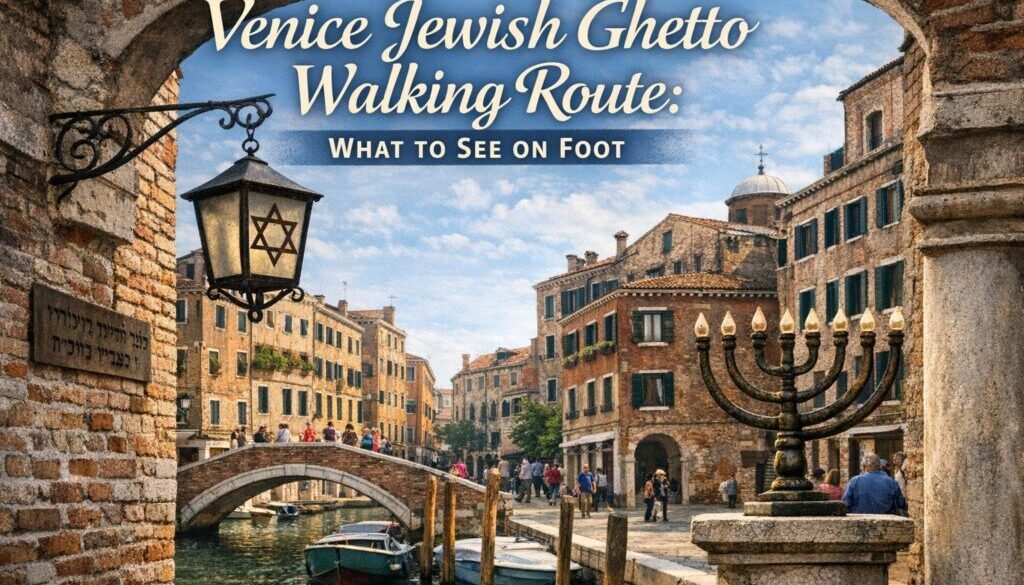
The Venice Jewish Ghetto walking route is one of the most meaningful short walks in the city. In a compact part of Cannaregio, you can see Campo del Ghetto Nuovo, the Jewish Museum of Venice, memorials, and the streets and canals that shaped centuries of Jewish life in Venice. Some parts are freely walkable, while the synagogues and museum spaces generally require tickets or arranged access, so it helps to plan before you go.
null
Quick Answer
The Venice Jewish Ghetto walking route is a short, heritage-focused walk through Cannaregio that is best enjoyed slowly. You can freely explore the public squares and surrounding streets, but museum entry and synagogue visits are typically ticketed and may depend on seasonal opening hours or guided access.
For travellers who like to understand a place as they walk, this area rewards a calm pace. It is not a neighbourhood to rush through. The history is layered, the scale is intimate, and the details matter. If you prefer to explore Venice in your own time, a self-guided format works especially well here, and a self-guided walking tour can help you connect the landmarks without being tied to a fixed group schedule.
For official background and current visitor information, it is worth checking the Jewish Museum of Venice at the museum’s official site and the Venice Jewish Community at veneziaebraica.it. If you are mapping your route, you can also view the location on Google Maps before you set out.
Venice Jewish Ghetto walking route: what it is
The Venice Jewish Ghetto is widely recognised as the first Jewish ghetto in the world, established in 1516 in Venice’s Cannaregio district. Today, it remains both a living part of the city and a place of remembrance. The area brings together public squares, historic buildings, memorials, and religious heritage sites in a setting that is compact enough to explore on foot but significant enough to deserve time and attention.
What makes the Venice Jewish Ghetto walking route compelling is its combination of atmosphere and history. You are not just ticking off sights. You are moving through a district where architecture, memory, and daily city life overlap. That is why a walking approach works so well here: it allows you to notice the scale of the square, the narrow connections between lanes, and the way the district opens and closes around you.
Why it matters in Jewish and Venetian history
This is a place of major historical importance. The ghetto became a defined Jewish quarter in the sixteenth century, and its survival as a visible part of Venice gives travellers a rare chance to see how history remains embedded in the city’s streetscape. The Jewish Museum of Venice helps interpret that story, while the surrounding area offers the physical context that makes the history feel real.
Where it is in Cannaregio
The ghetto sits in Cannaregio, a district that is generally walkable from central Venice, though many travellers will combine walking with a vaporetto ride depending on where they are starting. Cannaregio is also a good area to explore beyond the ghetto itself, because the surrounding canals and fondamenta add context to the neighbourhood rather than competing with it.
What to see on the walking route
The Venice Jewish Ghetto walking route works best when you treat it as a small cluster of meaningful places rather than a long checklist. The core sights are close together, which makes the walk manageable even if you only have a limited amount of time.
Campo del Ghetto Nuovo
This is the heart of the area and the obvious starting point for most visitors. As a public square, it gives you the best first impression of the district’s scale and layout. Spend a moment here before moving on. Looking around the campo helps you understand how the surrounding buildings frame the space and how the ghetto functions as a distinct part of Venice rather than just a single attraction.
Jewish Museum of Venice
The Jewish Museum of Venice is essential if you want more than a surface-level visit. According to the official museum site, opening times and access arrangements can vary, so check ahead rather than assuming walk-in entry will suit your timing. This is especially important if you are building the Venice Jewish Ghetto walking route into a packed Venice day.
The museum is where much of the area’s historical context becomes clearer. It is also the most practical place to begin if you want to understand which parts of the heritage area require tickets or arranged access.
Synagogues and heritage buildings
The synagogues are among the most important heritage sites in the area, but they are not usually treated like ordinary open-door tourist attractions. Access is commonly arranged through museum or guided visits, and visiting conditions can change depending on season, day of the week, and Jewish holidays. If the interiors are on your list, confirm your plan before you arrive.
This is one of the main reasons a little preparation matters on the Venice Jewish Ghetto walking route. The public squares are easy to see, but the interior heritage spaces are controlled more carefully, and that is part of what visitors need to respect.
Memorials and surrounding squares
Look beyond the obvious landmarks. Memorials and commemorative details give the district emotional weight and help explain why the area remains so significant. The square itself is important, but the smaller elements around it often leave the strongest impression.
Nearby canals and Cannaregio walkways
Once you have explored the core of the ghetto, continue into the surrounding Cannaregio lanes and canal edges. This is where the route becomes more atmospheric and where the neighbourhood starts to feel like part of everyday Venice rather than only a heritage site. The transition from the square to the nearby walkways is subtle, but it helps turn a short visit into a more rounded walking experience.
Ready to Explore Venice?
Discover Venice at your own pace with a Walkables self-guided audio walking tour.
How to walk the route well
The Venice Jewish Ghetto walking route is compact, which makes it ideal for independent travellers. Still, a little planning improves the experience. In Venice, even short distances can take longer than expected once you factor in bridges, turns, and orientation.
Best way to arrive
Most visitors will reach Cannaregio on foot, by vaporetto, or via a combination of both. If you are already in central Venice, walking may be the most straightforward option. If you are arriving from farther away, a vaporetto connection can reduce the amount of time spent navigating streets before you begin the route. For broader Venice transport planning, Venezia Unica is a useful official reference at veneziaunica.it.
How much time to allow
Allow enough time to move slowly. The public route itself may be brief, but the museum, synagogue access, and surrounding Cannaregio streets add to the visit. If you want to understand the area rather than simply pass through it, keep your schedule flexible.
Best time of day to visit
Daytime is usually the best choice. That gives you better orientation, easier access to ticketed spaces, and a clearer sense of the district’s layout. Evening can be atmospheric, but it is not the best time if your priority is museum access or a fully informed visit.
💡 Walkables Travel Tip
In Venice, a short walk can feel surprisingly complex once you factor in bridges and canal-side turns. Keep an offline map ready, and allow more time than your distance estimate might suggest.
Want to Discover More on Foot?
Explore Walkables self-guided audio experiences and discover destinations at your own pace.
Tickets, opening hours, and access
This is the part of the Venice Jewish Ghetto walking route that travellers most often underestimate. The district is walkable, but not everything in it is freely accessible. If you want to visit properly, you need to check the practical details before you arrive.
Museum admission and guided access
The Jewish Museum of Venice and synagogue access are generally ticketed, and opening hours can vary by season, day of week, and Jewish holidays. The official museum and Venice Jewish Community websites are the right places to verify current arrangements. Do not assume the interior sites will be open in the same way a standard museum would be.
Synagogue visitation rules
Synagogues are often not open as casual walk-in attractions. Access is commonly through museum arrangements or guided visits, which means advance checking is the sensible approach. If you are especially interested in Jewish heritage, this is one of the strongest arguments for planning the visit rather than improvising it on the day.
Why you should check before you go
The practical risk is simple: you may arrive expecting to see interiors that are closed, unavailable, or only open in limited time windows. A quick check in advance protects your schedule and lets you decide whether to prioritise the museum, the public square, or both.
For travellers who want to deepen the experience, it can also make sense to browse tours and activities to compare guided options and interpretive visits. Walkables may receive a commission if you book through this affiliate link.
Tips for Australian travellers
If you are travelling from Australia, the Venice Jewish Ghetto walking route fits well into a broader Italy itinerary, but there are a few practical points worth keeping in mind. The Australian Government’s Smartraveller advice for Italy is a sensible place to start before departure: Italy travel advice on Smartraveller.
Entry requirements and ETIAS status
Australian travellers generally visit the Schengen Area for short stays under standard entry rules, but ETIAS timing has changed more than once. Check the current status close to travel rather than assuming it is already active. That matters more for planning than most people realise, especially if your trip is booked well in advance.
Safety and practical walking advice
Venice is a pedestrian city, but it is still a place where you need to stay aware of your surroundings, especially in busier areas. Keep valuables secure, move at a measured pace, and watch your step on bridges and uneven surfaces. These are normal Venice habits rather than special warnings, but they matter on a walking route like this.
Mobility considerations
Venice can be difficult for travellers with reduced mobility because of bridges, steps, and narrow lanes. That does not make the Venice Jewish Ghetto walking route impossible, but it does mean you should plan carefully and avoid assuming the area is universally easy to navigate. If mobility is a concern, consider your route in advance and check the most practical access points before setting out.
Connectivity tips for navigating Venice
Mobile data is useful in Venice, particularly when you are moving between vaporetto stops, museums, and smaller lanes. The city can feel straightforward on a map and much less straightforward once you are on the ground.
Why mobile data helps
You may want data for live navigation, transit checks, and museum booking information. Offline maps are still a smart backup, but a stable connection can save time when you are working around waterways and irregular pedestrian routes.
Roaming or eSIM?
For short trips, many Australian travellers choose between roaming on their home plan and an international eSIM. If you are comparing options, keep the decision simple: look at data allowance, validity, hotspot support, and whether the plan works cleanly with your phone. For technical setup guidance, Apple’s eSIM support page is a helpful reference: Apple’s eSIM guide. If you rely on a specific device, check manufacturer support before you leave.
Self-guided or guided?
Both approaches can work well, but they suit different travellers. The Venice Jewish Ghetto walking route is compact enough for self-guided exploration, yet historically rich enough that some travellers will prefer a guide.
When self-guided makes sense
A self-guided visit is ideal if you value flexibility, want to move at your own pace, or are folding the route into a larger Venice day. It also suits travellers who prefer to pause, read, and reflect without following a group timetable. This is where a good audio experience can add clarity without taking away freedom.
When a guided visit may be better
If you want deeper historical interpretation, or if your main goal is accessing the synagogue interiors with context, a guided visit may be the better fit. That can be especially true for first-time visitors who want the story behind what they are seeing rather than just the physical landmarks.
For travellers who enjoy local experiences, it can also be useful to explore local tours and experiences alongside your own walking plan. Just remember that the best choice is the one that matches your pace and interest, not the one with the most polished sales pitch.
What to expect once you are there
The Venice Jewish Ghetto walking route is not large, but it is memorable because it is concentrated. You can move from public square to memorial to museum in a very short time, yet the feeling of the place lingers longer than the walk itself. That is partly because the district is so compact, and partly because the history is so present.
Expect a thoughtful, somewhat quieter experience than many of Venice’s headline sights. This is a place where respectful behaviour matters. Keep your voice low, be mindful when photographing, and remember that heritage sites are not just scenic backdrops.
FAQ
Is the Venice Jewish Ghetto free to walk around?
Yes, the public squares and surrounding streets are freely walkable. However, museum entry and synagogue access are generally ticketed or arranged separately.
Do you need tickets for the synagogue or museum?
The Jewish Museum of Venice and synagogue visits are generally ticketed, and access may depend on the current schedule. Check the official museum and community websites before your visit.
How long does the route take?
That depends on whether you only walk the public area or also visit the museum and arranged heritage spaces. A short visit is possible, but a more rewarding one needs time to slow down.
Is the area accessible for travellers with mobility limitations?
Venice can be challenging for mobility-impaired travellers because of bridges, steps, and narrow lanes. Plan carefully and do not assume the area is fully accessible.
Is this a good area to visit independently?
Yes. The Venice Jewish Ghetto walking route is particularly well suited to independent travellers who want a flexible, reflective visit. A self-guided approach works well if you are comfortable checking access details in advance.
Before you go, it is worth having a reliable plan for both orientation and pacing. If you enjoy discovering places at your own rhythm, Walkables is designed for that style of travel.
Final Takeaway
The Venice Jewish Ghetto walking route is best approached as a respectful, compact heritage walk. Visit the public square, confirm museum and synagogue access in advance, and leave enough time to understand the area rather than simply pass through it.
For travellers who want to see more of Venice on foot, especially beyond the obvious landmarks, a self-guided format can turn a short route into a richer travel experience. Start with the essentials, move at your own pace, and let the neighbourhood reveal itself one scene at a time.
Affiliate disclosure: Walkables may receive a commission if you book through some of the external links in this article, including Viator or Wise where relevant.
cruise companion guides and cruise port guides may also be useful for travellers combining Venice with a wider itinerary.
For travellers managing spending in Italy, you may also want to learn more about Wise for international payments and travel spending. Walkables may receive a commission if you sign up through this affiliate link.