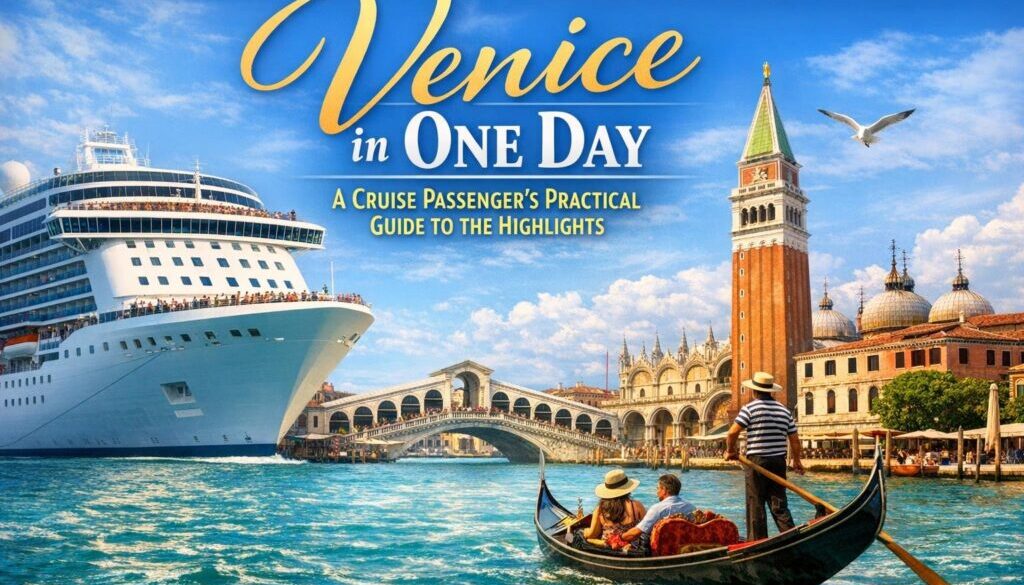
Seeing Venice in one day from a cruise is absolutely possible, but only if you treat it as a highlights visit. That means choosing a small number of essential sights, moving efficiently, and resisting the urge to try to cover every bridge, church, and canal. For most cruise passengers, the best use of time is a focused route through St Mark’s Square, the Doge’s Palace area, the Rialto Bridge corridor, and at least one canal journey to give the day some Venetian atmosphere.
The good news is that Venice rewards short visits. Even a single day can feel complete if you prioritise well. The challenge is logistics: arrival and departure timing, the city’s access-fee rules, and simple navigation can all eat into your day if you haven’t planned ahead. This guide gives you a realistic way to experience Venice in one day without feeling rushed or lost.
null
Quick Answer
If you only have one day in Venice from a cruise, focus on St Mark’s Square, St Mark’s Basilica, the Doge’s Palace area, the Rialto Bridge, and a Grand Canal or vaporetto segment. Do not try to see the whole city. A compact route gives you the best chance of enjoying Venice rather than spending the day in transit.
Venice in One Day: What Cruise Passengers Can Realistically See
Venice in one day works best as a highlights itinerary, not a full sightseeing marathon. The historic centre is compact enough to explore on foot, but it is also easy to underestimate travel time once you factor in waterways, crowds, and the simple pleasure of stopping to look around.
For a first visit, the core areas most worth your time are the St Mark’s district, the Rialto area, and the Grand Canal corridor. If you move efficiently, you can also fit in a short vaporetto ride or a scenic walk that gives you a better sense of the city’s rhythm. The official Venice tourism portal is a useful place to cross-check the key visitor areas and plan around current city information: official Venice tourism information.
Why one day is enough for a highlights-focused visit
If this is your first time in Venice, one day is enough to understand why the city is so distinctive. You will see the famous landmarks, the canals, the bridges, and the atmosphere that make Venice unlike anywhere else. That is a successful day in Venice.
The aim is not depth; it is clarity. In a short stop, it is better to remember a handful of excellent moments than to rush between too many places and remember none of them properly.
What you should not try to cram in
Do not attempt a long list of museums, multiple island day trips, or a zigzag itinerary that sends you back and forth across the lagoon. On a cruise stop, that approach usually means less time enjoying Venice and more time checking the clock.
Keep the day centred on the historic core. If time allows, add a neighbourhood like Dorsoduro, Cannaregio, or San Polo, but only after the essentials are done.
First Things First: Venice Cruise Logistics and Visitor Rules
Before planning Venice in one day, check the city’s current access rules. Venice has introduced day-visitor management measures on selected dates, and the rules can change. The official city page for the access contribution is the one to use for current dates, exemptions, and booking details: Venice access contribution information.
💡 Walkables Travel Tip
Check Venice’s access-fee rules close to your sailing date, not just when you book the cruise. For a short shore visit, a rule change can affect your plans more than a hotel stay would.
Where cruise passengers usually arrive
Cruise access in Venice has changed over recent years, so it is worth confirming your exact arrival point with your cruise line and port instructions. Do not assume the process will match older itineraries or advice from previous years. The Port System Authority of the Northern Adriatic Sea is one official reference point for current port guidance: Venice port authority information.
Why the access fee matters
If you are visiting for the day rather than staying overnight, the city may treat you differently from an overnight guest. That is why the access-fee page matters. It is also why you should not rely on generic blog advice for something as time-sensitive as Venice in one day.
Keep in mind that visitor-management rules are exactly the kind of detail that can change by date or season. If your cruise stop is close to departure, recheck the official city page before you go ashore.
Check official rules before you go
For the most reliable overview, use the city’s official tourism and access pages rather than social media posts or forum threads. Those sources can be helpful for opinions, but they are not the place to verify current rules.
The Best One-Day Route Through Venice
The most efficient way to see Venice in one day is to begin in the St Mark’s area, work your way toward the Rialto Bridge, and include a canal segment if your timing allows. That route keeps you close to the city’s most recognisable sights without wasting energy on backtracking.
Start near St Mark’s Square
St Mark’s Square is the natural starting point for a short visit. It gives you the big Venice moment immediately: the open piazza, the monumental setting, and the sense that you are standing at the centre of the city’s history.
From here, it is straightforward to move between St Mark’s Basilica and the Doge’s Palace area, which are among the most important places for first-time visitors. If you want to confirm practical details before your visit, use the official sites for current information: St Mark’s Basilica official site and Doge’s Palace and civic museums.
See St Mark’s Basilica and the Doge’s Palace area
These are not just famous names; they are the historic heart of Venice. Even if you do not go inside both attractions, the surrounding area is worth time on foot. You can appreciate the scale of the architecture, the flow of people through the square, and the way Venice combines grandeur with dense, walkable streets.
If you only have a short window, choose one interior visit and one exterior exploration rather than trying to queue for everything.
Ready to Explore Venice?
Discover Venice at your own pace with a Walkables self-guided audio walking tour.
A self-guided format can be especially helpful here because Venice rewards curiosity but punishes poor route-planning. If you prefer to explore independently, our self-guided walking tours are designed for travellers who want structure without losing flexibility.
Walk toward the Rialto Bridge
From the St Mark’s area, the route toward the Rialto Bridge gives you one of the most rewarding walks in the city. You will pass through narrow streets, small bridges, and everyday Venetian life rather than only the postcard views.
The Rialto area is busy, but that is part of its appeal. It is a practical anchor point for a one-day visit because it connects the ceremonial side of Venice with its trading past and its lively pedestrian flow.
Add a Grand Canal or vaporetto segment
If you can, include at least one water-based segment. A vaporetto ride along the Grand Canal is not just transport; it is part of the experience. It gives you a different perspective on the city and helps break up a walking-heavy day.
For current transport information, use the official ACTV/AVM site: Venice public transport information. Timetables can change, and disruptions can happen, so checking ahead matters more on a cruise day than it might on a longer stay.
Optional neighbourhood add-on if time allows
If your pace is good and you are not worried about returning to the ship, add a short detour into a quieter district such as Dorsoduro, Cannaregio, or San Polo. This can give you a different mood from the main landmark zone, but only if the basics are already done.
What to Prioritise If You’re Short on Time
When you are trying to see Venice in one day, prioritisation matters more than coverage. The city is not a checklist destination. It is better to see fewer things well than many things badly.
Must-see highlights
- St Mark’s Square
- St Mark’s Basilica area
- The Doge’s Palace exterior and surrounding square
- The Rialto Bridge
- At least one Grand Canal or vaporetto segment
Nice-to-have extras
- A quiet side street away from the main routes
- A short coffee or cicchetti stop
- One additional bridge or canal viewpoint
- A brief detour into a less crowded neighbourhood
What to skip on a one-day visit
Skip anything that adds a long transfer, requires multiple ticketing steps, or pulls you too far from the main historic core. That includes trying to fit in too many museums, unnecessary backtracking, or distant sightseeing that could be better saved for a longer trip.
Getting Around Venice Efficiently
Getting around is the real key to enjoying Venice in one day. Venice is walkable, but not in the usual grid-like sense. Streets narrow, routes twist, and bridges interrupt what looks straightforward on a map. The city is enjoyable precisely because it is not built for speed.
Walking vs vaporetto
Walking is the best way to understand Venice at street level. You will see the textures, the signs, the canal edges, and the small moments that make the city feel real. But a vaporetto ride can save time and give you a valuable perspective from the water.
The best short-visit approach is usually a mix of both: walk between key sights, then use the vaporetto for one efficient and scenic transfer.
Why timetables and strikes matter
For cruise passengers, transport disruptions matter because every minute counts. Italian public transport strikes can affect your day, and that is especially relevant when you need to get back to the ship on time. Australia’s Smartraveller advice for Italy is a useful official resource to review before travel: Smartraveller Italy travel advice.
It is also why you should build a margin into your return journey rather than planning to arrive back at the port at the last possible moment.
Offline maps and navigation tips
Download offline maps before you leave the ship. Venice’s layout is easy to misunderstand on a live map if your signal drops or if you are using data sparingly. Save your cruise terminal, St Mark’s Square, and the Rialto Bridge area in advance so you can orient yourself quickly.
That small bit of preparation can make Venice in one day feel much calmer.
What Australian Travellers Should Know
For Australians, the biggest practical issues are time difference, connectivity, payments, and transport timing. None of them is difficult, but all of them can become annoying if you leave them to chance.
Time difference and shore-excursion timing
Venice operates on Central European Time or Central European Summer Time, so there is a substantial gap from Australia. That means your body clock may not be aligned with your itinerary, and it can be easy to misjudge how long you have before all-aboard time.
Use your ship’s schedule, not your instinct, as the final reference for the day.
Currency, payments, and carrying some cash
Italy uses the euro. Cards are widely accepted in tourist areas, but a small amount of cash is still useful for incidentals such as water, toilets, snacks, or small purchases. The European Central Bank’s euro information page is a reliable reference: European Central Bank euro information.
If you are comparing ways to manage spending overseas, you may also want to learn more about Wise. Walkables may receive a commission if you sign up through that link.
Travel insurance and disruption awareness
For a one-day shore visit, insurance is less about dramatic scenarios and more about peace of mind. Transport delays, missed connections, or unexpected disruptions can be expensive if you are relying on a tightly timed cruise return. The best protection is a combination of insurance, clear timing, and conservative planning.
Staying Connected in Venice
Good connectivity matters when you are trying to see Venice in one day. You may need maps, translation, cruise messages, or a quick check of transport changes. Ship Wi‑Fi is useful onboard, but once you are ashore it is not the tool you want to rely on.
Why cruise Wi‑Fi is not enough ashore
Cruise ship Wi‑Fi can be expensive or limited, and it is not designed to help you navigate the city while walking between canals and squares. You need a connection that works on the move and can support basic navigation without fuss.
eSIM vs roaming vs ship Wi‑Fi
For a short visit, a travel eSIM is often the most practical option if your phone supports it. Roaming from an Australian provider may be simpler, but not always better value. Whatever you choose, confirm compatibility before you sail: Apple’s eSIM guidance for iPhone is here, and it is a good example of the kind of detail worth checking in advance: Apple eSIM support.
If you want to compare trip ideas, walkable routes, or local experiences while you are planning, you can also browse tours and activities. Walkables may receive a commission if you use the affiliate link.
What to check before buying an eSIM
Before you buy, make sure your phone is unlocked and eSIM-capable, and confirm whether the plan is data only or includes calls and texts. Also check whether activation begins on installation, on first connection, or before departure. Those small details matter far more than broad marketing promises when you are only in Venice for a day.
Want to Discover More on Foot?
Explore Walkables self-guided audio experiences and discover destinations at your own pace.
A Self-Guided Way to Experience Venice
Venice is ideal for a self-guided approach because it is compact, layered, and full of small details that are easy to miss in a rushed group tour. A good audio walk can help you understand what you are seeing without forcing you to stick to someone else’s pace.
That is especially valuable when you have Venice in one day. You want context, not a busier schedule.
Why a guided pace without a group suits a one-day visit
A self-guided audio experience lets you spend longer at the places that interest you and move faster through the bits that do not. If the square is crowded, you can pause. If the route is clear, you can keep going. That flexibility is exactly what a short cruise stop needs.
How audio helps with landmarks, navigation, and context
Audio can do three useful things at once: it can explain the landmark in front of you, help you orient yourself, and add enough background to make the city feel meaningful rather than merely famous. In Venice, that combination is particularly effective because the city’s history is embedded in the streets around you.
If you prefer to explore independently but want to avoid wandering in circles, a self-guided format is often the sweet spot.
FAQ: Venice in One Day From a Cruise
Is Venice realistic to see in one day?
Yes, but only as a highlights visit. Venice in one day is enough for a strong first impression if you focus on the city’s core sights and do not overplan.
Do cruise passengers need to pay the Venice access fee?
That depends on the current rules and your specific circumstances. Because Venice’s day-visitor system can change, always check the official access page before your visit: Venice access contribution information.
What are the must-see sights in one day?
The most important sights for a short visit are St Mark’s Square, St Mark’s Basilica area, the Doge’s Palace area, the Rialto Bridge, and a Grand Canal or vaporetto segment.
Is vaporetto worth it for a short visit?
Yes. If you can fit it in, a vaporetto ride is one of the best ways to see Venice quickly and from a different angle. It is both practical and memorable.
Final Thoughts: Making the Most of Venice in One Day
The best way to experience Venice in one day is to stay focused. Start with St Mark’s Square, work through the surrounding historic core, continue toward the Rialto Bridge, and add one canal ride if time allows. Along the way, check current visitor rules, keep your return timing conservative, and use offline maps so you can move confidently.
That approach will not show you everything, but it will show you the parts of Venice that matter most on a first visit. For a cruise day, that is the right goal.
And if you want a calmer, more flexible way to explore the city on foot, Walkables’ self-guided walking tours are built for travellers who prefer to Press Play and discover a place at their own pace.