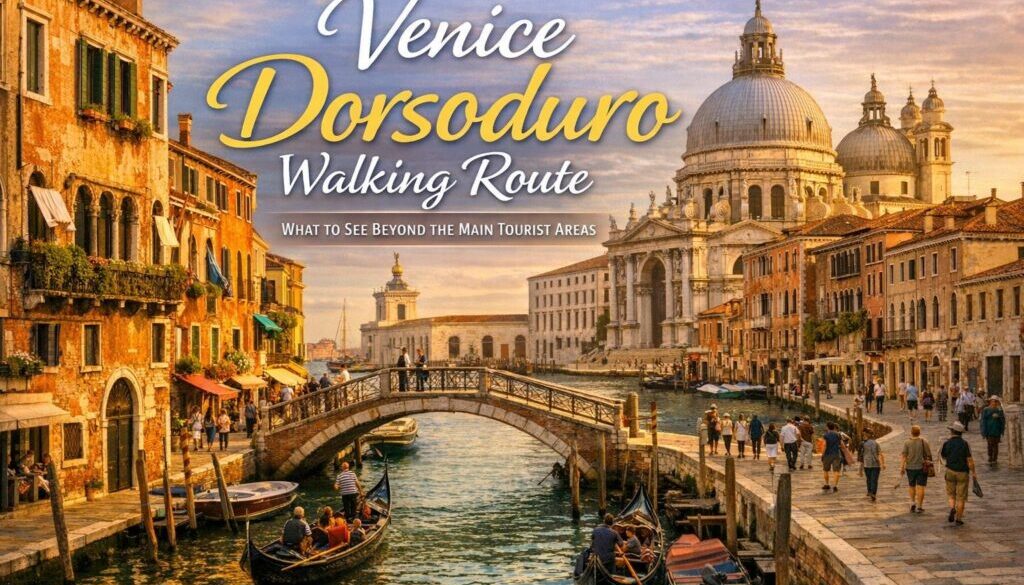
Venice Dorsoduro walking route is the kind of itinerary that shows you a quieter, more contemplative side of the city. Instead of rushing from one headline sight to the next, you move between canals, museums, churches, student-filled squares, and waterfront promenades that feel distinctly Venetian without the crush of San Marco or Rialto.
If you want a walk that balances art, atmosphere, and practical sightseeing, Dorsoduro is one of the best districts in Venice to explore on foot. It is compact, rewarding, and easy to shape into a short wander or a longer half-day route, depending on how much time you have.
Quick Answer
The best Venice Dorsoduro walking route usually links the Gallerie dell’Accademia, the Peggy Guggenheim Collection, the Zattere promenade, Basilica di Santa Maria della Salute, and Punta della Dogana, with optional detours through Campo Santa Margherita and Squero di San Trovaso for a more local feel.
null
Why Dorsoduro is one of Venice’s best walking districts
Dorsoduro is one of Venice’s six historic sestieri, and it has a different rhythm from the city’s busiest corners. You still get the essential Venetian ingredients — canals, bridges, churches, and grand views — but the atmosphere is generally calmer and more lived-in than the areas around St Mark’s Square.
That makes it a strong choice for travellers who want to see more than the obvious icons. The district is especially appealing if you like museums, modern art, waterfront walking, and the simple pleasure of wandering without a tightly packed schedule.
For independent travellers, Dorsoduro also suits a self-guided approach. The route is compact enough to follow at your own pace, and it rewards stopping often to look up, detour, and notice the small details that are easy to miss on a rushed visit. If you enjoy exploring cities with context, Walkables’ self-guided walking tours are designed for exactly this kind of experience.
For route planning and orientation, it helps to view the location on Google Maps before you set off so you can see how the bridges and waterfronts connect.
Venice Dorsoduro walking route overview
A good Venice Dorsoduro walking route works because the district is walkable without feeling repetitive. You can move from museum to promenade to square to canal-side viewpoint in a fairly short distance, yet each stop gives you a different slice of Venice.
This route is best for travellers who value art and architecture, but it also suits anyone who simply wants a less crowded section of the city with enough variety to keep the walk interesting. You do not need to be a dedicated museum-goer to enjoy it.
How long to allow
Allow at least two to three hours if you want to visit just the key outdoor highlights and one museum. If you want to include more than one museum, linger along the Zattere, or stop for a proper lunch or coffee, half a day is more realistic.
Best time of day to walk
Earlier in the day is usually best if you want quieter streets and softer light on the canals. Later in the afternoon can also be appealing, especially around the waterfront, where the light changes beautifully. If you prefer a livelier atmosphere, Campo Santa Margherita is one of the parts of the district where you are more likely to feel that energy.
For official Venice visitor information and current city notices, check Venezia Unica before you go.
Ready to Explore Venice?
Discover Venice at your own pace with a Walkables self-guided audio walking tour.
What to see on a Venice Dorsoduro walking route
Gallerie dell’Accademia
The Gallerie dell’Accademia is one of the district’s most important cultural stops and a natural starting point for a Venice Dorsoduro walking route. It anchors the area’s art reputation and gives the walk a strong sense of place. Even if you do not go inside, the building itself and its setting are part of the district’s character.
For current collection details and visitor information, the official museum site is the best place to verify what is open: Gallerie dell’Accademia.
Peggy Guggenheim Collection
Just a short walk away, the Peggy Guggenheim Collection adds a different artistic note to the route. It is one of Venice’s most recognisable modern art institutions and a reminder that Dorsoduro is not only about old-master Venice. It also gives you another reason to slow down and enjoy the canal-side setting around it.
Before visiting, check the official site for current exhibitions and opening details: Peggy Guggenheim Collection.
Zattere promenade
The Zattere is one of the most enjoyable stretches in the district for walking. It offers a broad waterfront perspective that feels different from Venice’s tighter lanes, and it is an excellent place to pause and take in the lagoon atmosphere. If you want a walk that includes open views and a sense of space, this is where Dorsoduro really stands out.
Basilica di Santa Maria della Salute
Few buildings define the Venetian skyline as clearly as Santa Maria della Salute, which sits at the entrance to the Grand Canal. It is one of the route’s most striking landmarks, and it works beautifully as a visual endpoint or turning point in your walk. The church’s setting makes it especially memorable from the waterfront approach.
Punta della Dogana
Punta della Dogana sits at the meeting point of important waterways and adds a strong sense of geography to the route. Even if you are not focusing on major museum interiors, the location itself is worth including because it helps you understand how Venice’s districts connect visually and spatially.
Campo Santa Margherita
If you want a more local atmosphere, add Campo Santa Margherita to your route. It gives the walk a different tempo from the museum-and-waterfront sections and is useful if you want to experience a side of Venice that feels lived in rather than purely visited.
Squero di San Trovaso
Squero di San Trovaso, the historic gondola workshop, adds a memorable working-Venice note to the itinerary. It is the sort of stop that makes a Venice Dorsoduro walking route feel more layered, because it links the romantic image of the city with the craft behind it.
If you want to extend the day with more cultural experiences, you can also browse tours and activities for Venice. Walkables may receive a commission if you book through this affiliate link.
Suggested walking sequence through Dorsoduro
There is no single perfect route, but a simple sequence helps you see the district without backtracking too much.
A shorter route
Start near the Gallerie dell’Accademia, continue to the Peggy Guggenheim Collection, then move towards the Zattere for a waterfront walk. From there, continue to Santa Maria della Salute and finish around Punta della Dogana if you want a concise route with strong visual variety.
A longer route with more local atmosphere
If you have more time, begin at Campo Santa Margherita, continue past Squero di San Trovaso, then head towards the Accademia and the museum area before finishing along the Zattere and Salute. This version adds more neighbourhood texture and a better sense of how people actually move through the district.
Where to pause
The best pauses are usually the simplest ones: along the waterfront, on a small bridge, or in a campo where you can watch daily life unfold. Dorsoduro is not a district to rush. Its appeal is in the transitions between quiet streets, open water, and grand architectural moments.
Practical tips for walking Venice
Venice rewards walkers, but it also asks you to be flexible. Streets can be narrow, bridges come with stairs, and your route can feel different depending on foot traffic, tide conditions, and how confidently you navigate the maze of lanes.
Bridges, stairs, and narrow streets
Expect frequent bridge crossings and occasional detours. A route that looks short on a map may take longer than expected once you factor in stairs, pauses for photos, and the occasional wrong turn. That is normal in Venice and part of the experience.
High water and seasonal conditions
Occasional high water can affect comfort and movement, so it is worth checking conditions if your trip falls in a wetter season. Venice is a city where a little preparation goes a long way, especially if you plan to walk several kilometres in a day.
Why offline maps help
Mobile data is useful in Venice, but offline maps are a smart backup because the city’s lanes and bridges can be confusing even when you are only a few minutes from your destination. If you rely on your phone for navigation, tickets, translation, and message access, make sure your connection plan is sorted before you arrive.
💡 Walkables Travel Tip
Download offline maps before you start your Venice Dorsoduro walking route. Even a short detour can save time and reduce stress when streets loop unexpectedly or a bridge changes the route you had in mind.
Travel advice for Australian visitors
If you are travelling from Australia, it is worth checking official advice before you depart. The Australian Government’s Italy travel advice on Smartraveller is the best starting point for current entry, safety, and practical guidance.
Australians should also confirm passport validity and Schengen entry rules, and keep an eye on ETIAS developments through official EU sources such as the EU’s ETIAS information page. These rules can change, so it is sensible to verify them close to departure rather than relying on older advice.
For money, Italy uses the euro, and card payments are widely accepted in cities. Even so, a little cash can still be useful for small purchases. If you are managing overseas spending, you may also want to learn more about Wise. Walkables may receive a commission if you sign up through this affiliate link.
Staying connected while exploring Venice
A Venice Dorsoduro walking route is much easier when you can check maps, museum details, and transport options on the move. That is especially true if you want to move between bridges and canals without stopping every few minutes to re-orient yourself.
If you are planning to use an eSIM or roaming package, make sure your phone is unlocked and compatible. It is also worth checking whether your plan is data-only, whether hotspot is allowed, and whether you still need SMS or voice access for banking codes. Apple’s eSIM support information is a useful reference if you are confirming device compatibility before departure.
Australian travellers often compare carrier roaming with travel eSIMs before a trip. For reference, you can check current roaming information from Telstra, Optus, or Vodafone Australia depending on your plan. The right option depends on how much data you need and whether you want the convenience of keeping your Australian number active.
For local research and extra planning ideas, a city walk can also be improved by seeing what else is available nearby. If you prefer to build a broader Venice day out, you can explore cruise companion guides and related destination experiences from Walkables when they fit your trip style.
Want to Discover More on Foot?
Explore Walkables self-guided audio experiences and enjoy Venice at your own pace, with the context that makes each stop more rewarding.
Why a self-guided audio tour makes sense here
Dorsoduro is exactly the kind of district that benefits from a self-guided audio experience. The walk is compact, but the meaning of what you are seeing often comes from the connections between places: an art museum beside a quiet canal, a church at the end of a waterfront, a working gondola workshop tucked into the urban fabric.
With audio, you can move at your own pace, stop when the view deserves a pause, and avoid the pressure of keeping up with a group. That is especially valuable in Venice, where the best moments often happen between the famous sights rather than only at them.
So if you are planning a Venice Dorsoduro walking route, think of it as more than a checklist. It is a chance to experience Venice with a little more breathing room — and to discover how much character the city reveals when you take the time to walk it well.