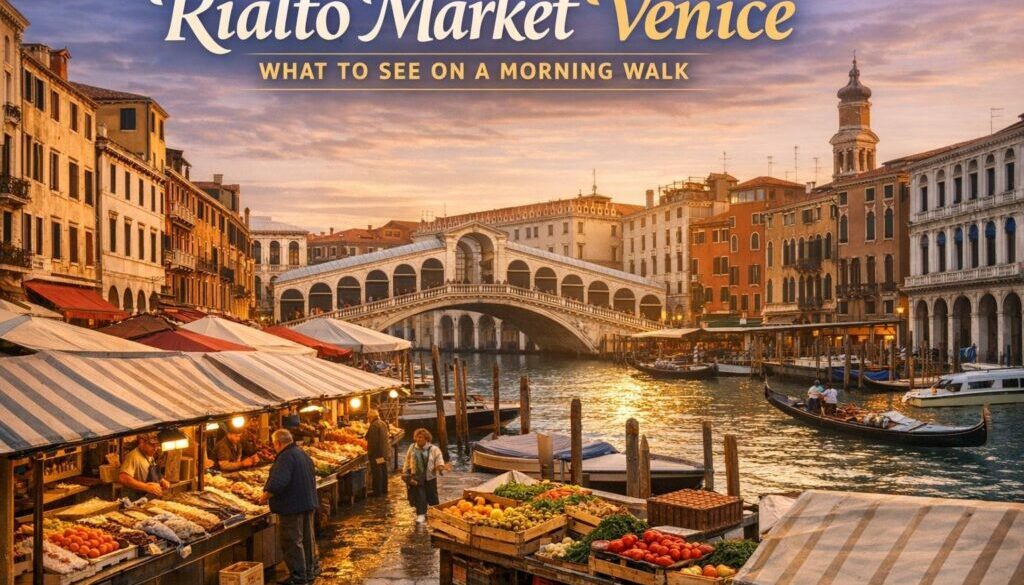
Rialto Market Venice is one of the best places to start a morning in the city if you want food culture, atmosphere, and an easy walk in Venice’s historic centre. Arrive early and you’ll see the market area as it wakes up: produce stalls in the Erberia, the fish market in the Pescheria, and the constant movement around the Rialto Bridge and Grand Canal.
It is not a large attraction in the usual sense. That is part of the appeal. Rialto Market Venice works best as a short, rewarding walk that gives you a feel for everyday Venice while still keeping you close to major sights. For first-time visitors, it is an excellent way to combine sightseeing with something practical and local.
Quick Answer
If you want the best experience of Rialto Market Venice, go early in the morning before the busiest crowds arrive. Focus on the produce stalls, the fish market, and the surrounding lanes and bridge area, then continue your walk toward nearby cafés, viewpoints, or the San Polo side of central Venice.
Rialto Market Venice: Why Go Early
The main reason to visit early is simple: the market feels alive without being overwhelming. Later in the day, the area becomes much busier with visitors crossing the bridge, stopping for photos, and moving through the narrow streets around the Grand Canal. Early morning is when the market activity is easiest to appreciate.
That timing also suits travellers who prefer calm, low-effort sightseeing. You can watch vendors setting out produce, browse the seafood display at the fish market, and then continue your day without losing half a morning to queues or crowds. Venice’s official tourism information highlights Rialto as a historic city-centre area, and the market remains one of the most recognisable parts of that landscape visit the official Rialto area page.
What makes the morning the best time
The market atmosphere is strongest when the stalls are active and the streets are still relatively manageable on foot. In practical terms, that means fewer bottlenecks on the bridge approaches and more space to actually look at what is being sold.
If you are travelling with a mobile map, early morning is also easier for orientation. A dense area like this is much simpler to navigate before the pedestrian flow peaks. If you like exploring cities at street level, this is exactly the sort of place where self-guided walking tours make sense: you can move at your own pace, pause when something catches your eye, and continue without being tied to a group.
Why the market feels different before the crowds build
Rialto is famous, but it still feels more authentic in the early hours. The produce and fish sections are most interesting when you can actually stand back and take them in. Once the area fills with visitors, the experience becomes more about passing through than observing.
That does not make it less worth visiting. It simply means the rhythm changes. If you want a calmer, more atmospheric experience, make this one of your first stops of the day rather than something you fit in after lunch.
What You’ll See at Rialto Market
Rialto Market Venice is usually understood as two related market zones: the fruit and vegetable market, known as the Erberia, and the fish market, known as the Pescheria. Together they give you a compact look at Venice’s food culture in a setting that has long been tied to trade and daily life.
The Erberia: fruit and vegetable stalls
The Erberia is where you’ll see seasonal produce, flowers, and the kind of stall displays that make a market feel immediate and local. Even if you are not buying anything, it is worth slowing down here. The colours, the pace, and the layout all tell you something about how Venice functions as a lived-in city rather than just a sightseeing backdrop.
For travellers who enjoy food-focused walks, this section is especially useful because it is easy to pair with breakfast or an early coffee nearby. You do not need to over-plan it. Just give yourself time to look and listen.
The Pescheria: the fish market
The fish market is often the most distinctive part of the visit. It is smaller than many travellers expect, but it has a strong sense of place and remains one of the clearest links to the city’s working food culture. Availability changes with the day and season, so it is better to visit with curiosity rather than assumptions about exactly what you will find.
The key point is not the individual seafood display. It is the setting: a historic market that still gives travellers a glimpse of Venice beyond the most photographed views.
The atmosphere around the Rialto Bridge and Grand Canal
The market is only part of the experience. The surrounding area matters too. Rialto Bridge is one of Venice’s most recognisable crossings, and the walk to and from it gives you constant Grand Canal views. Because everything is so close together, you can create a satisfying morning route without needing transport between stops.
For a useful reference point as you plan, you can also view the location on Google Maps before you head out, especially if you want to combine the market with a café stop or a longer walking loop through central Venice.
Ready to Explore Venice?
Discover Venice at your own pace with a Walkables self-guided audio walking tour.
How to Plan Your Morning Walk
Rialto Market Venice is best treated as part of a broader morning plan rather than a single stop you rush through. The area rewards unhurried walking, short pauses, and a flexible schedule.
Best time to arrive
Go early. That is the most reliable advice. The market is at its best before the day-tripping crowds build, and early arrival also makes it easier to take in the streets around the bridge without feeling pushed along.
If you are building a full Venice day, this is a strong first stop. You can then continue to nearby neighbourhoods, stop for breakfast, or simply keep walking and let the city unfold from there.
How long to allow
Most travellers will not need a huge amount of time. A focused visit can be short, while a slower walk with photographs, coffee, and detours through nearby lanes can easily stretch longer. The right amount of time depends on whether you are simply seeing the market or using it as the starting point for a broader central Venice walk.
If you enjoy slow travel, give yourself room to wander. Venice rewards that approach.
How to get there on foot or by vaporetto
The Rialto area is highly walkable and also well connected by public water transport. ACTV’s public transport guidance is useful if you want to understand how Venice’s vaporetto system links different parts of the city check how to get around Venice. For many visitors, though, the simplest way to reach the market is on foot from a central base or by vaporetto to a nearby stop, followed by a short walk.
Because Venice is compact and pedestrian-oriented, the last stretch is often the most memorable part. You are not just arriving at the market; you are moving through the city to get there.
What to Expect on the Ground
Rialto Market Venice is easy to enjoy, but it helps to know what the walking environment is like before you go. Venice is a city of bridges, stone paving, narrow lanes, and sudden changes in pedestrian flow.
Crowds, cobblestones, bridges, and walking conditions
Expect crowds to increase quickly once the morning gets underway. The approaches to the bridge can feel congested, and the pavement underfoot may be uneven in places. If you are carrying a day bag, keep it compact and easy to manage.
The walking itself is not difficult in the sense of being a long hike, but it is stop-start. You are weaving through other visitors, pausing at stalls, and crossing bridges. Comfortable shoes matter more than fashion here.
Accessibility and mobility considerations
Travellers with mobility concerns should plan carefully. Venice’s steps, bridges, and narrow passages can make even short distances more tiring than they first appear. If you use a wheelchair, pushchair, or simply want to avoid unnecessary stair climbs, it is worth checking your route in advance and leaving extra time.
The good news is that Rialto is central and generally straightforward to include in a Venice itinerary, but the physical environment still matters. Don’t assume it will be easy simply because it is short.
Money, cards, and cash
Italy uses the euro, and market areas can vary in how payments are handled. It is sensible to carry some cash for small purchases or for places that prefer it. For broader travel budgeting and overseas spending, some travellers also like to learn more about Wise before a European trip. Walkables may receive a commission if you sign up through that link.
That said, do not assume every stall will work the same way. If you plan to buy food or drinks in the area, keep a flexible approach.
💡 Walkables Travel Tip
Download your map before you leave your accommodation. In a busy area like Rialto, it is much easier to stay relaxed when you can check your route quickly without relying on public Wi‑Fi or stopping every few minutes to reorient yourself.
Tips for Australian Travellers
Australian visitors do not usually need to overcomplicate a short Italy trip, but a few practical checks are worth making before you head to the market.
Entry and passport checks
Before travelling, check current Italy entry advice from Smartraveller so you are up to date on passport and entry requirements read the latest Italy travel advice. Rules can change, and it is better to verify them close to departure than rely on memory from a previous trip.
If you are planning a wider Europe itinerary, also monitor official EU updates on ETIAS, since this is a policy area that has changed over time see official ETIAS information.
Staying aware of pickpockets in busy areas
Rialto is busy, and busy places are where travellers should be most alert to petty theft. Keep phones and wallets secure, especially when stopping for photos or standing close to crowds. This is not a reason to avoid the area. It is simply part of moving sensibly through one of Venice’s most popular pedestrian zones.
Using an eSIM for maps and translation
For Australian travellers, a travel eSIM can be especially handy in Venice because it keeps your maps, messages, translation apps, and ticket details accessible while you move on foot. If your trip includes several cities, an eSIM also reduces dependence on patchy public Wi‑Fi. For a market walk, that means less time navigating and more time actually noticing where you are.
If you want extra local context for your sightseeing day, you can also browse tours and activities through browse tours and activities. Walkables may receive a commission if you make a purchase through this link.
Make It Part of a Bigger Venice Morning
The best way to experience Rialto Market Venice is to treat it as the beginning of a broader morning route. Because the market sits in the heart of the city, it works well with other easy stops that do not require complicated planning.
Nearby walks and viewpoints
After the market, you can continue through the surrounding streets, cross the bridge, or drift toward other parts of central Venice. The real advantage is flexibility. You are already in a strong position for a second walk, whether that means continuing toward another neighbourhood or simply circling back for a different view of the canal.
That kind of loose, self-paced sightseeing is exactly what suits cruise companion guides as well as independent city exploration, because it helps travellers use limited time well without feeling rushed.
Breakfast or coffee after the market
A market visit naturally leads into breakfast. Even if you do not have a specific café planned, the area lends itself to a relaxed pause after your walk. The point is not to tick off a list of venues. It is to settle in, take stock of the morning, and let Venice unfold at a human pace.
Extending the route through central Venice
If you have a full day, keep going. If you have only a short window, the market still works as a compact and worthwhile experience. Either way, it is one of the most efficient ways to combine food culture, central landmarks, and on-foot exploration in Venice.
Want to Discover More on Foot?
Explore Walkables self-guided audio experiences and discover destinations at your own pace.
Is Rialto Market Venice Worth Visiting?
Yes, especially if you enjoy places that feel active rather than staged. Rialto Market Venice is not about spending hours in one spot. It is about arriving early, observing the movement of the city, and turning a short walk into something more memorable.
For first-time visitors, it is one of the easiest ways to experience Venice at street level. For repeat visitors, it offers a familiar but still rewarding reminder that the city is more than its landmarks. And for travellers who value flexibility, it is exactly the kind of place that benefits from exploring independently, with enough context to understand what you are seeing but enough freedom to follow your own pace.
If you want a morning that feels practical, scenic, and distinctly Venetian, this market walk belongs on the list.