null
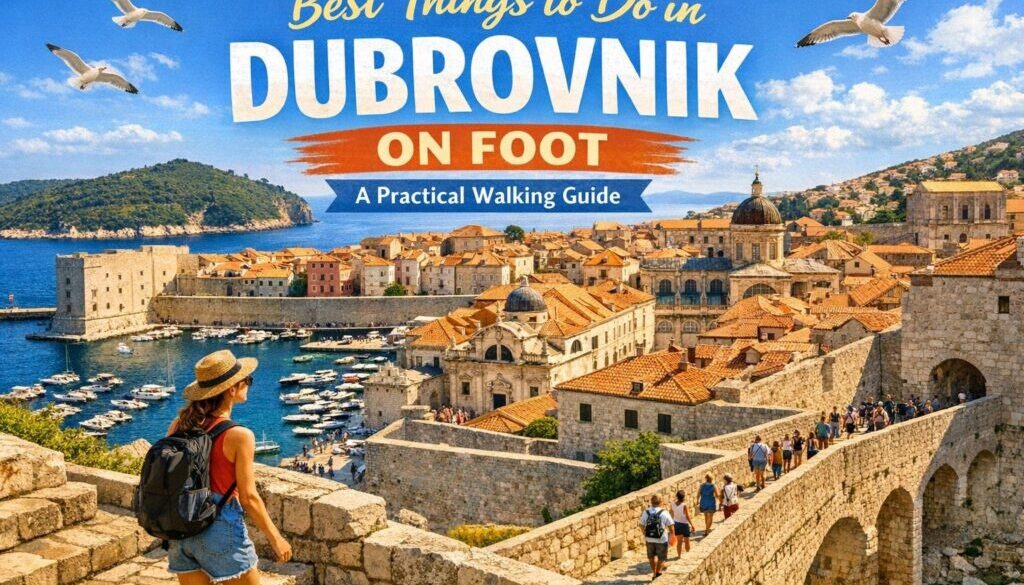
Dubrovnik is one of those cities that makes the case for slowing down. The best things to do in Dubrovnik on foot are concentrated inside and around the UNESCO-listed Old Town, where limestone streets, gates, palaces, monasteries, and fortress views sit within a compact historic core. If you want to understand the city properly, walking is the way to do it.
That does not mean Dubrovnik is effortless. The Old Town can be crowded, the streets are stone underfoot, and the heat can be intense in peak season. But it does mean that with a sensible route and a little timing, you can see a lot without needing transport. For many travellers, that is the pleasure of Dubrovnik: the city reveals itself one street, one stair, and one view at a time.
Quick Answer
The best things to do in Dubrovnik on foot are to walk the city walls, stroll Stradun, pass through Pile Gate and Ploče Gate, visit Rector’s Palace, Sponza Palace, the Franciscan and Dominican monasteries, see Onofrio’s Fountain, and make time for Lovrijenac Fortress and the coastal viewpoints near Buža Gate.
If you are planning a self-paced visit, Dubrovnik is also ideal for a self-guided walking tour, because so many landmarks are close together and the city’s history comes alive as you move between them.
For a broader sense of where everything sits, it helps to view the location on Google Maps before you start. That said, once you are inside the Old Town, the real map is the streets themselves.
Why Dubrovnik is one of Europe’s best cities to explore on foot
Dubrovnik’s Old Town is compact, pedestrian-friendly, and built for wandering. The main historic sights are clustered close together, and the city walls wrap the old core in a way that makes orientation surprisingly easy. UNESCO recognises the Old City as part of the World Heritage listing, and that protected historic setting is exactly what makes walking here so rewarding.
The city also has a clear rhythm on foot. You can move from the main street to a side lane, from a palace courtyard to a sea-facing lookout, without needing to plan a complicated route. That makes Dubrovnik especially appealing if you prefer destination-first travel rather than a structured group tour.
Compact Old Town and UNESCO-listed core
The Old Town is the heart of the experience. According to the Dubrovnik Tourist Board and UNESCO, the historic core is one of the city’s biggest draws, and the city walls are the signature walking experience. The result is a place where the major sights are not spread out across a citywide area; they sit in layers within a very walkable historic centre.
That compactness matters. It means you can combine landmarks naturally, pause for coffee or gelato, and still feel like you have seen the essentials without rushing.
Why walking is the best way to experience the city
Dubrovnik is not just about ticking off attractions. Walking lets you notice the details: the sheen of the limestone under the sun, the change in level between lanes, the sudden openings onto the Adriatic, and the way old buildings frame the streets. It also gives you control over pace, which matters in a city that can become busy quickly.
If you like travel that feels immersive rather than packaged, walking Dubrovnik is the right approach. You can stay longer at the places that interest you and skip the rest without feeling as if you are missing the point.
Ready to Explore Dubrovnik?
Discover Dubrovnik at your own pace with a Walkables self-guided audio walking tour.
The best things to do in Dubrovnik on foot
Walk the city walls
If you only do one walk in Dubrovnik, make it the city walls. They are the city’s signature on-foot experience, and for good reason. From the ramparts you get broad views over the Old Town’s terracotta roofs and the Adriatic beyond, while also gaining a sense of the city’s scale and defensive history.
Because this is one of Dubrovnik’s most famous attractions, it is worth planning for timing and comfort. Early in the day or later in the afternoon is usually a better bet than the hottest part of the day. Check current opening details and ticket information with the Dubrovnik Tourist Board before you go.
Stroll Stradun, the main street through Old Town
Stradun, also called Placa, is Dubrovnik’s main limestone street and the natural spine of the Old Town. It is where many walking routes begin and end, and it is the easiest place to orient yourself. Walk it once slowly, and then walk it again after you have explored the lanes branching off it; the street feels different each time.
This is also one of the best places to observe the city’s daily rhythm. In the morning it is calmer. Later in the day it becomes social and lively, with cafés and visitors spilling into the historic centre.
Enter through Pile Gate and Ploče Gate
Pile Gate on the western side and Ploče Gate on the eastern side are the classic entry points to the Old Town. They are more than practical access points; they help frame the experience of arriving into a fortified city. Entering through one gate and leaving through the other is a simple way to structure a walking loop.
If you are planning your day, one useful approach is to enter via Pile Gate, walk Stradun, explore the main landmarks, and then continue toward Ploče Gate and the eastern side of town.
Visit Rector’s Palace and Sponza Palace
Rector’s Palace and Sponza Palace are two of the most significant historic buildings in the Old Town, and they sit naturally within a walking route along the main streets and squares. Even if you do not step inside every museum or exhibition space, the exteriors alone reward a pause. They help explain how Dubrovnik once functioned as a powerful maritime republic.
Because these landmarks are so central, they are easy to combine with other nearby stops rather than treated as separate outings.
See the Franciscan Monastery and Onofrio’s Fountain
Near the western entry point to the Old Town, the Franciscan Monastery and Onofrio’s Fountain are among the most recognisable places to stop on foot. They are close enough to each other to fit comfortably into the same walking segment, and they offer a quieter historical counterpoint to the busier stretch of Stradun.
The fountain, in particular, is a useful landmark for orienting yourself if you are starting from Pile Gate. It is one of those places that often appears in photos, but it is more satisfying in person because it sits within the flow of the city rather than apart from it.
Explore the Dominican Monastery
On the eastern side of the Old Town, the Dominican Monastery adds another layer to Dubrovnik’s religious and architectural history. It is one of the key landmarks that can be folded into a self-paced walking route without needing to travel far out of your way.
If you like a route that moves from one historic building to the next, this side of the Old Town rewards patience. The streets are often less rushed than the central stretch, which makes it easier to pause and take in the details.
Walk to Lovrijenac Fortress
Lovrijenac Fortress sits just outside the western edge of the Old Town and is one of the most dramatic short walks you can make in Dubrovnik. The route is worthwhile even before you reach the fortress itself, because the approach gives you changing views back toward the walls and the sea.
This is a good example of how the best things to do in Dubrovnik on foot are not limited to the Old Town’s interior. Some of the most memorable moments happen at the edges, where the city opens toward the coastline.
Find the Buža Gate and coastal viewpoints
Buža Gate and the nearby cliffside access points are among the most atmospheric places in Dubrovnik to follow a walking route toward the water. These spots are less about grand monuments and more about the feeling of the city meeting the sea. If your idea of a rewarding walk includes looking out over open water, this is the area to prioritise.
It is also a reminder that Dubrovnik’s best walking moments are not always the most obvious ones. Sometimes they are the places where the stone walls give way to a view.
Take in Gradac Park and the surrounding views
Just beyond the Old Town, Gradac Park offers a quieter green contrast to the stone streets below. If you want a gentler walking break, this can be a good place to slow the pace and look back toward the historic core and coastline.
The park is especially useful if you want to balance a more intensive Old Town walk with a calmer stop that still feels connected to the city’s geography.
💡 Walkables Travel Tip
In Dubrovnik, try to build your day around short walking loops rather than a single long push. The city is compact, but the combination of steps, warm weather, and crowds can make a big difference to comfort. Break the Old Town into sections and you will enjoy it far more.
How to plan a walking day in Dubrovnik
A good Dubrovnik walking day does not need to be complicated. The main decision is whether you want to focus on the western side of the Old Town first, the central spine of Stradun, or the eastern side near Ploče Gate. Once you choose a starting point, the rest can unfold naturally.
Start early or later in the day
Timing matters. Dubrovnik can be busiest around peak cruise ship hours and during the hottest part of the day, so early morning and late afternoon are usually the most comfortable windows for walking. Those times also give the streets a better atmosphere: less rush, more space, and softer light on the stone buildings.
Allow extra time for stairs, steps, and stone streets
The Old Town is walkable, but it is not flat or perfectly even. The streets are stone, and there are steps and inclines throughout. Comfortable shoes are not optional if you plan to spend meaningful time here. If you are walking with limited mobility or simply prefer a gentler pace, keep your route short and selective rather than ambitious.
Build your route around nearby landmarks
The smartest Dubrovnik walking plan is one that groups nearby sights together. For example, Pile Gate, Onofrio’s Fountain, the Franciscan Monastery, and Stradun sit well together. On the eastern side, Ploče Gate, the Dominican Monastery, and the coastal viewpoints can form another logical loop. That approach lets you see more without feeling as if you are constantly backtracking.
Want to Discover More on Foot?
Explore Walkables self-guided audio experiences and discover destinations at your own pace.
What to know before you go
Crowds and cruise ship timing
Dubrovnik’s Old Town can feel particularly busy when cruise ships are in port, so crowd timing is not a small detail. If you value a calmer walk, aim to start early or later in the day and avoid the heaviest mid-morning to afternoon window when possible.
That does not mean the city loses its appeal when busy; it simply means the experience changes. If you prefer atmosphere over tranquillity, the crowds become part of the scene. If you prefer space, timing is everything.
Sun, heat, and comfortable footwear
Dubrovnik can be demanding in warm weather. The combination of direct sun, reflective stone, and plenty of walking adds up quickly, especially in summer. Bring water, wear a hat, and choose footwear that handles uneven surfaces well.
The city rewards those small preparations. Without them, even a short walk can feel longer than expected.
Tickets, opening hours, and seasonal changes
Some attractions and walking experiences in Dubrovnik may have seasonal hours, ticketing rules, or temporary changes. Rather than assume anything, check current information with the official tourism resources before you set off. The Dubrovnik Tourist Board is the safest starting point for current visitor guidance.
Using mobile data for maps and travel apps
Mobile data is genuinely useful in Dubrovnik, especially if you are navigating side streets, checking attraction details, or translating signs on the go. Many travellers also use maps and booking apps while moving through the city, which makes connectivity a practical part of the walking experience.
If you are travelling more widely through Europe, it can also make sense to learn more about Wise for international payments and spending. Walkables may receive a commission if you sign up or make a purchase through the affiliate link, at no extra cost to you.
Why a self-guided audio walk suits Dubrovnik
Dubrovnik is exactly the kind of city where a self-guided audio format works well. The landmarks are close together, the history is layered, and the best experience often comes from moving at your own pace rather than following a rigid schedule. A good audio guide can help you understand what you are looking at without slowing you down.
Explore at your own pace
Some travellers want to linger in a courtyard, while others want to move on quickly to the next view. A self-guided approach lets you do both. You decide how long to stay at a gate, a palace, or a viewpoint, and you can pause whenever a street catches your attention.
Get more context from each landmark
Dubrovnik’s beauty is obvious; its history is not always obvious at first glance. Audio context helps connect the pieces. It gives meaning to the stone facades, the defensive walls, the monastery spaces, and the city’s layout as a former maritime power.
Navigate confidently in a busy old city
In a city that can become crowded quickly, confidence matters. Knowing the next stop, the direction of travel, and how the major landmarks relate to each other can make the whole day feel smoother. If you are planning to keep exploring Croatia after Dubrovnik, you might also find Walkables cruise port guides useful for other compact destinations where walking is the best way to see the essentials.
For travellers who like to browse extra activities around the city, you can also browse tours and activities. Walkables may receive a commission if you book through this affiliate link, at no extra cost to you.
Build a simple Dubrovnik walking route
If you want a straightforward plan, start at Pile Gate, continue to Onofrio’s Fountain and the Franciscan Monastery, walk Stradun, then move toward Rector’s Palace, Sponza Palace, and the eastern side of the Old Town. From there, add the Dominican Monastery or continue toward the Buža Gate area and coastal viewpoints. If you still have energy, finish with a detour to Lovrijenac Fortress or Gradac Park.
That structure gives you a full sense of the city without trying to do everything at once. It is also flexible, which is exactly what a good walking day in Dubrovnik should be.
Final thoughts
The best things to do in Dubrovnik on foot are the ones that let you experience the city’s texture, not just its postcard views. Walk the city walls, move slowly through the Old Town, pause at the gates and palaces, and make time for the sea-facing viewpoints that define Dubrovnik’s atmosphere.
If you approach the city on foot, you will understand why it lingers in travellers’ memories. Dubrovnik is compact, beautiful, and layered with history — and it rewards anyone willing to explore it one street at a time.