
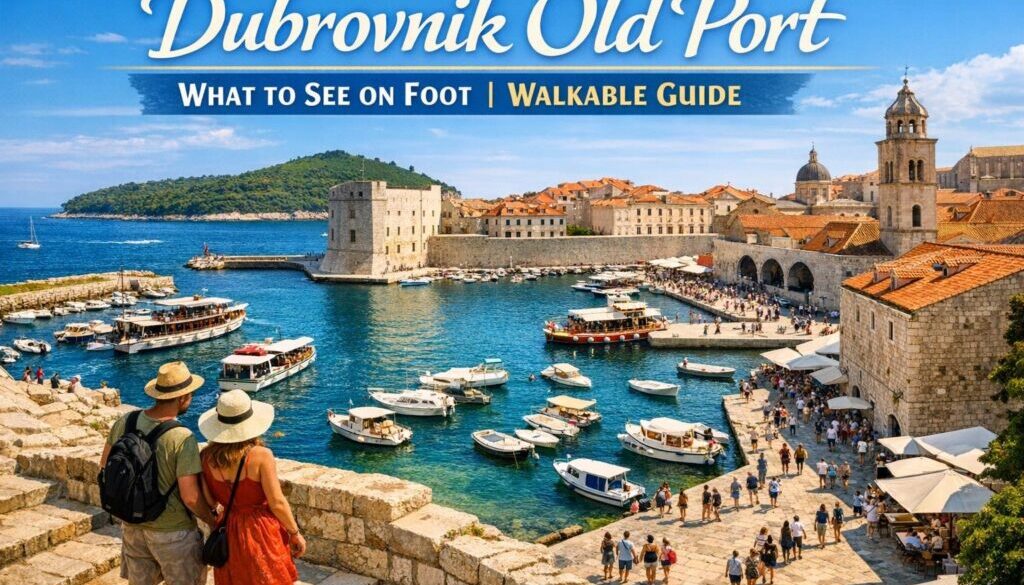
Dubrovnik Old Port is one of the easiest places in the city to experience without a plan, because the best way to see it is simply to walk. Set within Dubrovnik’s UNESCO-listed historic core, the port sits inside a pedestrian-focused old town where stone lanes, stairways, harbour views and major landmarks are all close together.
If you have limited time, the most useful answer is this: Dubrovnik Old Port works best as a compact on-foot experience. You can pair the waterfront with Stradun, Rector’s Palace, the Dominican Monastery and nearby gates or viewpoints, then slow down for photos, coffee or a short harbour pause. For an independent traveller, that makes the area ideal for self-guided exploration.
Quick Answer
Dubrovnik Old Port is best explored on foot in a short loop through the old town. Prioritise the harbour, Stradun, Rector’s Palace, the Dominican Monastery and nearby city walls access points, then allow time for stone streets, steps and crowds.
null
The Old Port matters because it connects Dubrovnik’s maritime history with the city you see today. It is not a separate district to tick off in isolation; it is part of the larger historic centre that people usually experience as one walkable whole. UNESCO lists Dubrovnik Old Town as a World Heritage Site, and that status reflects the city’s unusually intact historic fabric, including its walls, forts and waterfront identity. You can read more about Dubrovnik’s UNESCO listing if you want the broader historical context.
For planning, the area is straightforward in one sense and demanding in another. The layout is compact, but the terrain is not flat. Expect polished stone underfoot, steps, narrow lanes and the occasional incline. That is part of the appeal, but it also means comfortable shoes matter more here than in many other city centres. The Dubrovnik Tourist Board’s official visitor information is a useful place to start if you want a destination overview before you go: Dubrovnik Tourist Board.
What to see on foot around Dubrovnik Old Port
The best sights near Dubrovnik Old Port are close enough to see in a relaxed walking loop. You do not need transport inside the old town, and in most cases you will get a better sense of the place by slowing down rather than trying to cover too much ground.
Stradun and the historic core
Stradun is the city’s main pedestrian street and the natural spine of any walk through the historic core. Even if your main goal is the harbour, Stradun helps you orient yourself. It links the Old Port area with some of Dubrovnik’s most recognisable public spaces, and it is where many visitors first feel the rhythm of the old town: cafes, polished limestone, people watching, and short side lanes that lead toward smaller squares and monuments.
If you only have a little time, walk Stradun in both directions once. It gives you a practical sense of how the old town fits together and makes the rest of your route easier to navigate.
Rector’s Palace
Rector’s Palace is one of the most important landmarks near the Old Port. It sits within easy walking distance and gives the historic centre more depth than a harbour-only visit would. Even if you do not go inside, the palace area is worth pausing for because it helps explain why Dubrovnik feels so layered: civic power, maritime trade and daily life all intersected here.
For visitors with limited time, this is one of the best places to stop and regroup. It is central, photogenic and useful as a navigation point.
Dominican Monastery
The Dominican Monastery is another landmark that rewards a walk through the old town rather than a quick drive-by. Its setting near the walls and harbour area makes it an easy addition to a short walking route. The monastery also adds a calmer, more contemplative note to the otherwise lively historic core, which is useful if you want a more rounded impression of Dubrovnik rather than only the busiest streets.
As with any major heritage site, it is worth checking official opening details close to your visit rather than assuming year-round hours. The safest approach is to verify current information through official destination or attraction sources before you build your day around entry times.
City walls entrances and nearby viewpoints
One of the biggest advantages of starting near Dubrovnik Old Port is that you are close to the city walls. The walls are not something you casually pass through without noticing; they dominate the character of Dubrovnik and frame many of the best views over the old town and sea. Even if you do not walk the full circuit, the walls are part of the visual experience of the harbour area.
For practical planning, remember that wall access and timing can change, so check official sources before you go. If your visit is cruise-day short or you are travelling in summer heat, you may want to decide in advance whether the walls are your priority or a second-visit activity.
The waterfront and harbour atmosphere
The Old Port itself is compact, but that is part of its charm. It gives you a direct sense of Dubrovnik’s relationship with the Adriatic without needing to leave the old town. You will usually be there for atmosphere as much as for a specific attraction: boats coming and going, stone quays, views back toward the town and a feeling that the city still faces the sea as it has for centuries.
Spend a few minutes simply standing still. In a place like this, that is not wasted time; it is often the best way to absorb the setting.
Ready to Explore Dubrovnik on Foot?
Discover Dubrovnik at your own pace with a Walkables self-guided audio walking tour.
Suggested walking route for a short visit
If you are in Dubrovnik for a few hours, the best route is a compact loop that keeps you close to the Old Port while still showing the old town’s main layers. Think of it as a highlights walk rather than a checklist.
A 1-hour highlights loop
Start at the Old Port and orient yourself at the water’s edge. From there, move into Stradun, continue toward Rector’s Palace, and then make your way toward the Dominican Monastery and any nearby walls access points or viewpoints that fit your timing. Finish by returning to the waterfront for a final look at the harbour.
This version suits a cruise stop, a first look, or anyone who wants the most important impressions without rushing too hard. It is also a good structure if you prefer to keep walking decisions simple.
A 2-hour slower route for lingering and photos
If you have more time, stretch the same route by adding pauses for coffee, side lanes, and extra photo stops. Dubrovnik rewards lingering. The old stone surfaces catch the light differently through the day, and the harbour views are not all the same from one angle to the next.
This slower version is especially worthwhile if you enjoy travel journalism-style wandering: not just seeing the landmark, but noticing how the port, the street grid and the people all fit together.
For travellers who like combining self-paced exploration with richer context, Walkables’ self-guided walking tours are designed for exactly this kind of experience. You keep the freedom to stop, detour and linger, while still having a clear story to follow as you walk.
What Australian travellers should know before they go
Dubrovnik is easy to enjoy, but a few practical details matter for Australian travellers, especially if this is part of a longer European trip.
Croatia uses the euro
Croatia uses the euro, so budget accordingly. Cards are widely accepted in tourist areas, but it is still sensible to carry a small amount of cash for small purchases. If you are comparing payment options for overseas spending, you may also want to learn more about Wise for international payments and travel money management. Walkables may receive a commission if you sign up or make a purchase through the link.
For the official currency context, the European Central Bank explains Croatia’s move to the euro here: Croatia and the euro.
Schengen short-stay rules apply
Croatia is in the Schengen Area, so Australian visitors need to think about the 90/180-day rule if they are travelling through multiple European countries. If Dubrovnik is part of a longer itinerary, it is worth checking your total time across Schengen destinations before you finalise flights and hotels.
The European Commission’s Schengen pages are the most reliable place to confirm the current framework, and Smartraveller remains the best Australian-government source for country-specific advice: Croatia travel advice.
Expect crowds on cruise days
Dubrovnik is a major cruise destination, and that matters around the Old Port. When ships are in, the old town can feel much busier, especially in the middle of the day. If you want a quieter walk, earlier or later hours are usually more pleasant than peak mid-morning to mid-afternoon periods. The official Port of Dubrovnik is a useful reference point if you want to understand why crowd pressure can change so quickly: Port of Dubrovnik.
💡 Walkables Travel Tip
For a better on-foot experience, start early, wear shoes with grip, and keep your walking route flexible. Dubrovnik’s old streets are beautiful, but they are not made for speed.
Practical tips for walking Dubrovnik Old Port
A good Dubrovnik Old Port visit is less about distance and more about comfort, timing and pace. A few small decisions can improve the experience significantly.
Wear comfortable shoes
The old town’s stone paving looks elegant, but it can be tiring underfoot. Choose shoes that are comfortable on uneven surfaces and that still feel secure on steps and polished stone.
Expect stone streets, steps and inclines
The walking conditions are one of the defining features of the area. In some places the route is flat and easy; in others, the ground changes quickly. If you are travelling with someone who dislikes stairs or has mobility concerns, it is worth planning a gentler route and avoiding unnecessary backtracking.
Plan for heat and busy periods
Summer heat and heavy visitor numbers can make even short walks feel more demanding. Carry water, build in shade breaks where possible, and avoid assuming that a short route will feel effortless at midday. The same streets that feel atmospheric in the morning can feel crowded and hot later in the day.
Don’t rely on vehicle access in the Old Town
The old town is largely pedestrianised, so direct vehicle access into the core is limited. That is good news for walkers, but it means you should be prepared to move through the area on foot from nearby drop-off points or surrounding roads. For visitors who want a smoother self-guided experience without constant map-checking, cruise companion guides can also be useful when Dubrovnik is part of a larger port call.
Staying connected while exploring
Reliable connectivity is more than a convenience in Dubrovnik’s historic centre. It helps with maps, translations, bookings, ticket checks and meeting points. The old town is compact, but narrow lanes and stone buildings can still make orientation tricky if you are relying on live navigation the whole time.
Why mobile coverage can be uneven in stone streets
Tourist areas in Dubrovnik generally have mobile coverage, but old stone surroundings can produce weaker spots, especially in narrow lanes or enclosed parts of the city. That is one reason to download maps before you head out and not depend on perfect signal every minute.
If you are comparing data options for Europe, it is worth thinking in terms of practical use rather than headline price alone. Ask yourself whether you need hotspot sharing, whether you will move between countries, and whether you still need your Australian number for bank verification or family contact.
Why an eSIM is useful for maps and bookings
For Australian travellers, an eSIM can be a practical way to stay connected without swapping physical SIM cards. It is especially useful if you want to activate service before arrival and keep using maps, messaging and booking apps from the moment you land.
If you are comparing roaming and eSIM options, consult your carrier’s current roaming information, and look at reputable product documentation rather than relying on generic claims. The right setup for Dubrovnik may be different from the right setup for a longer Europe trip.
What to check before choosing roaming or eSIM
Before you buy, confirm phone compatibility, network coverage, activation timing, hotspot support and whether the plan works in multiple European countries. If you are staying only in Dubrovnik, a simpler option may be enough. If you are combining Croatia with neighbouring destinations, broader European coverage may make more sense.
Want to Discover More on Foot?
Explore Walkables self-guided audio experiences and enjoy destinations at your own pace.
Why a self-guided audio walk suits Dubrovnik
Dubrovnik is exactly the kind of place that suits a self-guided audio walk. The historic core is compact enough to explore independently, but layered enough that a bit of storytelling makes the experience much richer. You do not need to move with a group or keep pace with anyone else. You can pause at the harbour, step into a side street, skip a section that does not interest you, or stay longer where the light or the view is especially good.
That flexibility matters in Dubrovnik Old Port because the area is as much about atmosphere as it is about monuments. A self-guided format helps you notice what is around the corner, not just what is directly in front of you.
It also fits the way many travellers now prefer to move through cities: with enough structure to avoid wasted time, but enough freedom to keep the day feeling personal. For a destination like Dubrovnik, that balance is especially valuable.
Final takeaway
Dubrovnik Old Port is best seen on foot, not as a single attraction but as the starting point for a short, rewarding walk through the historic core. If you focus on the waterfront, Stradun, Rector’s Palace, the Dominican Monastery and the nearby city walls access points, you will cover the essential highlights without rushing.
For Australian travellers, the practical checklist is simple: use euro, check Schengen stay rules, expect crowds on cruise days, and make sure your phone setup is ready for maps and bookings. With comfortable shoes and a flexible route, Dubrovnik Old Port becomes one of those places that is best experienced slowly, one stone street at a time.
If you want to keep exploring beyond Dubrovnik, cruise port guides can help you make the most of limited time in port cities around the world.
External resources for planning: view the location on Google Maps, browse tours and activities, and for travel connectivity planning you can compare options through your preferred Australian carrier or first-party provider documentation. Walkables may receive a commission if you purchase through the affiliate links in this article.