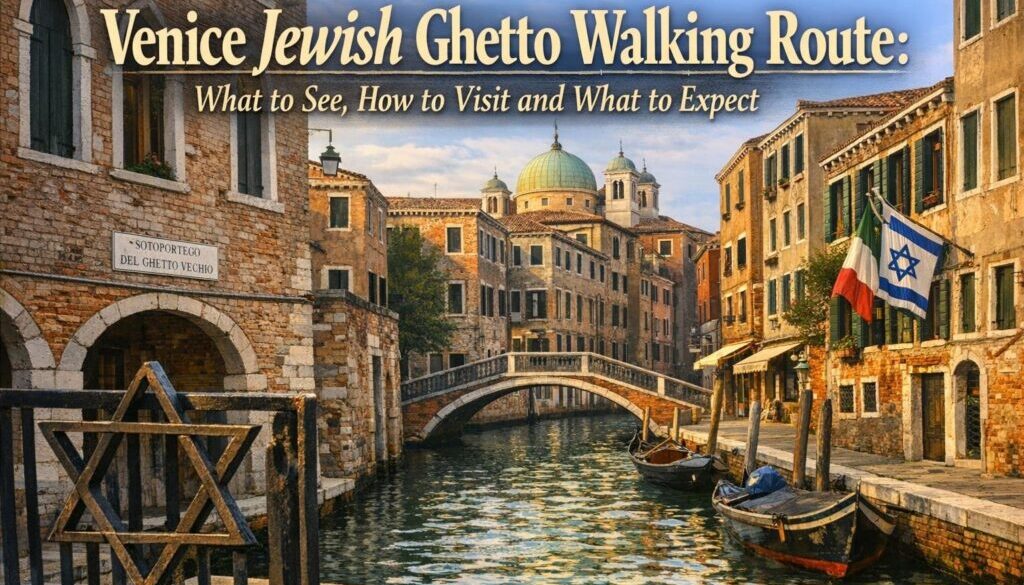
The Venice Jewish Ghetto walking route is one of the most rewarding short walks in the city: compact, historically significant, and best experienced slowly on foot. Set in Cannaregio, it is not the kind of neighbourhood you rush through. The main draw is the concentration of heritage sites — especially the Jewish Museum of Venice and the historic synagogues — but the real value of a visit comes from understanding the area as a lived-in part of Venice, not just a stop on a sightseeing list.
If you are planning the Venice Jewish Ghetto walking route from Australia or anywhere else, the practical question is simple: what is actually worth seeing, how do you move between the key sites, and what should you check before you arrive? The short answer is that the area is easy to explore on foot, but not everything is open in the same way every day, so a little planning makes a big difference.
Quick Answer
The Venice Jewish Ghetto walking route is a compact self-guided walk through Cannaregio centred on the Jewish Museum of Venice, the historic synagogues, and the surrounding squares and streets. It is best visited with a little time, a map, and a check of current opening hours before you go.
For travellers who prefer to understand a place as they walk, this is exactly the kind of neighbourhood that benefits from a self-guided audio walking tour. If you like discovering Venice at your own pace, Walkables’ self-guided walking tours are designed for that style of travel.
null
Venice Jewish Ghetto walking route overview
The Venice Jewish Ghetto walking route is short in physical scale but rich in context. The area is generally explored on foot, and that matters because the best way to absorb it is by moving between small spaces, pausing often, and noticing how the neighbourhood opens and closes around you.
Venice’s official tourism information and the Jewish Museum of Venice both point travellers toward a visit that is as much about atmosphere and memory as it is about individual landmarks. The area is historically important as one of the earliest formal ghettos in Europe, and UNESCO’s wider Venice heritage listing helps place it in the city’s long story of cultural layering. For background and official visitor details, you can visit the Jewish Museum of Venice official website and read UNESCO’s Venice heritage listing.
Why this area is worth exploring on foot
The Venice Jewish Ghetto walking route works well because the area is compact enough to navigate comfortably, yet layered enough to reward attention. You are not dealing with a sprawling district or a long transfer between sights. Instead, the experience comes from the way the museum, synagogue exteriors, squares, and narrow streets connect one another in just a few minutes’ walking time.
That scale makes the neighbourhood particularly appealing if you prefer a slower, more reflective way of travelling. It is also practical for a short stop in Venice, because you can absorb a meaningful part of the city without trying to cover too much ground.
What makes the ghetto historically significant
The Venice Jewish Ghetto has a particular historical weight because it is widely recognised as one of the earliest formal ghettos in Europe. That does not make it a place to experience only through plaques and dates, though. The significance is also visible in the way the neighbourhood still functions as a walkable urban space with memory built into its streets.
For many visitors, the value of the walk lies in seeing how history is embedded in the physical fabric of Venice. The buildings, courtyards and squares are not abstract story elements; they are the setting itself.
What to see on the route
The Venice Jewish Ghetto walking route is best approached as a sequence of connected stops rather than a strict checklist. The core sights are concentrated, and the route is less about ticking off many attractions than about understanding a small area well.
Jewish Museum of Venice
The Jewish Museum of Venice is the natural starting point for most visitors. It provides the main historical framework for the neighbourhood and is central to understanding the synagogues and the wider Jewish heritage of the area. Because opening hours and access conditions can change, check the official site before you go rather than assuming you can simply walk in at any time.
This is the stop most likely to shape the rest of your visit. If you want context before you explore, begin here. If you prefer to wander first, it still makes sense to return to the museum once you have seen the surrounding streets, because the place and the story reinforce each other.
The historic synagogues
The historic synagogues are among the most important parts of the Venice Jewish Ghetto walking route, but they are also the part where assumptions can lead travellers astray. Access is typically through guided visits or specific entry arrangements rather than casual free wandering, so it is wise to confirm the current format in advance.
That means a bit of planning is not optional if these are high on your list. The reward is a much richer visit, because the guided element helps explain what you are seeing rather than leaving you to interpret the spaces alone.
Ghetto squares and surrounding streets
Between the major heritage sites, spend time in the surrounding squares and lanes. This is where the Venice Jewish Ghetto walking route becomes more than a museum visit. The urban rhythm changes as you move through the area, and the scale of the streets gives you a sense of how distinct this part of Venice feels from the busier tourist corridors.
Look up as you walk. The architecture here matters as much as the signs and entrances. Even without stepping into every building, you will get a stronger sense of place by moving slowly and noticing how the neighbourhood is organised.
Heritage markers and atmosphere to look for
Some of the most meaningful details on the Venice Jewish Ghetto walking route are not large attractions at all. Look for heritage markers, inscriptions, and the way the built environment carries memory. The atmosphere is quieter than many other parts of Venice, but it is not empty; it feels lived-in, and that is part of what makes the visit memorable.
Travellers who are drawn to Jewish heritage travel often find that this is the point where the neighbourhood becomes deeply resonant. The story is not only in the formal exhibits, but in the everyday shape of the place.
Ready to Explore Venice?
Discover Venice at your own pace with a Walkables self-guided audio walking tour.
Suggested walking order
A sensible Venice Jewish Ghetto walking route keeps the movement simple. Start with the museum if you want orientation, then continue to the synagogue area and finish by wandering the surrounding lanes and squares at an unhurried pace. That sequence gives you the best chance of understanding what you are seeing before you move into the finer details.
Starting point and route flow
If you begin at the museum, you can build your visit in the right order: context first, then the more specific heritage sites, then the streetscape itself. If you start elsewhere, the route still works, but you may find it easier to appreciate the area once you have the historical frame in mind.
The neighbourhood is compact, so the route does not require complicated navigation. Still, Venice is a city where short distances can be deceptive, especially once bridges, turns and narrow streets come into play. The walking order should be about reducing friction, not racing through the area.
Where to pause for photos or context
Pause where the space opens up and where you can take in more than one element at once. A square or wider stretch of street is a better place to stop than a narrow thoroughfare, because you can look around properly without blocking flow.
It is also worth stopping before entering any museum or guided site. That gives you a moment to settle the area in your mind before moving indoors, which makes the experience feel more connected.
How long to allow
The Venice Jewish Ghetto walking route can be seen relatively quickly, but that does not mean it should be rushed. If you are only passing through, you will get a surface impression. If you want the visit to feel meaningful, allow enough time to explore the museum or guided sites and then walk the surrounding streets without checking your watch every few minutes.
A short visit may only give you an overview. A better visit gives you enough breathing room to read, listen and look properly.
💡 Walkables Travel Tip
Download any tickets, opening information and map directions before you leave your hotel. In Venice, it is much easier to enjoy a heritage walk when you are not relying on live searching every few minutes.
Visiting tips before you go
The Venice Jewish Ghetto walking route is straightforward once you are there, but the practical checks before you go matter a lot. Museum hours, synagogue access and holiday schedules can all affect what you are able to see.
Opening hours and booking checks
Do not assume the museum and synagogues follow a simple daily open-door pattern. The official Jewish Museum of Venice site should be your first stop for current hours, ticketing and access conditions. This is especially important if you are building the visit into a wider Venice itinerary and have limited time.
For Australian travellers planning from afar, this is one of those situations where checking close to departure is better than relying on older blog advice. Venue policies can change, and heritage sites are not always open in the way a general walking map might suggest.
Sabbath and Jewish holiday considerations
Sabbath and Jewish holidays can affect access. If the synagogue visit is a priority, verify the schedule directly with the official site before planning your day. This is one of the most important details on the Venice Jewish Ghetto walking route because it can change whether you are seeing the area as an exterior walk or as a fuller heritage visit.
A little flexibility goes a long way here. If your preferred time is restricted, shifting your walking order can still make the visit worthwhile.
Crowds, walking conditions and mobility notes
Venice is a pedestrian city, but that does not automatically make it simple. Bridges, narrow streets and general crowd conditions can affect how relaxed your route feels. If you are travelling with mobility limitations, luggage or a tight timetable, plan conservatively.
The ghetto itself is compact, but the journey to reach it and the route through Venice may take more effort than the map suggests. The best approach is to think in terms of walking time and comfort rather than pure distance.
Getting there and moving around Venice
One of the practical strengths of the Venice Jewish Ghetto walking route is that it fits well into a broader day of exploring Cannaregio and central Venice. But getting there still requires thought, because Venice’s transport system and pedestrian layout can be less intuitive than a normal city grid.
If you want broader Venice planning support, the city’s tourism portal at Venezia Unica is a useful official starting point for maps and visitor information. For general city guidance, the Comune di Venezia also publishes information at the official city website.
Vaporetto and walking connections
Depending on where you are staying, a vaporetto ride may make the approach easier before you continue on foot. What matters most is not just the stop you use, but the walking connection from that stop into Cannaregio. In Venice, that final stretch often determines whether a visit feels smooth or slightly confusing.
Why distance alone is not enough in Venice
On a map, the Venice Jewish Ghetto walking route may look very short. In reality, Venice rewards a more careful calculation. Bridges, turns and occasional congestion can stretch a simple-looking route into something that takes longer than expected, especially if you are unfamiliar with the area.
That is why it helps to treat the neighbourhood as a walking destination in its own right, not just a quick detour.
Navigation tips for narrow streets and bridges
Use a map, but do not let it become the whole experience. In Venice, navigation is helpful for orientation, yet the pleasure of the route is in allowing yourself enough slack to notice where you are. If you are moving between museum, synagogue and surrounding streets, a few wrong turns are not necessarily a problem — they are part of how the city reveals itself.
For travellers who like extra structure without losing freedom, a self-guided audio format can be a very good fit. That is exactly the appeal of Walkables’ cruise port guides and cruise companion guides in the right context, though for a city walk like this the broader benefit is the same: clear direction without a rigid group pace.
Want to Discover More on Foot?
Explore Walkables self-guided audio experiences and discover destinations at your own pace.
Why mobile data helps on this route
Reliable mobile data can make the Venice Jewish Ghetto walking route much easier to manage, especially if you are combining navigation, ticket checks and last-minute opening-hour confirmation. That is particularly useful for Australian travellers arriving after a long-haul flight and trying to avoid unnecessary stress.
If you are thinking about connectivity for Italy, it can also help to learn more about Wise for managing travel spending and currency when you are abroad. Walkables may receive a commission if you sign up through that link.
Maps, ticketing and last-minute checks
Mobile data is useful for checking official opening information, confirming meeting points and loading maps when you are already on the move. Even if you prefer to plan in advance, Venice has enough small intersections and turns that a quick live check can save time.
If you want a simple backup, save screenshots of key details before you leave your accommodation. That way you are not dependent on signal at the exact moment you need a time or address.
Offline prep for visitors
Download maps, ticket confirmations and any museum details you think you may need. Offline preparation is especially helpful in a destination like Venice, where the walk itself is part of the attraction but the streets can still be unexpectedly confusing.
If you are browsing experiences around Venice and want to compare what else is available, you can also browse tours and activities through Walkables’ approved Viator partner link. Walkables may receive a commission if you book through that link.
eSIM considerations for Australian travellers
If you are travelling from Australia, an eSIM can be a useful way to keep maps and bookings accessible without depending entirely on airport Wi-Fi. For a heritage walk such as the Venice Jewish Ghetto walking route, that often matters more than raw data volume. Think in terms of practical use: navigation, confirmations and messaging rather than heavy streaming.
For money and connectivity planning, it is wise to keep things simple. The less time you spend troubleshooting your phone, the more time you have to focus on the walk itself.
Final planning checklist
Before you set out on the Venice Jewish Ghetto walking route, confirm the essentials. Check the current museum and synagogue access details, decide whether you want a guided component, and map out how you will reach the area from your hotel or vaporetto stop. If you are staying in Venice for only a short time, this preparation is especially worthwhile.
What to confirm before departure
Confirm official opening hours, holiday-related changes and any booking requirements directly on the Jewish Museum of Venice website. Check your route on a city map and allow more time than you would for the same distance in a conventional city.
What to save offline
Save the museum website, any ticket confirmation, a map of Cannaregio and your accommodation details. If your phone signal drops or you are distracted by the maze-like streets of Venice, having the basics offline can save time and frustration.
When to book ahead
Book ahead whenever the museum or synagogue visit is likely to be part of your day rather than an optional extra. That is the safest way to avoid arriving and discovering that access is restricted or timing no longer suits your itinerary.
If you are approaching Venice as a destination to experience at street level, the Venice Jewish Ghetto walking route is an ideal example of why slow, informed walking works so well here. It is compact, meaningful and best experienced with a bit of context, a little flexibility and enough time to notice the details that make the neighbourhood matter.
For travellers who like to explore independently, that is exactly where a self-guided format adds value: you can move at your own pace, absorb the story properly and still leave room for discovery.
For more flexible destination exploration, see Walkables’ self-guided walking tours again when you are planning your next city walk, and remember to check official sources before you go.