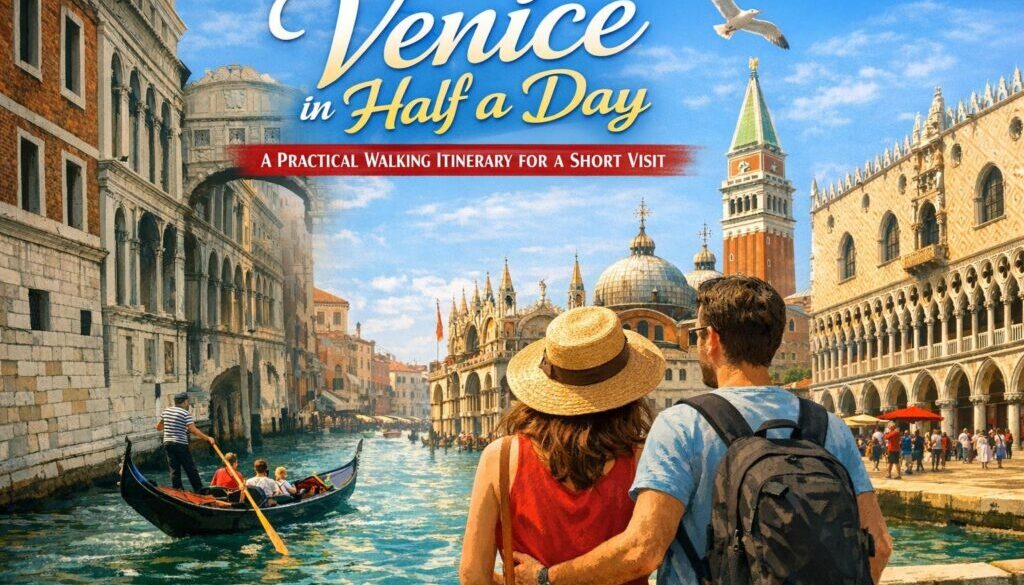
Venice in half a day is absolutely doable if you keep the plan tight. The trick is not trying to “do” the whole city. Instead, focus on the historic centre, walk the key canals and bridges, and give yourself enough time to linger in the places that make Venice feel unmistakably Venetian: Rialto, the route toward San Marco, and the spaces around St Mark’s Square.
For a short visit, Venice rewards travellers who arrive with a simple route and realistic expectations. Crowds, bridges and occasional access rules can make distances feel longer than they look on a map, so a good half-day plan is about pacing as much as sightseeing. If you want a premium, low-stress way to see the essentials, this guide will help you shape Venice in half a day without wasting time.
Quick Answer
The best way to see Venice in half a day is to start near Santa Lucia station or Piazzale Roma, walk to Rialto, continue toward San Marco, explore the basilica and square from the outside if queues are heavy, then finish with a slow wander through nearby canals before returning the way you came or taking a vaporetto back.
null
Venice in Half a Day: What’s Realistic?
Venice is best approached as a walking city, even if you use one vaporetto segment to save time or energy. The historic centre is compact enough for a short visit, but it is also full of detours, bridges and bottlenecks, which means your route needs to be efficient. In practice, Venice in half a day usually means four to six hours on the ground, depending on your arrival point and how long you spend at each stop.
Why Venice is best approached as a walking city
Walking is the most satisfying way to see Venice because it lets you absorb the city between the headline sights. The lanes between Rialto and San Marco are part of the experience: small bridges, sudden canal views, quiet campi, and the sense that the city reveals itself gradually. If you prefer a curated route with narration and navigation support, self-guided walking tours are a strong fit for Venice’s bridge-heavy layout.
What you can comfortably see in 4–6 hours
With a sensible pace, you can comfortably cover the Rialto area, walk toward San Marco, see St Mark’s Basilica from the outside or go inside if queues allow, and spend time around the Doge’s Palace exterior and adjacent squares. You can also fit in one or two unplanned detours if the city is quiet enough, but this is not the day to try to include every museum or island.
For current landmark access details, check official sources before you go: St Mark’s Basilica official site and Museo Correr and MUVE information for Doge’s Palace and related ticketing.
Before You Start: What Australian Travellers Should Know
For Australians, the basics are straightforward, but they matter if your Venice visit is part of a cruise stop, a train day trip or a short city break. Italy is part of the Schengen area, so travel conditions and passport validity still need to be checked before departure. The Australian Government’s Smartraveller Italy advice is the most reliable starting point.
Entry rules and Schengen basics
Australians generally travel to Italy under Schengen short-stay rules, usually without a visa for stays up to 90 days in any 180-day period. That said, it is still worth checking your passport and entry conditions well before travel rather than assuming everything is standard.
Venice day-tripper access contribution
Venice is actively managing visitor flows, and the historic centre is subject to a day-tripper access contribution on selected dates. The official scheme is handled by the Comune di Venezia, and the rules, eligible dates, exemptions and payment or registration steps can change. Check the official page at Venice Access Fee / Access Contribution before you travel so you do not get caught out by a date-specific requirement.
Crowds, queues, and realistic walking times
Venice is one of those cities where the map can be misleading. What looks like a short stroll can take longer because of bridges, narrow lanes and congestion near the major sights. If you are visiting in peak periods, queues and crowd flow can also affect how much you manage to see inside attractions. Build in margin rather than trying to pack the route tightly.
Ready to Explore Venice?
Discover Venice at your own pace with a Walkables self-guided audio walking tour.
Best Starting Point for a Half-Day Walk
The smartest half-day route starts where Venice naturally delivers visitors: Santa Lucia station or Piazzale Roma. From either point, you can head into the historic centre on foot and begin the itinerary without wasting time crossing the city unnecessarily.
Arriving at Santa Lucia station or Piazzale Roma
If you arrive by train, Santa Lucia is the easiest launch point. If you arrive by coach or taxi, Piazzale Roma is usually the practical starting area. From there, the goal is simple: move into the heart of Venice quickly, then keep your route compact.
When a vaporetto segment is worth it
A vaporetto can be worth using if it saves your legs for the best part of the day or if you are arriving tired, carrying bags, or trying to reach a specific part of the city quickly. ACTV operates Venice’s water transport network, and current routes, fares and passes should be checked on the official ACTV website. If you want one short waterbus segment and then an easy walking route, that is often the most efficient compromise.
If you are comparing broader sightseeing options in the city, you can also browse tours and activities; Walkables may receive a commission if you choose to book through that link.
A Practical Half-Day Walking Itinerary
This route is designed for Venice in half a day: efficient, classic, and realistic. It aims to show you the city’s most recognisable areas without turning the visit into a checklist.
Stop 1: Rialto area
Start at Rialto or walk toward it as your first major anchor point. This is one of the most recognisable parts of Venice and a natural place to orient yourself. The bridge itself is busy for a reason: it gives one of the clearest snapshots of the Grand Canal and the city’s layered traffic of boats, people and buildings. If you want to find the area quickly, view the location on Google Maps before you set out.
If the market is open on your travel date, the surrounding area becomes even livelier, but market hours and opening days can vary. The Venice tourism portal and city information sites are the best places to confirm current details before you rely on it as part of your plan.
Stop 2: Walk toward San Marco
From Rialto, make your way toward San Marco on foot. This is where Venice in half a day becomes especially rewarding, because the walk itself is part of the attraction. You will pass through lanes that feel more intimate than the grand landmarks, and you will start to see the city’s rhythm shift as you approach the heart of the historic centre.
Stop 3: St Mark’s Basilica area
St Mark’s Square is the obvious centrepiece, but on a short visit it is best treated as a place to absorb rather than to rush through. If the basilica queue is manageable, go in; if not, take your time around the square and save the interiors for a longer return visit. The official basilica site is worth checking for current visitor conditions because access and queue management can change.
Stop 4: Doge’s Palace exterior and nearby squares
Even if you do not enter the Doge’s Palace, the exterior and surrounding area are worth a pause. This is where Venice feels most ceremonial and most familiar at the same time. Look beyond the main façade and allow yourself a few minutes for the side streets and open spaces nearby. The point of Venice in half a day is not only the famous buildings; it is the way they sit against the water and the pedestrian network around them.
Optional extras if time allows
If you are moving efficiently and the city is not too crowded, you may have time for a short detour through quieter lanes, a coffee stop, or a return wander toward the Grand Canal. Keep the extra time flexible. Venice rewards unstructured moments, but only after the essential route is covered.
💡 Walkables Travel Tip
Download maps before you arrive or make sure your mobile data is working. Venice navigation is simple in theory but surprisingly time-consuming in practice because bridges and canal detours can throw off a route if you are relying on memory alone.
What to Skip if Time Is Tight
If you only have half a day, do not try to force every major site into the route. Choose the classic centre of Venice and let the day breathe.
Sites that require queues or advance planning
Attractions with heavy queues, strict timed entry or complex ticketing can consume the whole visit. If the basilica, a museum or another landmark looks too crowded when you arrive, take that as a sign to keep walking rather than standing in line and sacrificing the rest of the itinerary.
Why not to overpack the route
Overpacking Venice in half a day is the fastest way to miss what makes the city memorable. One good walking corridor between Rialto and San Marco will usually give you more satisfaction than three hurried museums and a water taxi schedule you spend the whole day trying to obey.
Want to Discover More on Foot?
Explore Walkables self-guided audio experiences and discover destinations at your own pace.
Transport, Timing, and Connectivity Tips
For a short Venice visit, logistics can make or break the day. The city is walkable, but only if you stay oriented and do not spend too much time guessing routes.
Vaporetto basics
ACTV runs the vaporetto network, which is the main public transport system in the lagoon area. You may not need it for a compact walking itinerary, but it is useful as a time-saver if you are tired or if your starting point is awkward. Check the official ACTV site for current services and fares rather than relying on old advice, because transport rules and pricing can change.
Why offline maps or data matter in Venice
Venice is one of the cities where mobile data feels less like a convenience and more like a practical tool. Even a short route can become slower if you have to stop repeatedly to figure out which bridge or turning leads back to your plan. Offline maps are helpful, and so is enough data to look up current transport or attraction information as needed.
Roaming vs travel eSIM for Australians
If you are visiting from Australia, it is worth comparing roaming with a travel eSIM before you leave. Roaming is simple because it keeps your existing number, but it can be expensive. A travel eSIM is often better for data use, especially if you mainly need navigation, messaging and quick checks on transport or opening times. For more consumer guidance, the ACCC’s overseas roaming advice is a good reference point, and you can also learn more about Wise if you are managing travel spending across currencies. Walkables may receive a commission if you sign up through that Wise link.
Final Tips for a Better Half-Day in Venice
Venice in half a day works best when you treat it as a focused introduction rather than a rushed overview. Keep your route simple, allow the city to set the pace, and save anything queue-heavy for another visit.
Best pacing strategy
The best pacing is deliberate and unhurried, but not slow. Spend a little longer at each landmark than a standard city walk would allow, and give yourself one or two pauses for photos, coffee or a quiet canal view. That balance is usually enough to make the day feel complete.
Common mistakes to avoid
Do not plan Venice as though it were a grid-based city. Do not assume distances are quick just because they look short on the map. And do not try to do too many interiors unless you are happy to miss the atmosphere outside. In Venice, the walk between places is part of the value.
If you want to explore more of the city in a structured way later, cruise port guides and cruise companion guides can also be useful for travellers pairing Venice with a wider itinerary.
FAQ
Is half a day enough for Venice?
Yes, if your goal is to see the essential historic centre rather than every major attraction. Venice in half a day is enough for Rialto, San Marco and a meaningful walk through the core of the city.
Should I buy vaporetto tickets?
Only if the route or your energy level makes it worthwhile. For a compact walking plan, you may not need the vaporetto at all. Check ACTV before travel if you want to compare ticket options.
Do I need to book St Mark’s Basilica?
It depends on current visitor rules and crowd management on your travel date. Check the official basilica website before you go, especially if your Venice in half a day itinerary depends on getting inside.
Is Venice walkable with luggage?
Technically yes, but it is not pleasant for a short sightseeing visit. Bridges, steps and crowds make luggage cumbersome, so travel light if you can.
Do Australians need a visa for Italy?
Australians generally do not need a visa for short tourist stays under Schengen rules, but they should still check current entry requirements and passport validity on Smartraveller before travelling.
Make the Most of Venice in Half a Day
Venice in half a day is not about ticking off everything. It is about choosing the right route, staying flexible with crowds and queues, and walking the city in a way that feels memorable rather than rushed. Start near Santa Lucia or Piazzale Roma, focus on Rialto and San Marco, check access rules in advance, and keep one eye on your timing so the day stays smooth.
If you want the ease of a curated route without having to keep checking your phone, a self-guided audio walk can be the most practical way to experience the city. Venice rewards travellers who move with intention, and on a short visit, that makes all the difference.