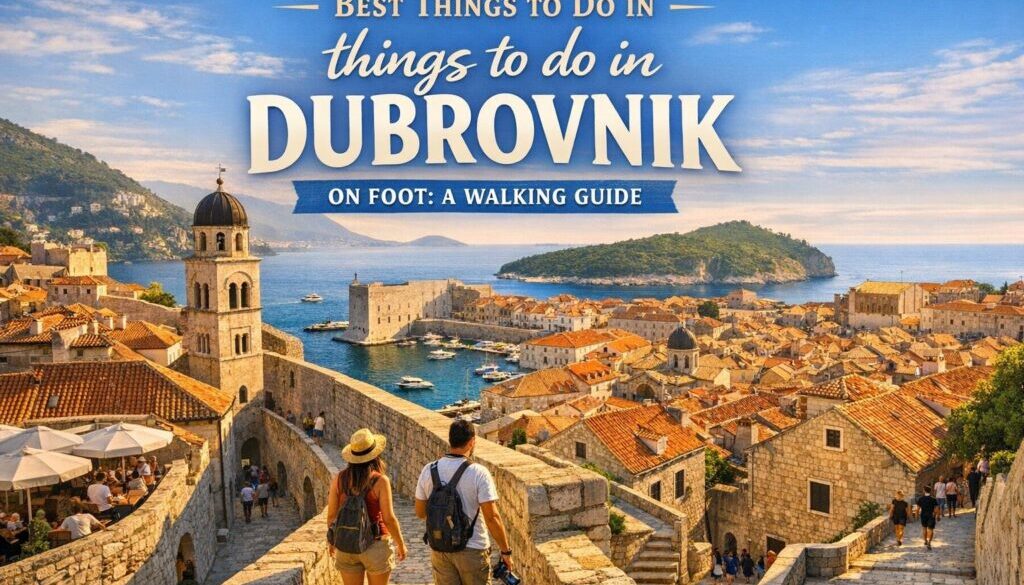
Dubrovnik is one of those cities that makes immediate sense on foot. The Old Town is compact, pedestrian-friendly, and packed with the sights travellers come for: the Stradun, the City Walls, the Old Port, the gates, and the viewpoints that reveal why this city has such enduring appeal. If you are searching for the best things to do in Dubrovnik, the answer is simple: walk it slowly, start early, and leave time to look up as often as you look ahead.
That is especially true if you only have a day or two. The most satisfying things to do in Dubrovnik are concentrated in the historic core, and the city rewards travellers who are happy to explore at street level rather than rush between landmarks. UNESCO’s listing of Dubrovnik’s Old City reflects just how significant this place is, and you can feel that heritage most clearly when you move through it step by step. For background, it is worth seeing the official UNESCO listing for Dubrovnik at the World Heritage site page and the city’s own tourism information at Dubrovnik Tourist Board.
Quick Answer
The best things to do in Dubrovnik on foot are to wander the Old Town, walk the City Walls, pass through Pile Gate and Ploče Gate, explore the Old Port, and pause for viewpoints before finishing with the cable car to Mount Srđ if you want a wider city panorama.
null
Why Dubrovnik is best explored on foot
Dubrovnik’s visitor heart is compact, and that is exactly why walking works so well here. The main sights sit close together, the Old Town is largely pedestrian-oriented, and the city’s narrow lanes are part of the experience rather than a challenge to be avoided. Walking is the best way to absorb the layers of the city: the gates, the limestone streets, the tiny side alleys, and the sudden openings that reveal the sea.
There is also a practical reason to keep your Dubrovnik plans simple. The Old Town includes stone surfaces, stairs, and some uneven ground, so your pace matters. A car is more of a complication than a benefit here. If you want to understand the city rather than just tick off landmarks, a walking-first approach is the right one.
For travellers who like to pair flexibility with context, a self-guided option can be ideal. Walkables’ self-guided walking tours are designed for exactly this kind of exploration: you press play, follow the route, and experience a destination at your own pace.
Best things to do in Dubrovnik on foot
If you are planning your day around the most rewarding things to do in Dubrovnik, start with the sights that define the city rather than trying to cover everything. The best walking day in Dubrovnik is usually a mixture of Old Town wandering, one major heritage experience, and one elevated viewpoint.
1. Wander the Stradun and the Old Town lanes
The Stradun is Dubrovnik’s main street and the natural starting point for any walking route. It gives you the city at its most recognisable: polished stone paving, historic facades, and a steady flow of people moving between gates, squares, cafés, and churches. But the real pleasure begins when you step off the main line and into the smaller lanes that branch away from it.
These side streets are where Dubrovnik feels more personal. You will notice laundry lines, tucked-away staircases, shaded pockets, and sudden views through to the harbour or the walls. This is one of the simplest but most satisfying things to do in Dubrovnik, and it costs nothing except time.
2. Walk the City Walls
The City Walls are one of Dubrovnik’s signature experiences, and they are best understood as a walking route, not just an attraction. The walls give you a different relationship with the city: rooftops, sea views, towers, and the famous red-tiled skyline spread out in every direction. They are iconic for a reason.
Because the walls are a paid attraction and details can change, check the current official information close to your visit through the Dubrovnik Tourist Board before you go. This is not the kind of stop to leave to chance if your time is limited.
3. Explore the Old Port
The Old Port is one of the calmest places to pause in the historic centre. It is an easy place to slow down after the more intense sections of the Old Town, and it adds a maritime dimension to the walking experience. From here, Dubrovnik feels less like a monument and more like a working coastal city with a long memory.
If you are building a shortlist of the best things to do in Dubrovnik, make sure you include a proper pause by the water rather than only racing between landmarks. That pause often becomes one of the most memorable parts of the day.
4. Pass through Pile Gate and Ploče Gate
The city gates are more than practical entrances. They help you read the city’s structure and appreciate how Dubrovnik was defended and organised. Pile Gate is the classic entry point for many visitors, while Ploče Gate gives you another useful perspective on the Old Town’s layout.
Walking through the gates also helps you understand the rhythm of Dubrovnik as a lived-in heritage place. Outside the walls, movement feels broader and more open. Inside, everything tightens and becomes more intimate.
5. Stop at viewpoints and photo spots
Dubrovnik rewards travellers who are willing to stop frequently. Some of the best views appear almost casually: over rooftops, down toward the harbour, or back across the city walls. You do not need to chase every photo spot on a list. In Dubrovnik, the best perspective is often the one you find while following your own curiosity.
For practical orientation, it helps to view the location on Google Maps before you set out, especially if you are trying to understand how the gates, walls, port, and cable car fit together.
Ready to Explore Dubrovnik?
Discover Dubrovnik at your own pace with a Walkables self-guided audio walking tour.
6. Combine your walk with the cable car to Mount Srđ
The cable car is not a substitute for walking Dubrovnik, but it is a strong complement to it. After time in the Old Town, heading up to Mount Srđ gives you the broader geographic picture: the walled city, the coastline, and the surrounding landscape all in one view. The official operator is the best place to confirm current operations before you go: Dubrovnik Cable Car.
For many travellers, this is the ideal way to round out the day. Walk the historic centre first, then shift the perspective upward.
The best time of day to walk Dubrovnik
Timing makes a big difference here. The same streets that feel beautiful and energetic in the morning can feel crowded and hot by midday in peak season. If you can choose your hours, Dubrovnik is most rewarding when you move through it in the cooler, quieter windows of the day.
Early morning
Early morning is the easiest time to enjoy the city on foot. The air is cooler, the light is soft, and the streets are usually calmer. If you want to appreciate the stonework, the gates, and the geometry of the Old Town without constantly weaving around other visitors, start early.
Late afternoon
Late afternoon is another strong option, especially if you prefer a slower pace. The city softens visually, and the walking experience becomes more relaxed. It is also a good time to pause for a drink or a meal after your main sightseeing is done.
Midday
Midday can be the toughest period, particularly in the warmer months. Crowds build, the streets heat up, and walking the walls becomes more demanding. That does not mean you should avoid the city entirely, but it does mean you should plan more breaks, carry water, and protect yourself from the sun.
Practical tips for walking Dubrovnik
A good Dubrovnik day does not require complicated planning, but a few practical choices make a real difference. If you treat the city as a walking destination rather than a checklist, you will enjoy it more and manage your energy better.
Wear sturdy shoes
Dubrovnik’s old stone surfaces are beautiful but not forgiving. Good walking shoes are a smarter choice than fashion-first footwear. You will thank yourself when you are on stairs, polished stone, or longer stretches of the City Walls.
Bring water and sun protection
Shade is limited in some parts of the Old Town, and the sun can be intense. Carry water, use sunscreen, and consider a hat or light cover-up. This matters even more if you plan to walk for several hours or add the walls to your route.
Plan for stairs and uneven surfaces
Dubrovnik is not a flat city. Some lanes are stepped, and many transitions between streets involve inclines or uneven paving. If mobility is a concern, build in extra time and keep the route simple. The city is still rewarding, but the pace needs to be realistic.
Check attraction opening hours and ticket prices
Do not rely on old information for the City Walls, the cable car, churches, or smaller museums. Hours and prices can change seasonally. Before your day out, confirm the latest details from the official sources. That is especially important if you are travelling during shoulder season or want to arrive at a specific time.
Use offline maps plus live data
Dubrovnik’s lanes can feel straightforward one minute and maze-like the next. Offline maps are useful, but live data is even better for checking routes, timing, and last-minute changes. If you are travelling from Australia or continuing through Europe, staying connected makes the walking experience smoother. If you are comparing ways to stay online, Walkables’ learn more about Wise is not relevant here, but for money management on broader trips, Wise can be useful for international spending. Walkables may receive a commission if you sign up through that link.
For travellers who like discovering a city with minimal friction, a connected phone is almost as important as a good pair of shoes. If you are planning multiple walking days, a self-guided format can help you move confidently without losing the feeling of independence. That is why many travellers pair a city walk with cruise companion guides or self-paced route content when they want structure without a group tour.
Connectivity tips for travellers in Dubrovnik
For a walking-focused day in Dubrovnik, mobile data is genuinely useful. You may not need much of it, but what you do need can make the difference between an easy day and a frustrating one. Maps, messaging, attraction checks, restaurant bookings, and translation all become more convenient when you are connected.
Why an eSIM is useful for walking days
If you are wandering the Old Town, an eSIM can help you stay flexible without hunting for Wi-Fi. Stone streets, narrow lanes, and occasional signal variations are not ideal for travellers who want to rely on memory alone. A reliable data plan is handy for navigation and for checking the next stop before you commit to it.
Roaming vs eSIM vs local SIM
Australian roaming is often the simplest option but not always the best value. A travel eSIM is usually easier to set up before you leave and can be ready the moment you land. A local SIM may suit longer stays, but it can take more time to organise. The right choice depends on how long you are in Croatia and how much you expect to use your phone while walking.
If you are comparing providers or devices, check official support pages before you travel. Apple’s eSIM guidance is available at Apple support, and Android and Samsung users should verify compatibility on their device-specific support pages.
What Australian travellers should check
Australians should also keep Schengen rules in mind, because Croatia is part of the Schengen Area. That matters if you are combining Dubrovnik with other European destinations. For the latest official advice, consult Smartraveller’s Croatia travel advice and the EU travel portal at travel-europe.europa.eu.
Dubrovnik is not the place to overcomplicate things, but it is the place to get the basics right. A connected phone, sensible footwear, and a flexible plan will carry you a long way.
Want to Discover More on Foot?
Explore Walkables self-guided audio experiences and enjoy Dubrovnik at your own pace.
Suggested walking-day itinerary
If you only have one full day, this is the most balanced way to experience the best things to do in Dubrovnik on foot.
Morning Old Town stroll
Start early with the Stradun, the side lanes, and the gates. This is when the city is easiest to enjoy and when it feels most atmospheric.
City Walls walk
Move on to the City Walls once you have your bearings. It is the most iconic walking experience in the city and gives you the clearest sense of Dubrovnik’s shape.
Lunch or coffee break
Take a proper break rather than pushing straight through. Dubrovnik is best experienced at a human pace, not as a race between sights.
Afternoon viewpoint or cable car add-on
If you still have energy, use the cable car to Mount Srđ for a broader look at the city and coastline. It works especially well after several hours on foot in the Old Town.
Sunset return to the Old Town
Finish with a final stroll through the historic centre when the day cools and the city becomes more relaxed again. This is often when Dubrovnik feels most rewarding.
⚠️ Important
Dubrovnik is a walking city, but it is not a flat or shaded one. If you are visiting in warmer months, pace yourself, carry water, and plan extra time for stairs, crowds, and photo stops.
Final thoughts
The best things to do in Dubrovnik are not spread across the map. They are concentrated in a compact, walkable historic centre that rewards curiosity, patience, and a good pair of shoes. Walk the Old Town properly, give the City Walls the time they deserve, stop by the Old Port, and save energy for a viewpoint or cable car ride at the end. That is how Dubrovnik makes the strongest impression.
If you like exploring at your own pace, with just enough context to make the streets come alive, Dubrovnik is an excellent city for a self-guided experience. Walk it slowly and it gives back far more than a rushed visit ever could.