null
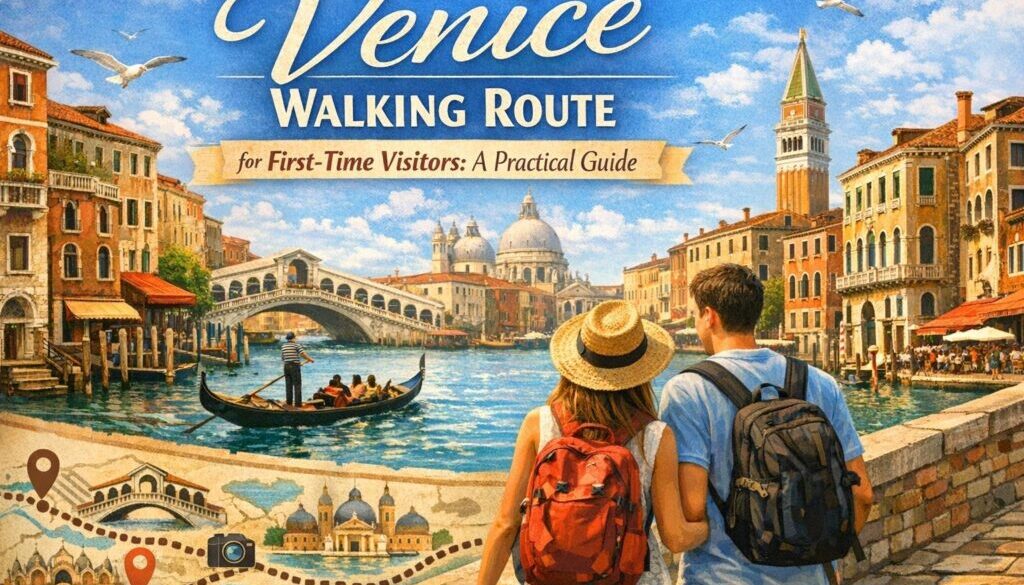
A good Venice walking route is less about covering distance and more about moving through the city in a way that makes sense: starting with the big landmarks, allowing time for bridges and lane changes, and accepting that Venice is a place where the map rarely tells the full story. For first-time visitors, the best route is usually a simple loop through San Marco, the Rialto area, and—if time allows—toward San Polo or Dorsoduro.
That approach gives you Venice’s essential sights without turning the day into a navigation exercise. It also leaves room to linger, get your bearings, and enjoy the city properly on foot. If you want the route to feel smoother, a self-guided audio experience can help you move confidently from one stop to the next, especially when the streets suddenly narrow or split. Walkables offers self-guided walking tours designed for travellers who prefer to explore at their own pace.
Quick Answer
The best Venice walking route for first-time visitors is a central on-foot loop that includes Piazza San Marco, St Mark’s Basilica, Doge’s Palace, the Rialto Bridge, and Grand Canal viewpoints, with extra time for detours, bridges, and crowd delays.
Venice is a pedestrian city in its historic centre, with bridges and narrow lanes connecting the main districts. Official city and tourism sources such as Venezia Unica are a useful starting point when you want to understand the city’s layout before you go.
What to expect from a Venice walking route
A Venice walking route is not difficult in the way a rural hike is difficult. The challenge is different: you are constantly crossing bridges, adjusting to dead ends, and rechecking directions in a city that can feel deceptively compact on a map. A route that looks straightforward on paper can take longer once you factor in foot traffic, photo stops, and route-finding.
Bridges, lanes, and sudden turns
Most of the historic centre is best explored on foot, but the city’s lanes do not always behave predictably. You may walk a short distance, cross a bridge, and find yourself in a completely different-feeling pocket of the city. That is part of the appeal, but it also means you should not schedule your Venice walking route too tightly.
Supportive shoes matter. Uneven surfaces, frequent steps, and long stretches of walking make Venice less forgiving than it first appears. If you are planning other European city walks too, Walkables’ cruise companion guides and cruise port guides can also help travellers who like structured, on-the-ground exploration; this article contains affiliate links, which means Walkables may earn a commission if you make a purchase through certain external partners.
Why maps can underestimate the time
Google Maps can be useful in Venice, but it is not always the final word. Narrow passages, pedestrian shortcuts, and crowd congestion can make a route look shorter or easier than it is in practice. It is smart to build in buffer time and, if possible, keep offline navigation available in case mobile data is patchy or you simply want to avoid stopping every few minutes to reorient yourself.
For a live reference while planning, it helps to view the location on Google Maps before you leave your hotel or cruise terminal.
Suggested Venice walking route for first-time visitors
The cleanest first-time route begins in San Marco and works outward toward Rialto. That keeps the day focused on Venice’s most recognisable sights while reducing the chance that you spend too much time backtracking.
1. Start at Piazza San Marco
Piazza San Marco is the city’s most famous square and the natural starting point for a first visit. It gives you immediate context: the scale of the buildings, the open space after the narrow streets, and the sense that Venice is both monumental and intimate at the same time. Arriving early is usually the calmest way to experience it.
2. Visit St Mark’s Basilica
St Mark’s Basilica is one of the key stops on any Venice walking route. Because opening arrangements can change, check the official site before you go rather than relying on memory or a dated blog post. The basilica’s official information is available through St Mark’s Basilica.
3. See Doge’s Palace
Just beside the basilica, Doge’s Palace adds the political and artistic dimension to the route. If you only have limited time, you may choose to view it from the outside and continue walking. If you have more time, it deserves a proper visit. The official site for ticketing and current visitor information is Doge’s Palace.
4. Walk toward the Rialto Bridge
From San Marco, head toward Rialto through a sequence of lanes and small bridges. This section is where Venice starts to feel most like itself: less formal, more lived-in, and much better at revealing everyday details. It is also where many first-time visitors begin to understand why a Venice walking route is best enjoyed slowly rather than rushed.
5. Pause for Grand Canal viewpoints
When you reach the Grand Canal, stop and take your time. The views matter here as much as the bridge itself. Vaporetto traffic, façades, and reflections give you a sense of Venice as a working city, not just a collection of famous landmarks.
6. End at Rialto Bridge or continue into San Polo
Rialto Bridge is a natural turning point. If your energy is fading, finish there and head back. If you still want more, continue into San Polo for a looser, less ceremonial feel. Another option is Dorsoduro, which can be a good choice for travellers who want a slower, more spacious pace after the busiest central sights.
Ready to Explore Venice?
Discover Venice at your own pace with a Walkables self-guided audio walking tour.
How long a Venice walking route takes
The time you need depends on how much you want to see and how often you stop. For first-time visitors, it is better to think in terms of a half-day or full-day outing rather than a strict point-to-point walk.
Fast version
If you only want the headline sights, you can move through the route fairly briskly. That might suit travellers who are short on time, but it leaves little room for detours or proper pauses.
Comfortable version
A more comfortable Venice walking route allows time to wander, stop for coffee, and recover from the inevitable route changes that happen in Venice. This is the version most visitors will actually enjoy.
Unhurried version
If you like to absorb a place rather than tick it off, an unhurried walking route is the best choice. Venice rewards people who are willing to pause at corners, step away from the obvious path, and let the city unfold gradually.
Practical tips for walking Venice
The route itself is only part of the experience. The practical details often matter more in Venice than they would in a more regular grid-based city.
Wear shoes you would happily walk in all day
Supportive footwear is essential. Venice has plenty of walking surfaces that can be uneven, slippery, or hard underfoot. A stylish pair that you cannot comfortably wear for hours is not worth the trade-off.
Use offline maps as backup
Even if you plan to rely on live navigation, download offline maps before you set out. That gives you a safety net if signal drops or battery runs low.
Expect crowds at key points
San Marco and Rialto are the obvious crowd magnets, especially in peak periods. Early starts generally make the route more pleasant, and a slower pace helps you avoid the feeling that Venice is one long queue.
Check for acqua alta and seasonal flooding
Seasonal high tides can affect walking conditions in parts of the city. In some situations, temporary raised walkways are used. Because conditions are time-sensitive, check local notices close to your travel date rather than assuming the route will feel the same year-round.
💡 Walkables Travel Tip
In Venice, the best strategy is to plan a route with a clear start and finish, then stay flexible in the middle. That way you still see the major sights without letting navigation take over the day.
Staying connected while walking Venice
Mobile data is especially useful in Venice because you may want maps, translations, booking confirmations, and occasional transport checks. For Australian travellers, that usually means deciding between roaming, a travel eSIM, or a physical SIM before departure.
If you are comparing options, it helps to think beyond price alone. Device compatibility matters, as does whether you want to keep your Australian number active for calls or banking messages. Official guidance on eSIM support is available from Apple, and Australian travellers can also review their carrier’s international roaming pages before they leave.
For many walkers, the main priority is simply enough data for maps and messages. Venice’s narrow streets and bridges make it useful to have live navigation available, even if you also carry an offline backup. If you are exploring Europe more broadly, you may also want to learn more about Wise for managing travel spending overseas; Walkables may receive a commission if you sign up through that link.
Good to know before you go
Venice’s visitor rules have changed in recent years, including day-tripper access fee measures on selected dates in peak periods. The safest approach is to check the official portal before travel so you know whether any booking or fee applies to your date. The current official site is the Venice access fee portal.
Australian travellers should also check the latest government advice for Italy before departure. Smartraveller provides practical safety information, including reminders about petty theft and general travel precautions: Smartraveller’s Italy advice.
Landmark hours, ticket rules, public transport information, and weather-related walking conditions can all change. In Venice, it is worth confirming details close to the day rather than assuming last month’s information still applies.
Want to Discover More on Foot?
Explore Walkables self-guided audio experiences and enjoy destinations at your own pace.
Make the Venice walking route easier with self-guided audio
Venice is one of the clearest cases for self-guided audio. The city is layered, atmospheric, and easy to misread if you are moving quickly or trying to navigate from memory alone. Audio guidance helps in two ways: it keeps the route moving, and it adds context to the places you are already seeing.
That matters in a city like Venice, where a bridge, a church façade, or a quiet field can feel more meaningful once you know what you are standing in front of. It also makes the experience more flexible. You can pause when you want, press Play again when you are ready, and walk Venice at your own rhythm rather than someone else’s timetable.
For first-time visitors, that balance of structure and freedom is often the sweet spot. You get the confidence of a planned Venice walking route without losing the sense that you are discovering the city for yourself.
In the end, the best Venice walking route is not the fastest one. It is the one that gives you enough direction to enjoy the city and enough space to notice what makes Venice feel unlike anywhere else.