
null
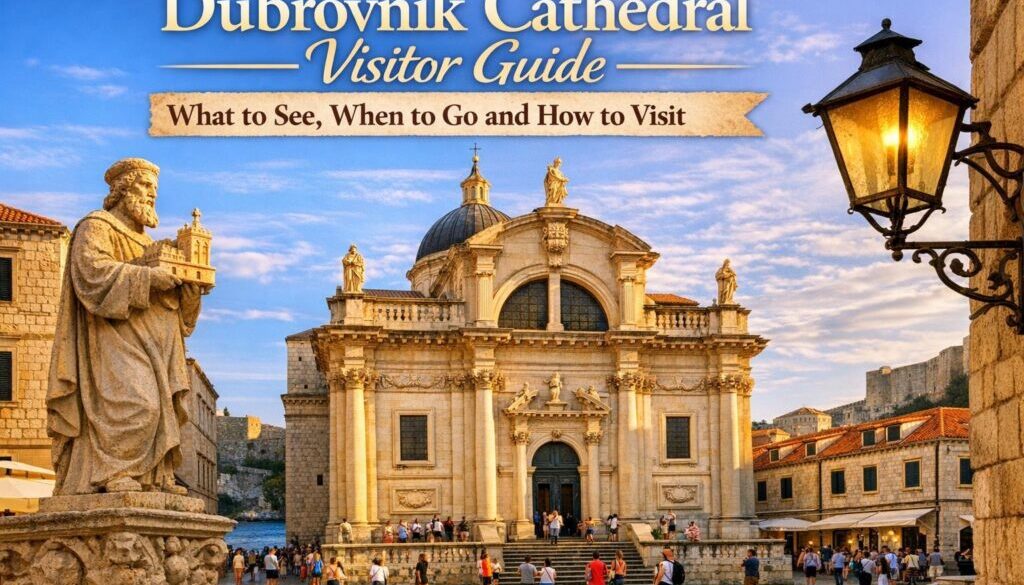
Dubrovnik Cathedral is one of the key landmarks in Dubrovnik Old Town: a working Catholic cathedral, an important historic monument, and an easy stop to fold into a walk through the city’s UNESCO-listed centre. If you are planning a visit, the most useful thing to know is this: Dubrovnik Cathedral is worth seeing not because it is the biggest sight in town, but because it sits right at the heart of Dubrovnik’s story and is best appreciated as part of a relaxed walk through the old city.
Quick Answer
Dubrovnik Cathedral, officially the Cathedral of the Assumption of the Virgin Mary, is a central Old Town landmark in Dubrovnik’s UNESCO World Heritage historic core. It is best visited on foot, ideally when the streets are quieter, and you should allow for changing access conditions around religious services and seasonal crowds.
For travellers who like to explore independently, it is exactly the kind of place that benefits from context. The building itself matters, but so does what surrounds it: narrow lanes, stone squares, civic history, and the layered atmosphere of Old Town. If you want to understand the cathedral as more than a photo stop, a self-paced route through the centre is the best way to do it. Walkables’ self-guided walking tours are designed for that style of travel: flexible, detailed, and easy to follow without rushing.
Dubrovnik Cathedral at a glance
Dubrovnik Cathedral is the city’s Catholic cathedral and one of the most significant monuments inside the Old Town. Its official name is the Cathedral of the Assumption of the Virgin Mary, though most visitors simply know it as Dubrovnik Cathedral. It stands in the pedestrian-only historic core, so once you are inside the walls, you reach it on foot.
That location is part of the experience. You do not approach Dubrovnik Cathedral as a standalone roadside attraction. You arrive through streets built for walking, where the city’s history feels tightly packed around you. The cathedral sits within the broader heritage landscape of Dubrovnik Old Town, which is listed by UNESCO as a World Heritage Site. You can read the UNESCO listing for the Old City of Dubrovnik for the official heritage context.
If you are checking your bearings before you go, it helps to view the location on Google Maps and see how closely the cathedral sits to the other main Old Town sights.
Why Dubrovnik Cathedral is worth visiting
Some travellers come for the exterior, some for the atmosphere, and some because it is one of the places that gives Dubrovnik its sense of civic continuity. Dubrovnik Cathedral matters because it is part of the city’s religious and political history, and because it houses important artworks and relics. Even if you are not planning a deep dive into church architecture, it is a landmark that rewards a short but attentive visit.
It is also one of the clearest examples of why Dubrovnik works so well on foot. In a compact old city, landmarks are connected not just by proximity but by mood, scale and sequence. The cathedral is best seen as part of the walk between squares, lanes and nearby monuments, rather than as a detached “tick-the-box” stop.
For travellers who want more than a quick pass-by, an audio-led experience can add useful background without forcing you into a group schedule. If you enjoy building your own day around what interests you most, that freedom is the real appeal. And if you are looking for additional things to do in the city, you can also browse tours and activities to compare other options. Walkables may receive a commission if you use the affiliate link.
Where Dubrovnik Cathedral is and how to get there
Dubrovnik Cathedral is in Old Town, inside the historic pedestrian zone. That means there is no vehicle-based “drive up and stop” approach in the usual sense. You will enter the old city first, then continue on foot through its streets and squares.
For most visitors, that is exactly what makes the visit enjoyable. Dubrovnik’s old centre is compact enough to explore without transport, but it still benefits from a little planning because the streets can be busy, especially in peak season and around cruise arrivals. The cathedral is easy to include as part of a wider walking circuit through the city walls area and central Old Town landmarks.
💡 Walkables Travel Tip
In Dubrovnik, the visit is not just the landmark itself but the walk between landmarks. Give yourself time to slow down, pause in the squares, and let the Old Town reveal itself one street at a time.
If you are the kind of traveller who prefers to discover places at a natural pace, the old city suits that style well. A self-guided route lets you stop when a side street catches your eye, linger where the light is best, and come back to the cathedral when the crowds thin out. That is one reason many independent visitors prefer self-guided walking tours rather than trying to keep up with a large group.
Ready to Explore Dubrovnik?
Discover Dubrovnik at your own pace with a Walkables self-guided audio walking tour.
Best time to visit Dubrovnik Cathedral
If you want the most comfortable visit, earlier and later in the day are usually the better choices. Morning visits tend to feel calmer, while late afternoon can be more pleasant if you want softer light and slightly lower foot traffic. Midday is often the busiest period in Dubrovnik Old Town, especially in high season.
Crowds matter here more than they might at a standalone site because the cathedral sits inside a compact, heavily visited historic centre. Seasonal congestion is a real part of the Dubrovnik experience, and cruise-day timing can make the streets feel especially full. If you can, plan your walk when the pressure is lower and avoid treating the cathedral as a rushed stop between other obligations.
It is also wise to keep in mind that this is an active place of worship. Access can change around services or special religious events, and visitors should be respectful even when the building is open to sightseeing. The most reliable approach is to check current local information before you go, rather than assuming the same pattern will hold year-round. The Dubrovnik Tourist Board is a useful starting point for destination information.
What Australian travellers should know before visiting
For Australian travellers, the most important pre-trip point is entry awareness. Croatia is part of the Schengen Area, and Australians can generally enter the Schengen zone for up to 90 days in any 180-day period for tourism or business, subject to standard conditions. Before you travel, check the latest official advice from Smartraveller’s Croatia page and confirm your passport and trip details are in order.
There are also practical on-the-ground considerations. Dubrovnik’s old streets are beautiful but uneven, with stone paving, steps and slopes that can be tiring in heat. Summer walking can become hot quickly, so water, comfortable footwear and a slower pace are sensible choices. Travellers should also stay aware in crowded areas, where pickpocketing is a possibility in any major tourist centre.
In an emergency, the EU-wide number is 112. The European Union’s 112 emergency number information is worth saving before you go, especially if you are relying on your phone for navigation and translation.
Practical visiting tips for Dubrovnik Cathedral
Because Dubrovnik Cathedral is an active religious site as well as a visitor landmark, it is sensible to treat current opening arrangements as changeable. Hours, entry conditions and access during mass or special ceremonies can vary, so do not rely on outdated blog posts or old forum comments.
It is also worth planning with a flexible mindset. In Dubrovnik, the best visits are often the ones that leave room for the city to set the pace. If the cathedral is busier than expected when you arrive, step away for a while, explore a nearby lane or square, and return later. That is one of the advantages of independent walking: you are not locked into a fixed schedule.
For more ideas on what to pair with your visit, the approved tour and activity listings can help you compare additional experiences in Dubrovnik. Walkables may receive a commission if you book through the affiliate link.
Cash and card habits can also vary in historic European destinations, so it is sensible to carry a small amount of cash for incidental costs or donations, even if you expect to use card most of the time. Avoid assuming every small point of entry or church-related interaction will be card-only.
⚠️ Important
Do not assume opening hours, access rules or service times are fixed. Dubrovnik Cathedral is an active place of worship, so conditions can change, especially in peak season or during religious observances.
Staying connected in Dubrovnik Old Town
Good mobile data can make a noticeable difference in Dubrovnik, particularly if you are navigating on foot, checking current opening information or finding your way through narrow streets. That said, signal quality can vary in dense stone areas and around parts of the Old Town, so it is smart to download maps in advance as well.
For Australian travellers, it is worth checking whether your phone is unlocked, whether your carrier supports roaming in Croatia, and whether an eSIM is the better fit for your trip. If you are managing overseas payments, navigation and messaging while away, it may also be useful to learn more about Wise for international spending. Walkables may receive a commission if you sign up through the affiliate link.
Travel money is not the headline issue in a cathedral visit, but smooth connectivity and payment access can make the whole day easier, especially if you are moving independently through a busy historic district.
Visiting Dubrovnik Cathedral with a self-guided audio tour
Dubrovnik is one of those cities where the story becomes clearer as you walk. A cathedral like this is not just a building to look at; it is a place that gains meaning through the streets leading to it, the square around it, and the wider civic history of the old city. That is exactly where a self-guided audio experience works well.
With a self-guided format, you can decide how long to spend at the cathedral, when to pause, and whether to continue straight on or linger in the surrounding lanes. You also get the benefit of context without losing the freedom to shape the day around your own energy levels, weather, or cruise schedule.
If you prefer to understand a destination as you move through it, rather than after the fact, a self-guided walk can be the most satisfying way to see Dubrovnik. It suits first-time visitors, repeat travellers, and anyone who wants to avoid being rushed through one of the city’s most atmospheric areas.
Want to Discover More on Foot?
Explore Walkables self-guided audio experiences and discover destinations at your own pace.
Dubrovnik Cathedral is one of the Old Town’s essential landmarks, but the best way to appreciate it is in context. Visit it on foot, go when the streets are calmer, and leave room for the surrounding city to shape the experience. For Australian travellers, that means checking entry basics, planning for heat and crowds, and keeping your day flexible enough to enjoy the walk itself. In Dubrovnik, the journey between landmarks is often as rewarding as the landmark itself.