
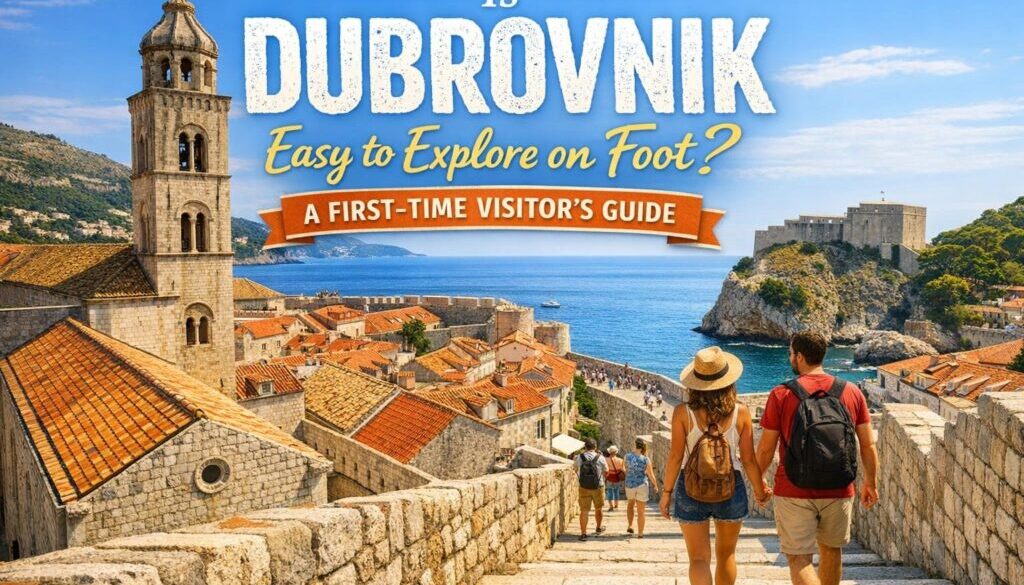
Dubrovnik is easy to explore on foot in the Old Town, but not every part of the city is equally comfortable for walking. If you’re planning your first visit, the real answer is more nuanced: the historic centre is compact, atmospheric and best experienced on foot, while the wider city includes hills, stairs, cobblestones and summer crowds that can make walking more demanding than you might expect.
For first-time visitors, that means Dubrovnik rewards slow exploration, but it also rewards good planning. Knowing where to walk, when to pause, and when to rely on transport can make the difference between a memorable day and an exhausting one. The UNESCO-listed Old City is the place where walking works best, and it is where self-guided walking tours make the most sense: you can move at your own pace and absorb the city’s history without being rushed.
Quick Answer
Yes — Dubrovnik is easy to explore on foot in the Old Town, where the streets are compact and vehicle access is limited. But cobblestones, stairs, summer heat and crowds mean it is not equally easy for every traveller or every part of the city.
The city’s historic core is also a UNESCO World Heritage Site, which helps explain both its appeal and its walking challenges. Narrow lanes, stone paving and preserved medieval streets are part of what makes Dubrovnik distinctive, and they are also why comfortable shoes and realistic expectations matter. You can read the UNESCO listing for Dubrovnik’s Old City if you want to understand why the historic centre feels so different from a modern city layout.
Is Dubrovnik Easy to Explore on Foot?
The short answer: yes in the Old Town, not always across the wider city
If you are staying in or near the Old Town, walking is usually the simplest and most enjoyable way to get around. The streets are compact, most of the main sights sit close together, and the pedestrian-friendly layout makes it easy to drift between churches, squares, viewpoints and cafés without constantly checking a timetable.
Once you move beyond the historic core, the picture changes. Dubrovnik’s wider geography includes slopes, steps and more spread-out areas where walking becomes less convenient. That does not mean you should avoid walking altogether — only that you should not assume the whole city works like the Old Town.
Why Dubrovnik feels walkable in the historic centre
The Old Town is the part of Dubrovnik that most visitors mean when they say they want to “see Dubrovnik.” It is compact enough to explore slowly, and the experience is improved by doing exactly that. You notice details on doorways, stonework, alleyways and small squares that you would miss if you were moving quickly in a vehicle.
For visitors who like to understand a place rather than just photograph it, a self-guided format can be ideal. That is where Walkables fits naturally: if you want to explore independently, a self-guided walking tour can help you move through the city with context, rather than just navigation.
What Makes Dubrovnik Walkable — and What Makes It Harder?
Compact streets and limited vehicle access
One of the biggest reasons Dubrovnik is easy to explore on foot in the Old Town is that cars are not the point here. The historic core is arranged for people, not traffic, so walking feels natural and often more practical than trying to move around by vehicle.
This is useful for first-time visitors because it means you can focus on the experience rather than logistics. You do not need to treat every corner as a transport problem. Instead, you can follow your curiosity, pause for views, and explore side streets without worrying that you are missing something just because you are not in a car.
Cobblestones, stairs and uneven surfaces
The same features that make Dubrovnik visually distinctive can also make it tiring. Cobblestones and stone paving can be slippery or uneven, and many streets involve steps. That matters especially if you are carrying a bag, wearing the wrong shoes, or trying to cover too much ground in one stretch.
In practical terms, Dubrovnik is best enjoyed by travellers who are comfortable slowing down. This is not a place to race between sights. If you pace your day well, you will probably enjoy walking more — and feel less like the city is working against you.
Hills and gradients outside the Old Town
Outside the historic core, walking can become more demanding because the terrain changes. The city is not flat in the way many visitors hope it might be. If your accommodation is uphill, or if you are trying to connect the Old Town with other parts of the city, expect some gradients and a bit more physical effort.
That is one reason many visitors mix walking with public transport or taxis. Walking is still central to the Dubrovnik experience, but it does not have to do all the work.
Ready to Explore Dubrovnik?
Discover Dubrovnik at your own pace with a Walkables self-guided audio walking tour.
Summer heat and peak-season crowds
Dubrovnik can feel very busy in peak season, and heat makes walking more tiring. For Australian travellers used to warmer weather, that does not automatically make the city uncomfortable, but it does mean you should plan your walking hours carefully and leave room for breaks.
In hot weather, the city becomes less about covering distance and more about managing energy. Early starts, shaded pauses and lighter sightseeing days can make a big difference. The Dubrovnik Tourist Board is a good place to check current destination information before you go: visit the official Dubrovnik tourism website.
Is Dubrovnik Easy to Walk for First-Time Visitors?
What to expect if you’re staying in or near the Old Town
If your accommodation is inside the Old Town or just outside it, you will probably find Dubrovnik very manageable on foot for day-to-day sightseeing. Many visitors are able to cover a lot without needing transport, especially if they are content to explore one area at a time.
The best approach is to think in terms of clusters rather than distance. You may not “do” all of Dubrovnik in one continuous walk, but you can comfortably experience a lot of the historic core if you keep your route focused.
What to expect if your accommodation is outside the centre
If you are staying farther out, walking may still be part of your routine, but probably not the whole routine. The journey into the centre may be manageable, yet returning uphill or after a long day can feel more demanding than expected.
That is where a balanced plan helps. Walk the centre, use transport for the parts that are less enjoyable on foot, and save your energy for the streets and views that matter most.
When walking is realistic, and when transport helps
Walking is most realistic when your goal is to explore the Old Town, enjoy sightseeing at a relaxed pace, or follow a route that is tightly packed with landmarks. Transport becomes more useful when you are dealing with hills, luggage, tired legs or a tight schedule.
For many first-time visitors, the sweet spot is simple: walk the Old Town, then use a bus or taxi when distance or elevation starts to outweigh the pleasure of moving on foot.
Is Dubrovnik Accessible on Foot for Everyone?
Why accessibility can be challenging in a heritage city
Dubrovnik is beautiful, but it is also a preserved historic city, and that affects accessibility. Cobblestones, steps, narrow passages and uneven surfaces can make movement more difficult for travellers with mobility limitations, prams or heavy luggage.
This is why it is better to describe Dubrovnik as highly walkable rather than universally accessible. Those are not the same thing. The former is true in the Old Town; the latter needs much more caution.
What travellers with mobility limitations should consider
If accessibility is a priority, it is worth checking route details in advance and not assuming that all “short” distances will be easy. A short walk in Dubrovnik can still include stairs or uneven paving. For some travellers, that is a manageable inconvenience; for others, it changes what is realistic for the day.
Planning ahead matters here. If you need practical destination information before you commit to a route, official local tourism guidance and current maps are both worth consulting before arrival.
How Should Australian Travellers Plan a Walking-Focused Dubrovnik Trip?
Check Smartraveller and current local conditions
Australian travellers should always check current official advice before travel. For Croatia, that starts with Smartraveller’s Croatia travel advice, which is the clearest government-backed source for up-to-date entry, safety and planning information.
If you are building Dubrovnik into a wider European itinerary, this also helps you confirm timing, local conditions and any changes that may affect your plans.
Understand Schengen short-stay rules
Croatia is part of the Schengen Area for short stays, so Australian travellers need to respect the 90 days in any 180-day period rule that applies across Schengen countries. If Dubrovnik is just one stop on a longer Europe trip, that matters.
For the official rule explanation, see the European Commission’s Schengen visa policy page.
Why travel insurance matters on walking-heavy itineraries
Walking-heavy city trips sound relaxed, but they still involve the usual travel risks: slips, heat, crowded areas and the occasional stumble on uneven stone. Good insurance is part of sensible planning, especially if you expect to spend a lot of time on foot.
Before you go, it is worth reviewing Smartraveller’s travel insurance guidance. Walkables may receive a commission if you make a purchase or sign up through some affiliate links on this page, including the travel services mentioned below.
Do You Need Mobile Data or an eSIM in Dubrovnik?
Why maps and navigation matter in narrow streets
In Dubrovnik, mobile data is not just about scrolling or messages. It helps with live maps, restaurant searches, translations, transport checks and route planning in streets that can feel confusing the first time you walk them.
That is one reason an eSIM can be useful for visitors who want to stay flexible. If you are comparing options, it helps to understand your phone’s compatibility before departure. Apple’s support page on eSIM is a useful starting point: learn more about eSIM setup on iPhone.
eSIM vs roaming vs local SIM
For most Australian travellers, the decision comes down to convenience versus cost. Australian roaming is easy, but often expensive for sustained use. A travel eSIM can be simpler to set up before departure. A local SIM can work well for longer stays, but it requires more effort once you arrive.
If you want to compare roaming options from Australian providers, you can review Telstra’s roaming information, Optus international roaming, or Vodafone’s roaming support. For travellers who prefer flexibility and international payments beyond roaming, you can also learn more about Wise for overseas spending. In relevant cases, Walkables may receive a commission if you use affiliate links.
What to check before buying a plan
Before you commit to any travel data plan, check three things: whether your phone is unlocked, whether the plan covers Croatia or wider Europe, and whether the data allowance matches how much navigation you expect to do. A small plan may be fine for light use, but if you rely on maps all day, a more generous allowance can be worth it.
For travellers who want flexibility while moving around a destination, an eSIM can pair especially well with a self-guided experience. It makes it easier to follow a route, stop when something catches your eye, and keep going without needing to join a group.
Want to Discover More on Foot?
Explore Walkables self-guided audio experiences and discover destinations at your own pace.
How Walkables Can Fit Into a Dubrovnik Itinerary
The appeal of exploring at your own pace
Dubrovnik is the kind of city that rewards curiosity. A fast visit gives you the broad outline; a slower walk gives you the atmosphere. That is one reason a self-guided experience works so well here. You can spend longer at the viewpoints you like, move past the places that do not interest you, and avoid the pressure of keeping up with a group.
For travellers who prefer independent exploration, that is often the ideal balance: structure without rigidity. You stay in control of your time, but you still get context along the way.
Why a self-guided audio format suits Dubrovnik’s Old Town
Dubrovnik’s Old Town is compact enough to explore on foot, but layered enough to benefit from commentary. A self-guided audio format suits that perfectly. It can help you understand what you are seeing as you move, rather than after the moment has passed.
That is especially useful in a city where every turn seems to reveal another historic detail. Instead of rushing from landmark to landmark, you can let the city unfold scene by scene and still keep your own pace.
If you are comparing broader experiences in Croatia and beyond, you can also explore cruise companion guides and browse cruise port guides for other travel styles and destinations.
For additional ideas on tours and day experiences in the city, you can also browse tours and activities. That can be useful if you want to compare a self-guided approach with other local options.
Final Verdict: Is Dubrovnik Worth Exploring on Foot?
Yes — Dubrovnik is easy to explore on foot where it matters most, which is the Old Town. That is the part of the city that first-time visitors usually come for, and it is the part that walking brings to life best. But the city is not flat, not uniformly accessible and not always comfortable in peak heat or heavy crowds.
If you go in with realistic expectations, Dubrovnik is one of those places that feels richer when you walk it slowly. Stay flexible, wear sensible shoes, use transport when you need it, and let the historic centre do what it does best: invite you to wander.
For travellers who want the freedom to discover at their own pace, a self-guided audio approach can turn a simple walk into a much more memorable experience.
To see the location while planning your route, you can also view the area on Google Maps.
External sources used: Dubrovnik Tourist Board, UNESCO Dubrovnik Old City, Smartraveller Croatia advice, European Commission Schengen policy.