Piazza San Marco is Venice at its most concentrated and most rewarding: one square, several headline landmarks, and enough detail to fill a careful walking visit without rushing. If you want to explore Piazza San Marco properly, the best approach is to walk it slowly, book the major sights in advance, and plan around Venice’s access rules and crowd patterns.
That matters because this is not a place to “wing it.” The square and the streets around it are among the busiest parts of the city, and the real experience comes from knowing what each building is, how the area fits together, and where you want to spend your time.
Quick Answer
The best way to experience Piazza San Marco is on foot, with a simple route that covers St Mark’s Basilica, Doge’s Palace, St Mark’s Campanile, the Procuratie arcades, and the nearby museum area. Book major attractions ahead, check current Venice access rules before you go, and leave time to pause rather than just pass through.
St Mark’s Square at a glance
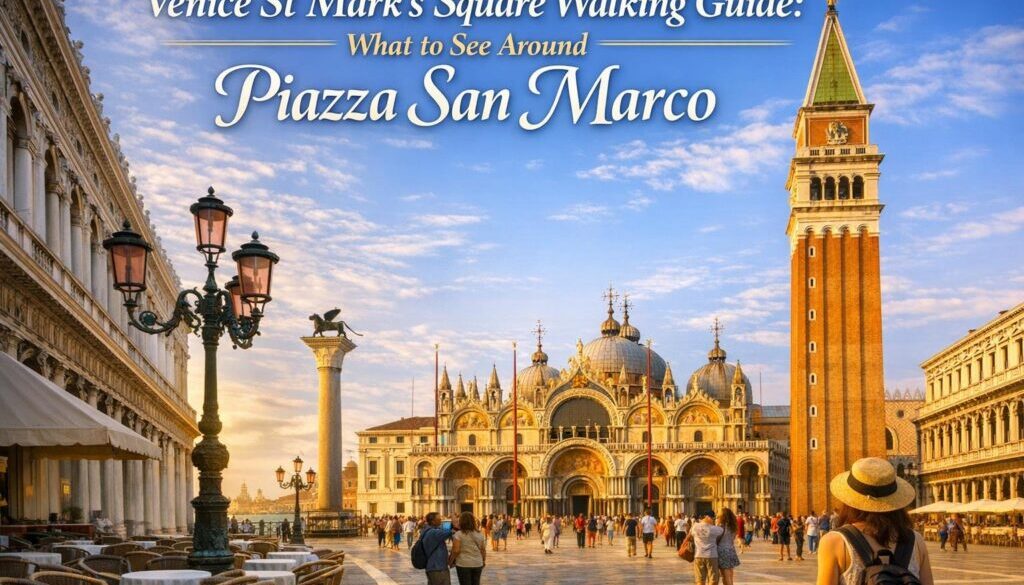
Piazza San Marco is the main square in Venice’s historic centre and one of the city’s most important pedestrian spaces. It is surrounded by the landmarks most first-time visitors come to see, including St Mark’s Basilica, Doge’s Palace, St Mark’s Campanile, the Procuratie buildings, and the museum area around Museo Correr, Museo Archeologico Nazionale and Biblioteca Nazionale Marciana. Official Venice tourism information and the city’s own visitor resources both describe it as the heart of the historic centre.
Because central Venice is largely pedestrian, this area works especially well as a self-guided walking experience. You move between sights at street level, stop when something catches your eye, and understand the square as a connected public space rather than a series of isolated attractions. For travellers who prefer independence, that flexibility is one of the biggest advantages of walking here. If you enjoy exploring at your own pace, self-guided walking tours are a natural fit for Venice-style sightseeing.
For a simple orientation check before you arrive, it helps to view the location on Google Maps and zoom out to see how the square sits in relation to the surrounding canals and pedestrian routes.
What to see around Piazza San Marco
The square itself is the main attraction, but the value of a visit comes from understanding the major buildings around it and the small details between them. If you only have limited time, these are the sights that matter most.
St Mark’s Basilica
St Mark’s Basilica is the most iconic church in the square and one of the most important religious sites in Venice. It is also one of the places where advance planning makes the biggest difference. The official basilica website is the best place to check current opening information, visitor rules and booking details before your visit: St Mark’s Basilica official site.
Even if you are not going inside, the exterior is worth time on its own. Look closely at the façade, the mosaics and the movement of people in the square. From ground level, the basilica has a different presence than it does in photos; it feels both ceremonial and tightly integrated into the life of the square.
Doge’s Palace
Directly beside the basilica, Doge’s Palace is the other major anchor of Piazza San Marco. Its scale, façade and position beside the water make it one of the most distinctive civic buildings in Italy. The official site for the palace is the best place to verify opening hours, ticketing and any entry requirements: Doge’s Palace official site.
If you are short on time, it is still worth pausing outside the palace even if you do not enter. The architecture and the views across the basin and surrounding façades tell you a great deal about Venice’s political and maritime history.
St Mark’s Campanile
The campanile is the square’s vertical marker and one of the easiest ways to orient yourself. It is visible from much of the surrounding area and helps define the skyline of Piazza San Marco. For many visitors, it is less about “doing” the tower and more about using it as a visual reference while moving through the square.
The Procuratie buildings and arcades
The long arcaded buildings around the square are easy to overlook if you are focused only on the headline monuments. But they are essential to the atmosphere of Piazza San Marco. The arcades create shade, frame the movement of the square and give the whole area its formal, measured shape. They are also where you feel the transition between open public space and the more enclosed rhythm of Venice’s streets.
Museo Correr and the nearby cultural area
The museum and cultural buildings on the square’s edge are useful if you want context rather than just photographs. They help explain how the square functions as both a ceremonial space and a civic one. If your time in Venice is limited, you may choose one major interior visit rather than trying to do everything. That is often the better way to experience Piazza San Marco without turning the day into a queue marathon.
Ready to Explore Venice?
Discover Venice at your own pace with a Walkables self-guided audio walking tour.
The best way to explore Piazza San Marco on foot
Walking is not just the best way to see Piazza San Marco; it is really the only way to understand it properly. The square, the arcades, the entrances to major monuments and the surrounding pedestrian lanes all reward slow movement. You notice how people filter through the space, where lines form, where the views open up and where the square feels calmest.
A good approach is to arrive with a simple sequence rather than a packed schedule. Start in the square itself, orient yourself visually, then move to the attractions that matter most to you. If you want interiors, prioritise those first. If you want atmosphere, walk the perimeter, pause under the arcades and return to the open centre when the light changes or the crowd shifts.
Because Venice can be confusing at street level, offline navigation is useful. A phone map is handy for finding your way to the square, but once you are there, it is better to move by landmarks than by turn-by-turn directions. That is especially true if you are arriving from a vaporetto stop or from elsewhere in the historic centre. Official Venice transport information is available through ACTV, which is worth checking if you are planning your arrival by water transport.
💡 Walkables Travel Tip
In Venice, the smartest walking strategy is to treat your route as a series of visual anchors rather than a straight line. Aim for the square first, then use the basilica, campanile and palace as reference points as you move around the area.
If you enjoy learning as you walk, a self-guided audio experience can make this kind of visit much richer. It gives context without forcing you to keep pace with a group, and it helps you understand why the square looks the way it does. For travellers who like to pair walking with commentary, cruise companion guides can also be useful for shore days and time-limited stops in Venice. Walkables may receive a commission if you purchase through affiliate links on this page.
For extra sightseeing ideas once you have finished in the square, you can also browse tours and activities and compare options that suit your time and interests.
What to book in advance
Advance booking matters in this part of Venice more than in many other city centres. The main reason is simple: Piazza San Marco concentrates the most visited sights in a very small area, so queues can quickly eat into your day.
St Mark’s Basilica
Check the official basilica website before you go and book ahead if the current system allows it or recommends it. This is the most straightforward way to reduce waiting time and avoid disappointment if entry rules change or capacity is limited.
Doge’s Palace
The palace is another attraction where booking ahead is sensible, especially during busy travel periods. The official site is the safest source for current ticketing and visitor information.
Timed tickets and peak periods
If you are visiting in a high season, on a weekend, or as part of a short stop in Venice, timed entry becomes more valuable. Even when a site allows walk-up tickets, pre-booking gives you a clearer rhythm for the day and reduces the risk that one long queue throws off the rest of your itinerary.
Current Venice access and crowd considerations
Venice has introduced access management measures for some day visitors on selected dates, and those rules have changed over time. The official access-fee portal is the place to check whether the contributo di accesso applies on your travel date, whether exemptions apply, and what registration or payment steps may be required: Venice access fee official portal.
Do not assume the same rules apply year-round. This is exactly the sort of detail that should be checked close to departure, especially if you are planning a short visit or a cruise stop. The city’s official channels also remain the best source for crowd-management updates and local notices.
Crowds around Piazza San Marco are often heaviest around the square’s most famous façades, but the experience changes throughout the day. Early arrival usually means calmer conditions and easier photography. Later in the day, the square can feel more compressed, especially when multiple groups arrive at once.
Want to Discover More on Foot?
Explore Walkables self-guided audio experiences and discover destinations at your own pace.
How to get to Piazza San Marco
The historic centre of Venice is shaped by water and walking, so the journey is part of the experience. Most visitors reach Piazza San Marco by a combination of water transport and a short walk, or simply on foot if they are already staying nearby.
Vaporetto and water transport
ACTV is the official public transport operator for Venice, and its site is the most reliable starting point for route and service information. If you are arriving by vaporetto, allow extra time for the final approach, because the walk from the stop to the square may be slower than expected in busy periods.
Walking connections from nearby areas
Once you are in the historic centre, the route to Piazza San Marco is usually best handled on foot. This is where a paper map or offline map is more useful than trying to rely on live navigation alone. Venice’s lanes can be compact, indirect and deceptively confusing, especially if you are new to the city.
What Australian travellers should plan for
If you are travelling from Australia, the practical details matter. Check your Italy entry requirements with Smartraveller’s Italy advice before departure, especially if your trip involves multiple Schengen countries or a long itinerary. It is also worth confirming that your passport has sufficient validity for your travel plans.
Payment and connectivity deserve attention too. Card payment is widely used in Venice, but backup payment is sensible. For mobile data, consider whether your Australian roaming plan, a travel eSIM or another setup suits the length of your trip. If you need local currency management or cross-border spending support, you can also learn more about Wise. Walkables may receive a commission if you purchase through affiliate links on this page.
For visitors who want a faster way to decide what else to do in the city, cruise port guides can also be a useful planning tool when Venice is just one stop on a larger trip.
Practical tips for a smoother visit
There are a few simple habits that make a large difference in Piazza San Marco. Arrive early if possible. Book interior attractions ahead. Keep your route flexible so you can pause when the square is quiet. And give yourself time to stand still, because the square is more rewarding when you are not always in motion.
If you only have a few hours, focus on the exterior of the basilica and palace, the scale of the square itself and one interior visit that matters most to you. If you have longer, build in time to circle back through the area at a different hour. Venice often feels different once the largest crowds thin out.
For many travellers, the real value of Piazza San Marco is not that it is a box to tick, but that it is the place where Venice becomes legible. The architecture, the pedestrian flow, the water access and the ceremonial scale all come together here. Walking lets you notice that structure rather than just pass through it.
Why a self-guided audio walking tour can help
A self-guided audio walking tour is particularly well suited to Piazza San Marco because the area is dense with context. You do not need a rigid group schedule to appreciate it, but you do benefit from interpretation: what each building means, how the square evolved, and why certain viewpoints matter.
That is exactly where self-guided audio can improve the experience. You can press play when you want direction, pause when you want time for photos, and move on when you are ready. For independent travellers, that balance between structure and freedom is often the ideal way to explore a place like Venice.
It is also a sensible option for short-stay visitors and cruise passengers, who often want to see the key landmarks without feeling rushed. In a compact but crowded setting like Piazza San Marco, pace matters as much as content.
For broader travel planning, you may also want to compare experiences on Viator to see what else is available nearby. That can be a useful complement to a self-guided day on foot.
The easiest way to enjoy Piazza San Marco is to treat it as a living square rather than a checklist. Walk it once to orient yourself, return when the light or crowd changes, and book the interiors you care about most. If you do that, you will leave with a better sense of Venice than visitors who only rush from one famous façade to the next.
For travellers who value independence, context and a calmer pace, Piazza San Marco is exactly the kind of place where walking pays off.