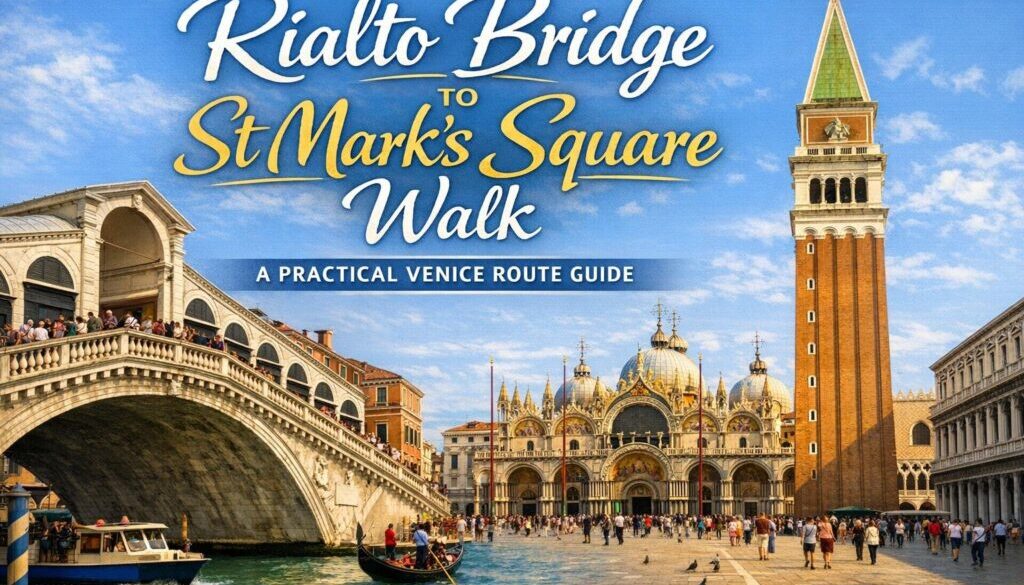
Walking from the Rialto Bridge to St Mark’s Square is one of Venice’s most famous short routes, but it is not a straight line. The route threads through narrow lanes, across bridges, and past the kind of side streets where it is easy to lose your sense of direction for a moment. That is part of the appeal — and also why a little planning goes a long way.
If you want the simplest answer: yes, the Rialto Bridge to St Mark’s Square walk is doable for most travellers, and it is usually a short, rewarding way to move between two of Venice’s best-known landmarks. Just expect steps, turns, crowding near the main sights, and the occasional need to check your map.
Quick Answer
The Rialto Bridge to St Mark’s Square walk is a classic Venice stroll through the historic centre. It is short, scenic, and easy to enjoy, but it can be confusing to navigate because Venice’s lanes are narrow and indirect. Bridges, crowds, and tide conditions can also affect the experience.
For travellers who prefer to explore at their own pace, this is exactly the kind of route that works well with a self-guided approach. self-guided walking tours can help you stay focused on the experience rather than the logistics, especially in a city where the route matters as much as the destination.
Venice’s classic short walk: Rialto Bridge to St Mark’s Square
Rialto Bridge and St Mark’s Square sit in the heart of central Venice, and the walk between them is one of the city’s most common on-foot connections. It is popular because it links two of the places most first-time visitors want to see, but it also gives you a feel for Venice away from the waterbus stops and tourist bottlenecks.
What makes this route special is that Venice is not laid out like a normal city. Streets become alleys, alleys become bridges, and the route often asks you to trust the signs, the map, or your instincts. That is why travellers often find the walk more memorable than the landmarks alone.
Official Venice information is useful here, especially if you are checking access rules or tide alerts before you head out. You can start with the city’s tourism and municipal resources at Venezia Unica and the Comune di Venezia.
Why this route is so popular
This is a short route with a lot of payoff. You move through the historic centre, see Venice at street level, and arrive at one of the city’s most recognisable squares. For many visitors, it is the kind of walk that turns a checklist stop into a more textured experience.
It also suits travellers who like flexible sightseeing. You can stop for a coffee, detour into a quiet lane, or simply pause on a bridge and take in the canals. That freedom is one of Venice’s strengths.
What makes Venice walking different
In Venice, walking is not just transport — it is the way you understand the city. But it is also a city where orientation can be tricky. The route from Rialto Bridge to St Mark’s Square may look simple on a map, yet the real experience involves turns, signs, and the occasional backtrack.
That is where offline maps or reliable mobile data become useful. If you are relying on your phone, download what you need before you set out. In a historic city like Venice, a strong signal is helpful, but a backup map is even better.
How to walk from Rialto Bridge to St Mark’s Square
There is no single “perfect” way to walk from Rialto Bridge to St Mark’s Square, because Venice’s network of lanes does not behave like a grid. The practical approach is to follow signed pedestrian routes toward San Marco, staying alert for bridges and turns.
The route is usually straightforward in the sense that it is short and central, but not always intuitive in the moment. If you are not used to Venice, expect to pause occasionally to confirm you are still headed in the right direction.
The route in simple terms
In broad terms, you begin around Rialto and make your way south-east through the historic centre toward Piazza San Marco. The exact streets you use will vary depending on where you start from the bridge and how you prefer to navigate, but the overall direction remains the same.
Along the way, you will likely pass through narrow pedestrian lanes, cross one or more small bridges, and move into busier territory as you approach the square. It is a walk that rewards patience more than speed.
What to expect on the way
Expect narrow lanes, changes in direction, and more foot traffic as you get closer to the major sights. You may also find that the route feels more crowded at peak times, especially if you are walking in the middle of the day.
The scenery changes subtly as you go. One moment you are in a quieter lane, the next you are approaching a stretch where more visitors are converging on the same destination. That shift is part of the rhythm of Venice.
Ready to Explore Venice?
Discover Venice at your own pace with a Walkables self-guided audio walking tour.
How long does the walk take?
The time it takes to walk from Rialto Bridge to St Mark’s Square varies depending on crowds, stops, route choice, and how often you pause to orient yourself. Because Venice is a city where people naturally stop to look around, take photos, or consult a map, it is best to think of the route as flexible rather than fixed.
If you move steadily, it is a short walk. If you linger, it can become part of a much longer city wander. Either way, the route is best treated as a sightseeing experience, not just a transfer between attractions.
Why timing can vary
Several things affect the pace of this walk. Crowds near key crossings can slow you down. Narrow lanes can create bottlenecks. And if you choose to detour for a canal view, a café stop, or a more scenic lane, the route naturally expands.
That variability is not a problem; it is simply part of Venice. The best plan is to leave a little flexibility rather than aiming to arrive at a precise minute.
Crowds, stops, and detours
Peak visitor times can make the route feel busier than expected, particularly near the most famous approaches to St Mark’s Square. If you prefer a calmer walk, earlier in the day is often easier than late afternoon, though local conditions can change with season and events.
If you want to make the route feel more personal, allow time to drift. Venice rewards those who are not in a rush.
For people who want additional ideas once they arrive, browse tours and activities for other ways to experience Venice. Walkables may receive a commission if you book through this link.
Things to know before you go
A few practical realities can make the Rialto Bridge to St Mark’s Square walk much smoother. Venice is beautiful, but it is also a city where footpaths, bridges, and tide conditions can affect how comfortable the experience feels.
Steps, bridges, and uneven surfaces
Expect bridges with steps and surfaces that are not always perfectly even. That matters if you are carrying a day bag, pushing a stroller, or travelling with mobility concerns. It is also worth wearing shoes that handle cobblestones and stairs well.
The route is manageable for many travellers, but it is not the kind of walk where you should expect fully flat, uninterrupted pavement from start to finish.
Finding your way in Venice
Venice can be disorienting even for confident travellers. Signage helps, but it is easy to take a wrong turn if you are moving quickly or trying to follow your map while weaving through other pedestrians. Offline maps are useful, and so is a little patience.
If you prefer to wander without worrying about navigation, a self-guided audio experience can help add structure without removing freedom. That is one reason many travellers choose self-guided walking tours when exploring complex historic cities.
Why offline maps or mobile data help
Mobile data is useful in Venice for navigation, tide checks, and general travel planning. Australian travellers should also think about roaming costs and whether an eSIM or roaming pack suits their trip better.
💡 Walkables Travel Tip
Before you leave Rialto, download your map, save any ticket confirmations, and check tide conditions for the day. Venice is much easier to enjoy when the practical bits are sorted in advance.
If you are weighing travel connectivity options, it can also be worth learn more about Wise for spending overseas. Travel money planning matters in Italy, especially if you want to keep fees and payment hassle under control. Walkables may receive a commission if you sign up through this link.
Tides, flooding, and visitor rules
Two of the most important planning factors for the Rialto Bridge to St Mark’s Square walk are tides and visitor management. Venice is a city where the route may be the same, but conditions can change from one day to the next.
Why St Mark’s Square can be affected by acqua alta
St Mark’s Square is one of Venice’s lowest-lying areas and is especially prone to flooding during high tides or adverse conditions. If you are walking there on a day with acqua alta, the experience can change significantly.
Before setting out, check official tide information from the city of Venice at Centro Maree. That is the most practical way to avoid being surprised by standing water or access issues.
Venice access fee considerations
Venice has introduced visitor management measures that may include an access fee on certain dates. If you are planning a day trip, it is worth checking whether your visit requires payment or registration, because that can affect your whole itinerary, even if your actual walking route is short.
For the latest official information, use the city’s access fee page at Comune di Venezia access fee information.
Checking official alerts before you walk
Because tides and access rules can change, it is sensible to check official sources on the day you travel, not just when you book. That is especially true if your time in Venice is limited and you want the walk from Rialto to San Marco to go smoothly.
For Australian travellers, Smartraveller is also worth a look before an Italy trip, especially for entry guidance and general travel advice: Smartraveller Italy travel advice.
Is this walk accessible?
In a city built on canals and bridges, accessibility is always a live question. The Rialto Bridge to St Mark’s Square walk includes steps and is not guaranteed to be step-free, so travellers with wheelchairs, mobility aids, or strollers should plan carefully.
Mobility, strollers, and luggage considerations
Bridges, narrow lanes, and uneven surfaces can make this route harder with luggage or a stroller. Even if the route itself is short, the physical effort can be more than you expect.
If accessibility is a priority, check the city’s official mobility resources before you go. The Comune di Venezia provides information on architectural barriers and access-related issues at barriere architettoniche.
When to consider a different route
If you need a flatter or more direct movement through the city, it may be worth reassessing whether the classic route is the best option for that day. Venice does have accessible information and support channels, but the standard Rialto-to-San-Marco walk is not the easiest choice for everyone.
Want to Discover More on Foot?
Explore Walkables self-guided audio experiences and discover destinations at your own pace.
Make the walk more rewarding
The real value of this route is not simply getting from one landmark to another. It is the way Venice reveals itself in motion: a bridge here, a narrow passage there, a brief glimpse of water, then a square opening up ahead. Walking lets you experience that sequence properly.
If you enjoy travel with context, a self-guided audio experience can add depth without locking you into a fixed group schedule. It gives you the freedom to pause, explore, and continue at your own rhythm.
Why a self-guided audio tour suits Venice
Venice is a city where you benefit from narration that respects the place rather than rushing through it. A self-guided format works well because it supports curiosity. You can stop to take in a lane, listen to context when you want it, and move on when you are ready.
That flexibility is especially useful in a city where walking is both transport and discovery.
How Walkables fits a flexible city walk
Walkables is designed for travellers who want to experience a place at street level, with context that supports independent exploration. For a route like Rialto Bridge to St Mark’s Square, that means you can enjoy the walk without turning it into a logistics exercise.
For travellers who like the idea of wandering with a bit more confidence, that combination of freedom and structure can make all the difference.
If you want more ideas for what to do once you arrive in the square or nearby, it can also help to explore local tours and experiences. Walkables may receive a commission if you book through this link.
Practical travel tips for Australian visitors
For Australians heading to Venice, the route itself is only one part of the picture. Connectivity, payments, and travel preparation all matter if you want the day to feel easy.
Data, roaming, and eSIM considerations
Reliable mobile data helps with navigation, translations, tickets, and tide checks. If you are using your Australian phone plan abroad, confirm whether roaming is enabled and what it will cost. If you prefer a travel eSIM, make sure your device supports it and that it will work for the length of your stay.
For a route like this, the practical goal is simple: make sure you can get your map when you need it.
Currency and payment basics
Italy uses the euro, and cards are widely accepted in tourist areas. Even so, it is sensible to keep a backup card and some cash, especially for smaller purchases. The European Central Bank provides official euro information at the euro area information page.
If you are planning several days in Italy, it is also worth thinking about travel money before you arrive. Having a practical payment plan can save time on the ground.
Safety and travel preparation
Venice is generally straightforward for independent travellers, but crowded tourist areas can attract opportunistic pickpocketing. Keep your bag zipped, be aware in busy places, and store digital copies of important documents. For wider travel advice, Smartraveller is a sensible reference point for Australians.
And if you want to compare transport, walking, and excursions around the city, view the location on Google Maps before you go so the route feels more familiar when you arrive.
Conclusion
The Rialto Bridge to St Mark’s Square walk is short, iconic, and very Venice. It is also a route that rewards a little preparation. If you know how to handle the turns, expect bridges and crowds, and check for tides or access rules, the walk becomes one of the easiest ways to experience the city properly.
Take it slowly, keep your map handy, and give yourself time to enjoy the spaces in between the famous landmarks. In Venice, the walk is often the best part.