San Polo is one of the easiest places to understand Venice on foot, and the Venice San Polo walking route is a smart way to see the city’s historic heart without trying to do too much at once. This district sits on the west side of the Grand Canal and is closely associated with Rialto, one of Venice’s most recognisable crossings, plus markets, churches, and a dense web of lanes and bridges that reward unhurried walking.
If you want a route that feels classic Venice rather than a checklist of sights, San Polo delivers that balance. It is compact, atmospheric, and practical for travellers who prefer to explore independently, but it also asks you to walk with intention: bridges, steps, narrow passages, and crowd flow all shape the experience. That is exactly why a well-planned walk matters here.
Quick Answer
The best way to approach the Venice San Polo walking route is to start around Rialto, follow the district’s lanes and squares at a relaxed pace, and build in time for bridges, crowds, and possible vaporetto access points. It is a route best enjoyed slowly, with offline maps and a flexible plan.
For route planning, it helps to begin with the official city and transport resources, especially Comune di Venezia and ACTV, which are the most reliable places to check for city information and water-bus operations. If you want to cross-check your walking plan visually, it is also useful to view the location on Google Maps before you set out.
Why walk San Polo in Venice?
San Polo is one of Venice’s six historic sestieri, and its scale makes it especially appealing for travellers who want to see real neighbourhood life rather than only the headline landmarks. In practical terms, that means you get a route that is rich in atmosphere without requiring a long transfer or a complicated itinerary.
The district’s appeal comes from the way history is woven into everyday movement. You are not simply moving from attraction to attraction. You are crossing bridges, passing small campo squares, and tracing the city’s commercial past through an area that has long been tied to Rialto and trade. For many visitors, that is what makes the Venice San Polo walking route feel so satisfying: it gives context to Venice rather than just views.
One of Venice’s six historic sestieri
San Polo sits centrally on the west side of the Grand Canal, which places it in an excellent position for a walking route. The official city and tourism sources describe it as one of Venice’s historic districts, and that history is still visible in the layout of the area, where pedestrian movement remains the default way to get around.
Because Venice is built for walking, San Polo is a natural starting point for travellers who want to experience the city at street level. It is also a useful district for first-time visitors because it offers strong orientation points, especially around Rialto.
Why it works well as a self-guided walk
San Polo suits self-guided exploration because the route structure is intuitive even when the lanes become indirect. You can move at your own pace, pause for a café stop, and decide how much time to give the market area or nearby churches without being tied to a schedule. That flexibility is especially valuable in Venice, where a short detour can lead to a very different street scene.
If you enjoy exploring independently but still want a stronger narrative to guide the walk, this is exactly the kind of place where self-guided walking tours make sense. They let you experience a destination as a story, not just a map route.
Ready to Explore Venice?
Discover Venice at your own pace with a Walkables self-guided audio walking tour.
Start your route around the Rialto area
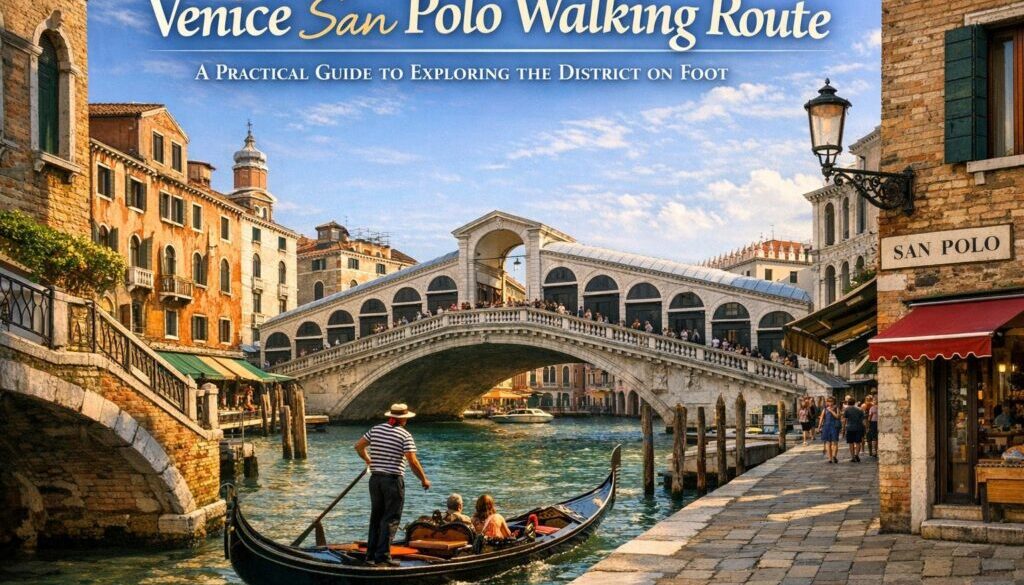
For most travellers, Rialto is the natural anchor for the Venice San Polo walking route. It is one of the city’s defining places and gives the walk both direction and historical weight. If you are trying to make sense of San Polo on your first visit, starting here is the most practical choice.
Rialto is where Venice’s commercial story becomes especially visible. It remains a place associated with trade, movement, and the flow of people across the Grand Canal. As a result, the area can feel busy, but that activity is part of the experience rather than a distraction from it.
Rialto Bridge and why it matters
The Rialto Bridge is one of Venice’s most recognisable landmarks and a key reference point for any San Polo route. Even if you have seen it in photographs, it feels different when you cross it on foot and understand how central it is to the city’s geography and daily movement.
For many visitors, the bridge is also a practical orientation tool. Once you know where Rialto sits, it becomes easier to make sense of nearby lanes and plan the rest of your walk. If you are using a self-guided format, that sense of orientation is especially helpful because Venice can be disorienting even for confident travellers.
Rialto Market and the district’s commercial history
The Rialto market area remains one of Venice’s most important historic commercial zones, and it adds texture to the route. This is where the district feels lived-in, not staged. The movement of shoppers, workers, and visitors creates a rhythm that is distinctive to Venice and worth experiencing at street level.
Market timings can change, so it is sensible to check current local information before you go. The official Venice tourism portal, Venice Unica, is a useful starting point for trip planning and local service information. For travellers who like to add a broader activity around a walking day, browse tours and activities and compare other experiences in Venice. Walkables may receive a commission if you purchase through this link.
What you’ll experience along the way
The best thing about the Venice San Polo walking route is that it feels layered. You are not moving through a single monument zone. Instead, the route mixes landmark moments with quieter passages, and that contrast is what makes it memorable.
Expect a walk that shifts between open squares, shaded lanes, bridges, and small pauses where the city opens out unexpectedly. San Polo is full of those moments. It is one of the reasons Venice is so compelling on foot: the city reveals itself gradually, not all at once.
Historic churches and civic spaces
San Polo includes churches and civic spaces that add depth to a walk, even when you are not entering every building. The point is not to rush through a list of sights, but to notice how architecture and public space frame daily life in the district.
Because opening hours and access rules can vary, it is worth checking current official sources if a particular church or site is important to your itinerary. For broad planning, the city’s official information at Comune di Venezia is the safest place to start.
Narrow lanes, bridges, and classic Venetian street life
This is a district where the walking itself is part of the attraction. Bridges are frequent, and some routes involve steps and uneven surfaces, so comfortable shoes matter more than stylish ones. If you prefer a route that lets you pause and look around, San Polo rewards that approach.
You will also notice how local movement and visitor movement overlap. That is one of the more authentic parts of the walk: Venice is still a working city, and San Polo shows that reality clearly.
Views, pauses, and photo-worthy moments
One of the advantages of walking San Polo rather than simply passing through it is the opportunity to slow down for views. The area offers plenty of places where the relationship between bridge, canal, and lane creates a natural pause. These are the moments that often become the strongest memories of a Venice trip.
To keep those moments easy to find, it helps to use a map app or downloaded route notes. In a city as layered as Venice, good wayfinding is not just convenient; it improves the experience.
💡 Walkables Travel Tip
Download offline maps before you leave your accommodation. In Venice, that small step makes the Venice San Polo walking route much easier to enjoy, especially if you want to wander without worrying about signal gaps or battery drain.
Want to Discover More on Foot?
Explore Walkables self-guided audio experiences and see destinations at your own pace.
Practical walking tips for San Polo
San Polo is walkable, but it is not effortless in the way a flat city centre might be. The more you understand Venice’s physical realities, the more enjoyable the route becomes. A good plan helps you save energy for looking around rather than recovering from avoidable logistics.
Expect bridges, steps, and uneven walking conditions
Bridges are part of the Venice experience, and San Polo includes plenty of them. That means the route can be tiring if you are carrying a heavy day bag or moving too quickly. If mobility is a concern, it is worth planning a shorter walk with clear exit points.
Comfortable footwear is essential. Even short distances feel different when they involve repeated steps, narrow paths, and changing surfaces. The district is best enjoyed at a measured pace.
Check for flooding and weather impacts
Venice can be affected by flooding, so timing matters. If conditions are poor, some parts of your walk may be less comfortable or require adjustment. It is wise to check local conditions before you set out and remain flexible if the weather changes during the day.
For official transport and city information, ACTV and the municipality are the most relevant sources to check if your route needs to shift around services or conditions.
Use vaporetto stops for access and exit planning
Even though the route is on foot, vaporetto stops can make the day easier. They are useful both for reaching San Polo and for leaving the area without backtracking through crowded lanes. That can be especially helpful if you are arriving with limited time or want to combine the walk with another part of Venice.
Route flexibility is one of the biggest advantages of independent walking in Venice. You can decide where to begin and where to finish rather than being locked into a fixed loop.
If you are comparing transport or service information for the day, the official local sources from Venice Unica remain a practical reference point.
Venice visitor access rules and trip planning
Venice has introduced day-visitor access measures on certain dates and conditions, and that makes pre-trip planning important. For a walking route article, this matters because entry rules can affect when you visit, how you book, and what you need to carry with you.
The city’s access-fee system is managed through official channels, so before your trip it is sensible to check the current rules directly. Start with the official access-fee site at cda.ve.it, which is the most relevant source for dates, exemptions, and booking requirements.
If you are an Australian traveller, also check the latest guidance from Smartraveller for Italy-specific entry advice and travel safety information. For longer lead-time planning, the EU’s ETIAS information page is worth monitoring, since entry requirements can change over time.
Staying connected while walking in Venice
Connectivity sounds minor until you need it for maps, translations, a vaporetto timetable, or a booking confirmation. In Venice, that matters more than in many cities because the layout is not always intuitive and the walking route may change if you miss a turn or cross the wrong bridge.
Offline maps are essential
For the Venice San Polo walking route, offline maps are one of the most useful tools you can bring. They reduce stress, help with wayfinding, and make it easier to adjust the route if you decide to stop somewhere longer than planned.
You can also use device guidance from Apple’s eSIM support page or Samsung Australia’s eSIM guidance if you are setting up travel data before leaving Australia.
eSIM, roaming, or local SIM?
There is no one best option for every traveller. An eSIM is convenient if your phone is compatible and unlocked, while a physical SIM may suit travellers who want a local plan with a different mix of features. The main point is to sort it out before you arrive so you are not relying on airport Wi-Fi or last-minute troubleshooting.
If you want to compare travel connectivity options more broadly, it helps to understand how much of your day depends on mobile data: maps, messaging, translation tools, and booking confirmations all become more important in a walkable city like Venice.
Why compatibility matters before you arrive
Not every device handles eSIM the same way, and not every plan supports the same features. Australian travellers should check handset compatibility, dual SIM behaviour, and whether they need access to texts on their Australian number while abroad. Those details are easy to overlook, but they can affect your whole trip.
For a full walking day in Venice, it is not just about being connected. It is about being connected reliably enough to keep the walk relaxed.
For travellers who want to compare money tools alongside trip planning, it can also help to learn more about Wise for international payments and spending overseas. Walkables may receive a commission if you sign up through this link.
Who this walk is best for
The Venice San Polo walking route works well for a wide range of travellers, but it is especially strong for people who value flexibility and context over a rigid sightseeing schedule.
First-time Venice visitors
If this is your first time in Venice, San Polo is a practical district to help you get your bearings. Rialto provides a strong anchor point, and the surrounding lanes give you enough variety to feel immersed without becoming overwhelming.
Independent travellers
Travellers who prefer to move at their own speed will appreciate how San Polo rewards curiosity. You can make the walk shorter or longer depending on your energy, add in a coffee stop, or divert toward a church or square if something catches your eye.
Premium self-guided explorers
If you like your travel to feel polished but not packaged, this is a good fit. San Polo offers a route that feels richly textured without requiring a group format. That is where a self-guided audio experience can add real value: it gives you structure while leaving you free to explore.
Plan your Walkables experience
Venice is one of the best cities in Europe for walking, but it also benefits from context. A self-guided audio format can help you understand why you are standing where you are, what the area once meant, and how to move through it with confidence. That is exactly the kind of experience Walkables is designed to support.
If you want to experience San Polo in a more immersive way, an audio walk can help you connect the dots between the district’s lanes, its Rialto story, and the practical realities of walking in Venice. It is a simple way to turn a route into a richer travel memory.
For travellers who enjoy combining walking with other experiences, it can also be useful to explore cruise companion guides or cruise port guides if Venice is part of a wider itinerary. These are especially helpful when time is limited and you want to make each stop count.
See More of Venice at Your Own Pace
Discover Venice beyond the highlights with a self-guided audio experience designed for travellers who like to walk with confidence.
The best Venice San Polo walking route is the one that leaves room for discovery. Start with Rialto, allow time for bridges and detours, keep your maps offline, and treat the district as a place to experience rather than a place to rush through. That approach suits Venice, and it suits San Polo especially well.
With a little planning, the walk becomes more than a line on a map. It becomes a clear, enjoyable way to understand one of Venice’s most historic districts on your own terms.