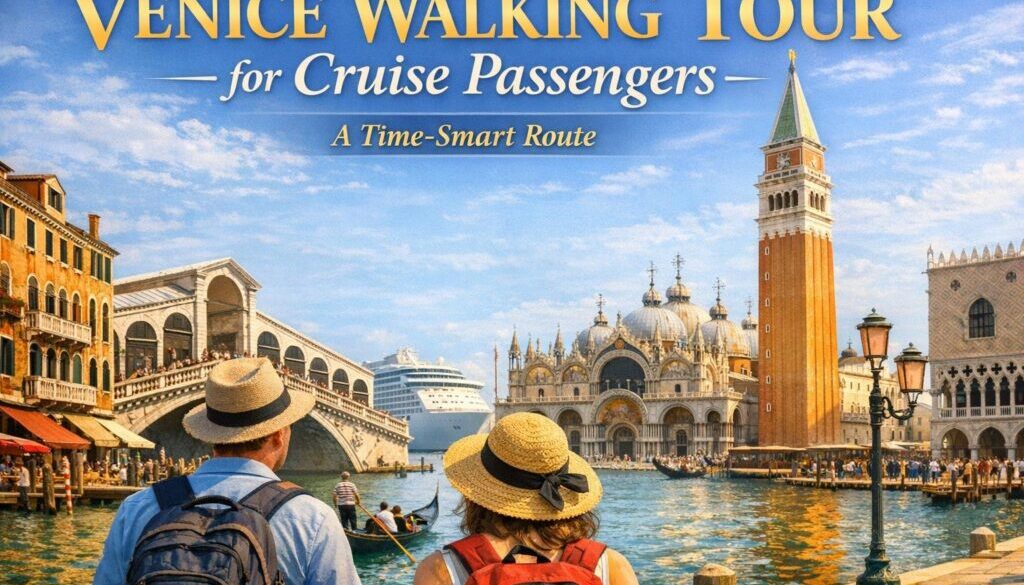
Venice rewards travellers who keep the plan simple. For a Venice walking tour for cruise passengers, the smartest approach is not to chase everything at once, but to build a short route around your actual disembarkation point, current tide conditions, and the amount of time you really have ashore.
That matters because a “Venice cruise” does not always mean you step off beside St Mark’s Square. Venice’s cruise access and port logistics have changed in recent years, and your starting point can shape the whole day. The most useful route is the one that gets you to the city’s essentials without unnecessary backtracking, bridge-hopping, or last-minute stress.
Quick Answer
The best Venice walking tour for cruise passengers is a short, focused loop that starts from your actual transfer point, prioritises a handful of landmark-rich streets and squares, and leaves room for tides, crowds and the return journey to the ship.
Before you walk, it is worth checking the current port context from the Port of Venice and keeping an eye on official tide information from the city’s tide forecasting center. In Venice, those two details can determine whether your route feels smooth or rushed.
Can cruise passengers walk Venice easily?
Yes, Venice is walkable. But it is not flat, and it is not always straightforward. The historic centre is built across islands linked by bridges, so even a short-distance route may involve steps, narrow lanes, occasional detours, and plenty of turning points. For a cruise passenger with limited time, the goal is less about covering distance and more about choosing the right stretch of the city.
That is why a Venice walking tour for cruise passengers works best when it is designed around one or two major routes rather than a full-city wander. Venice’s famous sights are close enough together to make a compact walk rewarding, but you still need a plan that respects your ship’s schedule and the city’s conditions on the day.
If you want a wider framework for independent sightseeing, Walkables’ self-guided walking tours are designed for travellers who prefer to move at their own pace rather than follow a rigid group timetable.
Why your docking point matters
Not every cruise itinerary puts you in the same place. Some passengers transfer into the city, while others may disembark closer to Venice’s transport hubs rather than the historic core. That changes everything: how long the walk takes, how many bridges you cross, and which sights make sense to prioritise.
For that reason, the best starting question is not “What is the best Venice route?” but “Where am I actually starting from?” Once you know that, the route becomes much easier to shape.
Why Venice is walkable but not always simple
Venice is the kind of place that can feel compact on a map and surprisingly slow on foot. Crowds around Rialto and St Mark’s Square can also stretch simple transfers into more time than expected. So the smartest Venice walking tour for cruise passengers is often a loop with a clear start, a clear midpoint and a clear return path.
That approach helps you see more of the city without getting trapped in the common mistake of zigzagging between famous landmarks.
The smartest Venice route for a short cruise stop
If your time is limited, the best walking strategy is to focus on landmark density. In practical terms, that means choosing a route where each turn gives you something worth noticing, rather than spending your precious time on long, repetitive transfers.
A good Venice walking tour for cruise passengers should prioritise:
- easy orientation from your arrival point
- short, logical walking segments
- fewer unnecessary bridge crossings
- well-known highlights that feel worth the effort
- enough flexibility to adjust for tide, crowding or delays
For sightseeing beyond Venice itself, it can also help to compare local activities before you go. If you want to browse options alongside your own walking plan, browse tours and activities through Walkables’ approved Viator affiliate link. Walkables may receive a commission if you book through it.
What a time-smart walking route should prioritise
In a short port stop, you want a route that feels coherent from the first few minutes. Start with a practical arrival area, move toward the most recognisable central streets or squares, then loop back without doubling your steps. Venice rewards people who walk with intention.
The point is not to see every landmark. The point is to leave Venice with a real sense of place rather than the memory of a rushed checklist.
How to avoid unnecessary backtracking
Backtracking is one of the easiest ways to waste time in Venice. Narrow lanes and bridge crossings can make a short return leg feel surprisingly long, especially if you are trying to keep to a ship’s timetable. A well-planned Venice walking tour for cruise passengers should be built as a loop where possible, so the return feels like part of the route rather than an afterthought.
That is also where a self-guided audio experience can be useful. With a clear sequence to follow, you spend less time wondering where to turn next and more time actually seeing the city.
Ready to Explore Venice?
Discover Venice at your own pace with a Walkables self-guided audio walking tour.
What to know before you start walking
There are three practical issues cruise passengers should check before setting off: bridges, crowds and tides. These are not minor details in Venice; they are the difference between a relaxed walk and a route that chews through your limited time.
Bridges, stairs and accessibility
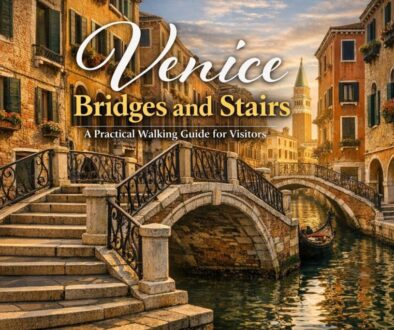
Venice’s bridges are part of the experience, but they can slow you down. If mobility is a concern, keep your route conservative and avoid overcomplicating it. Even an apparently short walk can feel more demanding when steps are involved, especially if you are carrying bags or walking in the heat.
For official city guidance and visitor information, the Venezia Unica portal is a useful place to check current transport and visitor details.
Crowds around Rialto and St Mark’s Square
These are the obvious centres of gravity for first-time visitors, which means they are also the places most likely to feel crowded. A time-smart route should still include them if they fit your schedule, but you do not need to linger longer than your stop allows.
In Venice, standing in the right place for five minutes can be more rewarding than walking for fifteen and arriving exhausted.
Checking tide conditions on the day
Acqua alta can affect walking conditions, and it is worth checking tide forecasts before you disembark. The city’s official tide forecasting center is the best place to verify current conditions. If water levels are higher than expected, a route that looked easy on paper may need to be shortened or adjusted.
⚠️ Important
Do not assume your ideal route will work exactly as planned. In Venice, tides, bridge access and crowding can change the pace of a walk very quickly, so build in margin time before you need to return to the ship.
Getting from the ship into the city
Depending on your docking point, you may need a shuttle, water taxi or vaporetto before your walking route even begins. That is normal in Venice, and it is another reason a Venice walking tour for cruise passengers should be planned around the real arrival point, not a fantasy starting line on a map.
The city’s public transport information is managed through ACTV, and that is the place to check if your route depends on water transport connections. If your cruise line has arranged a transfer, confirm where it drops you and whether it gives you enough time to walk the route you want.
For Australian travellers, the Australian Government’s Smartraveller Italy advice is worth reading before departure, especially for guidance on staying alert in busy tourist areas and keeping valuables secure.
Staying connected for maps and timing
A good walking plan in Venice is easier to follow when you have live maps, transport updates and a way to check your ship timing. Even if you prefer paper notes, it is wise to have digital backup in case you need to adjust quickly.
For a short stop, Australian travellers usually have three options: roaming, eSIM or the ship’s Wi‑Fi. The most useful onshore choice is often the one that gives you reliable map access the moment you step off the transfer.
If you are deciding how to stay connected for navigation, it can also help to learn more about Wise for travel spending and international payments. Walkables may receive a commission if you sign up through the link. While Wise is not a navigation tool, it can be useful when managing travel money across countries.
Roaming versus eSIM for a short Venice stop
For a cruise passenger with limited time ashore, the easiest option is often whichever setup is already working before you arrive. The key is not speed for its own sake, but reliability: maps, messages and any needed transport coordination should be available without fuss.
If you are using your phone to navigate, Venice is one of those cities where live positioning can save time. A small navigation error can become a much longer detour once bridges and narrow lanes are involved.
Why live navigation matters in Venice
Venice is a place where a few blocks can feel much more intricate than they look on a screen. That is especially true for first-time visitors trying to combine limited time with several landmarks. Real-time maps help you keep the route simple, stay oriented and avoid drifting away from your return path.
💡 Walkables Travel Tip
Download your maps and check your tide forecast before you leave the ship or transfer point. If your connection drops in the narrow streets of Venice, you will still have the route you need.
Practical tips for Australian cruise travellers
If you are travelling from Australia, a few extra checks will make your Venice stop much easier to manage. The practicalities are straightforward, but they matter when your time ashore is short.
ETIAS status check before you travel
ETIAS has been delayed several times, so do not assume the situation months in advance is still current when your trip approaches. Before departure, check the official ETIAS page to confirm the latest status for visa-exempt travellers. Keep this as a pre-trip check rather than relying on outdated advice.
Cash, cards and valuables
Venice is a city where cards are widely accepted, but it is still sensible to carry a small amount of cash for minor purchases. More importantly, keep valuables secure and avoid making yourself an easy target in crowded areas. That advice is especially relevant around transport points and major sightseeing zones.
If you want a broader sense of the city’s heritage and why the historic centre is treated so carefully, UNESCO’s Venice and its Lagoon listing is a helpful reference point.
Want to Discover More on Foot?
Explore Walkables self-guided audio experiences and make the most of Venice at your own pace.
Why a self-guided audio tour works well in Venice
For cruise passengers, the appeal of a self-guided format is obvious: you stay flexible without losing structure. That is exactly the balance a Venice walking tour for cruise passengers needs. You can move when you are ready, pause when a square or view deserves more time, and adjust if the tide or crowds change your pace.
Self-guided audio also reduces decision fatigue. Instead of standing at each turning point wondering whether you are still on the right route, you can simply follow the experience and keep your attention on the city around you. If you prefer a more structured experience, Walkables’ cruise port guides can also help you make sense of short port stops in a practical, traveller-first way.
Explore at your own pace
That pace matters in Venice. A good walk is not about rushing between famous places; it is about noticing the detail between them. A canal view, a quiet lane, a sudden opening into a square — those moments are part of the appeal.
Stay flexible around ship timing
Cruise schedules are fixed. City walking routes are not. The best independent walking experience is one that respects both realities. With a clear route and a sensible return buffer, you can enjoy Venice without the constant feeling that you are being pulled by the clock.
Make the most of a short port call
That is the real value of a Venice walking tour for cruise passengers: it gives you a way to see a lot without trying to see everything. In a city like Venice, restraint is often the smartest strategy.
For readers wanting to compare more options before they go, the approved Walkables affiliate link to browse tours and activities can also help you identify additional experiences to pair with a short walking stop.
Final tips before you disembark
Before you head off the ship, confirm three things: your exact arrival point, the latest tide forecast and your return timing. Those checks take only a minute, but they can save a lot of stress later.
Keep your route simple. Focus on a small cluster of highlights rather than trying to “do” Venice in one go. That approach gives you a much better chance of enjoying the city properly, even on a tight cruise schedule.
If you want a trip that feels calm rather than compressed, the smartest Venice walking tour for cruise passengers is the one that starts with reality, follows a clear loop and leaves enough space for the unexpected. Venice is at its best when you let it unfold at walking pace.
Affiliate disclosure: Walkables may receive a commission if you use certain affiliate links in this article, including Viator and Wise, at no extra cost to you.