Choosing between a self-guided walking tour vs guided tour comes down to what you want most on the day: freedom, context, ease, or a bit of all three. For travellers heading to walkable cities such as those in Italy, the decision is usually less about which option is universally better and more about which one fits the way you like to travel.
A self-guided option usually gives you more flexibility and control. A guided tour usually gives you more structure, local insight, and less mental load. If you are deciding between the two, the right answer depends on how confident you feel navigating, how much detail you want from the experience, and how much you want to rely on mobile data, maps, and planning.
Quick Answer
If you want maximum freedom, a self-guided walking tour is usually the better fit. If you want local storytelling, less planning, and easier navigation, a guided tour is often the better choice. The best option depends on your budget, confidence, and destination.
For Australian travellers, one extra factor matters more than many people expect: connectivity. A self-guided tour is much easier when you have reliable data, offline maps, and a charged phone. That is why some travellers now pair independent exploration with a travel eSIM or offline navigation backup. If you are building that kind of trip, self-guided walking tours can be a very practical way to explore at your own pace.
And if you are planning a city break, you can also view the location on Google Maps before you go, which is especially useful when you want to check distances, neighbourhood layout, or the start point of a route.
Self-Guided Walking Tour vs Guided Tour: The Key Difference
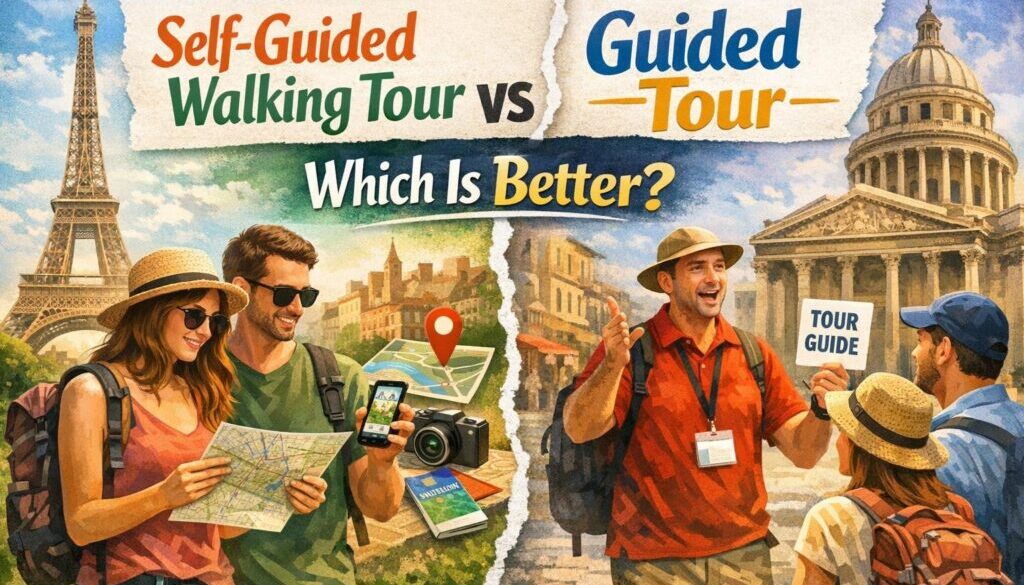
The simplest way to think about self-guided walking tour vs guided tour is this: one puts you in control, the other puts the route and commentary in someone else’s hands.
What is a self-guided walking tour?
A self-guided walking tour is a route you follow independently, usually with a map, app, GPS instructions, written guide, or audio commentary. You decide when to start, when to pause, and how long to linger. That makes it ideal for travellers who like to stop for coffee, take photos, browse shops, or detour when something catches their eye.
What is a guided walking tour?
A guided walking tour is led by a person who manages the route and adds commentary along the way. It can be a better fit when you want history, local context, and a bit of help making sense of the streets around you. The trade-off is less freedom: you generally follow the group’s pace and schedule.
Which Tour Type Is Better for Different Travellers?
The better choice often becomes obvious once you match the format to the traveller.
Best for independent travellers
If you enjoy moving at your own pace, a self-guided walking tour is usually the better fit. It suits travellers who do not want to feel rushed, especially in places where the best part of the day is wandering rather than ticking off stops.
Best for first-time visitors
For a first visit to a complex city, a guided tour can reduce stress. You do not need to worry as much about finding the route, missing key sights, or wondering whether you are in the right place. That can be especially helpful in historic centres where streets are dense, signs are limited, and there may be traffic restrictions or crowded pedestrian areas.
Best for solo travellers
Solo travellers often split into two camps. Some prefer the independence of a self-guided walk, especially if they like quiet time and photography. Others appreciate the confidence and company of a guided walk, particularly in a destination they do not know well.
Best for families, older travellers, or anyone wanting more structure
A guided tour can be easier when you are travelling with people who prefer a clear plan, or when you want to minimise decision-making during the day. It may also feel more comfortable if you are concerned about navigation, language barriers, or uneven streets.
Ready to Explore at Your Own Pace?
Discover destinations with a Walkables self-guided audio walking tour and enjoy a more flexible way to see the highlights.
Cost, Flexibility, and Experience: How They Compare
When travellers compare self-guided walking tour vs guided tour, cost is usually the first thing they notice. But value is not only about the ticket price. It is also about what you get in return.
Self-guided tours: lower upfront cost, more flexibility
A self-guided walk is often cheaper because you are not paying for a live guide or group structure. But there can still be costs if you use a paid audio guide, buy museum tickets, or rely on mobile data while out and about. In practice, the value comes from freedom as much as savings.
Guided tours: higher upfront cost, richer context
Guided tours usually cost more because you are paying for expertise, logistics, and the convenience of having someone else handle the route. For many travellers, that extra cost is worth it if it means better storytelling, easier navigation, and less planning.
Which offers better value?
There is no single answer. If you already know the destination well and simply want to explore, self-guided can be the best value. If you want to understand what you are seeing rather than just pass through it, a guided tour may justify the higher price.
Why Connectivity Matters for Self-Guided Tours
This is where the self-guided walking tour vs guided tour decision becomes very practical, especially for Australian travellers heading overseas.
Mobile data, maps, and GPS
A self-guided walk often depends on live navigation, attraction information, translation tools, and maybe a few backup screenshots or tickets. That means mobile data and GPS matter more than they do on a guided tour.
Why eSIMs matter for Australian travellers
Many travellers now use a travel eSIM to avoid expensive roaming charges and keep maps and route instructions working smoothly. Device compatibility still needs to be checked carefully, but when it works, it can make self-guided exploring much easier.
If your trip involves a lot of wandering on foot, you may also want to learn more about Wise for managing travel spending while overseas. Walkables may receive a commission if you sign up through the link.
Why offline maps are a smart backup
Even if you have a data plan, offline maps are still worth downloading before you leave your hotel. They help when coverage drops, when your battery is running low, or when you want to save data for the rest of the day. Google Maps support has helpful guidance on offline map use at Google Maps Help.
Battery and charging considerations
Navigation, audio playback, translation, and camera use all drain battery faster than most travellers expect. For a self-guided tour, charging ahead of time and carrying a power bank can make the difference between a relaxed walk and a stressful one.
💡 Walkables Travel Tip
Before a self-guided walk, download your route, save key stops offline, and check your battery level. If you are using a travel eSIM, test it before you head out so you are not troubleshooting in the street.
Why Guided Tours Can Be a Better Fit in Italy
Italy is one of the places where the self-guided walking tour vs guided tour question really matters. Historic centres are often highly walkable, but they can also be busy, layered, and easy to misread if you are unfamiliar with them.
Historic centres, crowds, and navigation complexity
In many Italian cities, the charm is in the details: narrow streets, sudden piazzas, small churches, hidden courtyards, and a pace that rewards patience. A guided tour can help you orient yourself quickly, especially if you are short on time or visiting for the first time.
Local expertise and cultural context
A good guide can explain not just what you are looking at, but why it matters. That context can be hard to get from signage alone, particularly in neighbourhoods where the best stories are not obvious from the street.
For official destination context and route ideas, it is worth checking the Italian tourism portal at Italia.it, which is useful when you want a broader sense of how a city or region fits together.
Comfort, confidence, and easier logistics
If you would rather not worry about meeting points, route-finding, or whether you have interpreted the map correctly, a guided tour can be a calmer way to see a city. That is especially true when you are dealing with jet lag, a tight schedule, or a destination you have only just arrived in.
Want to Discover More on Foot?
Explore Walkables self-guided audio experiences and enjoy a premium way to walk a destination at your own pace.
When Self-Guided Walking Tours Are the Better Choice
There are plenty of situations where self-guided walking tour vs guided tour is not even a close call.
Slow travel and personal pacing
If you like to wander slowly, stop often, or change plans as you go, self-guided is usually the stronger option. It lets you follow your curiosity rather than a fixed schedule.
Coffee stops, shopping, photos, and detours
Self-guided walks suit travellers who want to browse a market, step into a church, sit for an espresso, or spend extra time in a square that feels especially lively. Guided tours can be excellent, but they rarely offer the same freedom to drift.
Repeat visitors and confident explorers
If you have already seen the main sights, or if you are comfortable navigating new places, a self-guided route may feel more rewarding. You can focus less on the “must-see” checklist and more on the atmosphere of the place.
When a Guided Walking Tour Makes More Sense
Sometimes the answer is simple: a guided walk is the better choice because it saves time, energy, and guesswork.
First-time visitors
First-timers often get the most value from a guided tour because it reduces uncertainty. You do not have to wonder whether you have taken a wrong turn, missed the significance of a building, or overlooked a story that adds meaning to the street in front of you.
Travellers who want history and storytelling
If you enjoy hearing how a place evolved, guided tours can be particularly satisfying. The right guide can turn a simple walk into a much richer experience by connecting architecture, local history, and everyday life.
People who prefer structure and less planning
Some travellers simply want the easiest possible day. If that is you, the organised nature of a guided tour may be exactly what you need.
How to Decide Which Is Better for Your Trip
When you compare self-guided walking tour vs guided tour, the best answer usually comes from five practical questions.
Budget
If price is the main concern, self-guided usually wins on upfront cost. But if you will spend a lot on data, tickets, or detours caused by poor planning, the gap may narrow.
Confidence navigating
If you feel relaxed using maps and reading streets, self-guided can be very satisfying. If navigation stresses you out, guided is likely the better match.
Connectivity and roaming
Self-guided works best when you have a data plan, an eSIM, or offline backups. Guided tours reduce your dependence on tech, which can be helpful if you do not want to think about connectivity while travelling.
Accessibility and mobility
Accessibility can change the equation. A guided tour may be easier if you want support with pace or route adjustments. A self-guided walk may be better if you need to build in extra breaks or choose a route that suits you.
Destination complexity
Simple, compact neighbourhoods are often ideal for self-guided exploring. Dense historic centres, crowded landmarks, and places with confusing street patterns can make guided tours more appealing.
For travellers who want to add something extra after a walk, you can also browse tours and activities for more ideas beyond a single route. Walkables may receive a commission if you book through the link.
So, Which Is Better?
The truth is that the self-guided walking tour vs guided tour debate does not have one winner. It depends on how you travel.
A self-guided tour is usually better if you want freedom, flexibility, and a slower pace. A guided tour is usually better if you want context, confidence, and less planning. In a place like Italy, where walking is part of the pleasure, both can work beautifully — but they serve different travellers.
If you like to explore independently but still want structure and storytelling, a premium self-guided audio format can be the sweet spot. It gives you the independence of walking solo with the feel of having someone knowledgeable along for the route.
For many travellers, that is the real answer to the self-guided walking tour vs guided tour question: choose the format that helps you enjoy the place, not the one that sounds best in theory.