
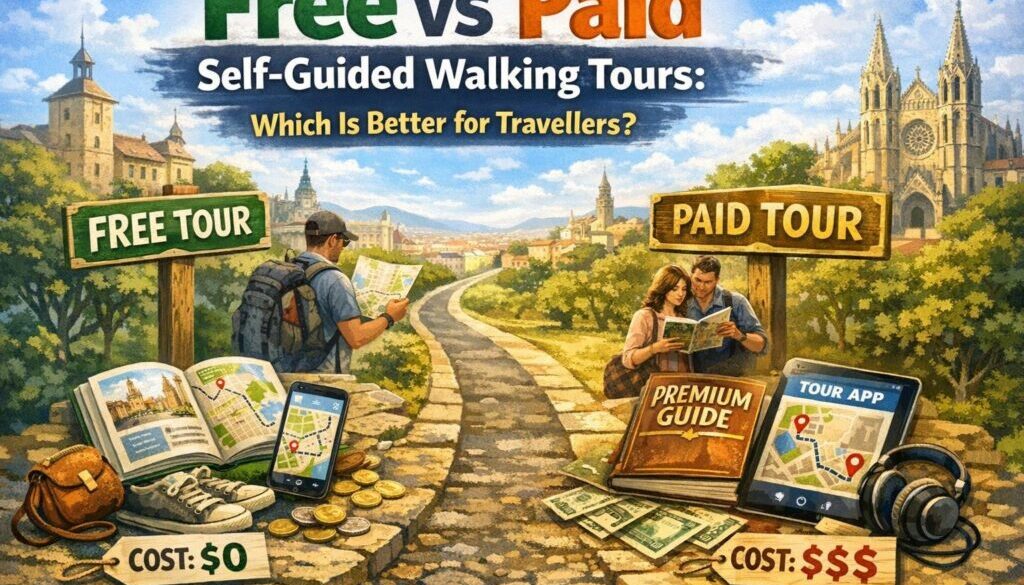
Free vs paid self-guided walking tours is not just a question of price. It is really a question of how you want to travel: do you want the lowest upfront cost, or do you want a smoother, more reliable experience when you are standing in a city centre with patchy signal, limited battery, and a short list of places you want to see well?
For Australian travellers in Europe, especially in cities such as Rome, Florence, Venice or Milan, the difference can be surprisingly practical. A free tour may work perfectly if you are comfortable piecing things together yourself. A paid tour may be worth it if you value offline access, stronger storytelling, cleaner route design, and less time spent troubleshooting maps and downloads.
In other words, the best choice is not always the cheapest one. It is the one that fits your trip style, your data setup, and how much planning you want to do before you leave the hotel.
null
Quick Answer
If you want the simplest answer: free vs paid self-guided walking tours usually comes down to control versus convenience. Free tours suit confident, budget-minded travellers. Paid tours are often better for first-time visitors, offline reliability, and polished storytelling.
What’s the difference between free and paid self-guided walking tours?
A self-guided walking tour is a route you follow on your own, usually with maps, audio, photos, written notes, or a mix of all three. You decide when to start, when to stop, and how long to linger. That flexibility is the appeal.
With free vs paid self-guided walking tours, the difference is usually less about the idea and more about the delivery.
What “free” usually means
Free tours often come from blogs, apps with limited free content, downloadable PDFs, or ad-supported platforms. They can be genuinely useful, especially if the route is well written and the points of interest are clear. But “free” may still come with trade-offs such as ads, upsells, reduced offline access, or more work on your part to connect the dots.
What “paid” usually includes
Paid tours usually offer a more curated experience: tighter route design, cleaner narration, better audio production, and sometimes offline downloads or in-app maps. The value is not only the tour itself, but the time and effort it saves while you are travelling.
That matters because walking trips are often at their best when they feel effortless. If you are constantly checking signal, reloading pages, or trying to work out which turn to take next, the experience can start to feel like admin.
For a broader look at how guided-on-your-own travel works, Walkables’ self-guided walking tours are designed for travellers who want to explore at their own pace without losing the story of the place.
The real-world costs travellers often forget
The headline price is only one part of the equation. When people compare free vs paid self-guided walking tours, they often forget the hidden cost of making a free option work well.
Mobile data and roaming
If a free tour depends on live loading, streaming, or repeated map lookups, you may end up using more data than expected. For Australians travelling overseas, roaming can be expensive, which is why many travellers rely on a travel eSIM or local data plan instead.
That is where the real value conversation begins. A paid tour with offline content may cost more upfront, but it can save you frustration, roaming charges, and wasted time. For background on device and offline map planning, Google explains how to download areas and use offline maps.
eSIM setup and compatibility
Travel eSIMs can make walking trips much easier, but they still need proper setup. Providers typically recommend activating them with internet access, often before departure or on arrival using Wi‑Fi. Device compatibility also matters: your phone needs to support eSIM, and it may need to be unlocked.
If you are comparing free vs paid self-guided walking tours while also sorting your connectivity, the safest approach is to test everything before your first walk. Apple’s guidance on using eSIM on iPhone is a useful starting point.
Offline maps, battery life, and backup planning
Offline access is one of the biggest reasons travellers choose paid content. It is also one of the biggest reasons free tours can become annoying in the real world. A walking tour is only as good as your ability to keep following it.
Google Maps and Apple Maps both support offline use in different ways, but offline mode is never quite as flexible as full live navigation. That means battery life matters too. A long day of walking, filming, messaging, and mapping can drain a phone quickly. A power bank, downloaded route, and screenshots of key stops are simple precautions that pay off.
💡 Walkables Travel Tip
Before you leave, download your route, save the starting point, and check that your tour works in airplane mode. If it does not, it is not really a stress-free walking tour.
When free self-guided tours work best
There are plenty of situations where free options make sense. The key is to know what you are giving up, and whether that matters on your trip.
Best for budget travellers
If your priority is keeping costs down, free tours can be a smart choice. They can be especially useful if you are already comfortable using maps, researching a neighbourhood, and making your own decisions on the ground.
Best for flexible, independent explorers
Some travellers do not want a guided narrative so much as a loose framework. They want a starting point, a few landmarks, and the freedom to wander. For that style of travel, free routes can be enough.
Best when you already know the destination
If you have visited the city before, or you are only looking for a simple neighbourhood walk, a free route may be all you need. You may already know how the city flows, where the tricky crossings are, and which areas deserve more time.
Ready to Explore at Your Own Pace?
Discover destinations in a more polished way with a Walkables self-guided audio walking tour.
When paid self-guided tours are worth it
Paid tours tend to shine when you care about ease, reliability, and the quality of the experience itself. That is why many travellers end up preferring paid options after trying a few free ones.
Better for first-time visitors
If this is your first time in a city, a paid tour can reduce decision fatigue. You do not need to assemble your own story from several sources. The route is usually more deliberate, and the pacing is often better thought through.
Better for polished storytelling and route design
This is where paid products often justify their cost. A good paid tour does more than point you to landmarks. It explains why the place matters, how the streets connect, and what you should notice as you walk between stops. That kind of storytelling can turn a simple route into a much richer visit.
Better for travellers who want less planning
If you are already managing train tickets, hotel check-ins, and restaurant bookings, a paid tour can remove one more layer of decision-making. For many travellers, that convenience is worth paying for.
When you are looking beyond the walk itself and want ideas for other activities in the city, it can also help to browse tours and activities. Walkables may receive a commission if you book through this link.
What Australian travellers should check before choosing
For Australians travelling in Europe, the choice between free vs paid self-guided walking tours often comes down to how well the setup works on the day. A brilliant route is not much use if your phone is not ready for it.
Device compatibility
Check whether your phone supports the app or download format before you leave Australia. If you plan to use an eSIM, make sure your device supports that too. Apple’s support page and your provider’s help centre are the best places to confirm details.
Offline access
Ask a simple question: what still works when you have no signal? If the answer is “not much,” the tour may be less reliable than it first appears. Offline access is especially useful in busy historic centres where buildings, crowds, and narrow streets can make reception patchy.
Roaming vs travel eSIM
For many Australians, a travel eSIM is a cleaner solution than using standard roaming. It can keep maps, translation tools, and messaging running without the shock of roaming bills. But it still needs setup and testing. Do not assume that buying an eSIM solves every connectivity issue automatically.
Local safety and route practicality
Not every route is equally comfortable on foot at every hour. Consider traffic, crowding, lighting, and how easy the route is to follow if you stop to take photos or step into a café. Smartraveller’s Italy travel advice is a sensible place to check general safety and preparation guidance before you go.
For destination planning, it is also helpful to view the location on Google Maps so you can see how the route sits within the wider city rather than just as a list of stops.
Want to Discover More on Foot?
Explore Walkables self-guided audio experiences and enjoy a destination with more structure, story, and ease.
Which option is better for Italy?
Italy is one of the clearest places to think seriously about free vs paid self-guided walking tours. Major cities are intensely walkable, but they are also busy, layered, and often crowded. That makes route clarity and offline reliability especially important.
City walking culture and tourism routes
Italy’s official tourism platforms regularly frame the country through city exploration and walking-friendly experiences, which says a lot about how visitors actually move around these places. You are rarely just “going from A to B.” You are moving through history, neighbourhoods, and public spaces where the details matter.
For official destination inspiration, Italy’s tourism portal is a useful starting point when you want to understand the broader travel landscape.
Why offline access matters in busy historic centres
In older city centres, streets can be narrow, intersections can be confusing, and the most interesting detours are often the easiest to miss. If your tour depends on live loading or constant connectivity, you may find yourself checking your phone more than looking around.
That is why paid self-guided tours often feel better in Italy: not because free tours cannot work, but because the practical margin for error is smaller when you are navigating dense, high-traffic areas.
The bottom line: free, paid, or hybrid?
The smartest answer is not always one or the other. In many cases, the best value comes from a hybrid setup: a reliable route, offline maps, and the right connectivity for your trip.
Best choice by travel style
Choose free if you are budget-focused, confident with navigation, and happy to do more planning yourself.
Choose paid if you want a smoother experience, better storytelling, and less risk of technical hassle while you walk.
Choose hybrid if you want the best of both: offline maps, a travel eSIM, and a tour that keeps the walk enjoyable rather than mechanical.
Why hybrid can be the smartest option
Hybrid is often the answer for Australian travellers in Europe because it balances cost and convenience. You can keep data usage under control, avoid roaming surprises, and still enjoy a walk that feels guided rather than improvised.
If you like the idea of exploring independently but want a more polished experience than a typical free route, Walkables’ self-guided walking tours are built for that kind of travel: unhurried, story-led, and easy to follow at your own pace.
For travellers comparing options in the broader market, explore local tours and experiences can also help you understand what else is available alongside a self-guided walk. Walkables may receive a commission if you book through this link.
So, which is better?
If your priority is saving money and you enjoy figuring things out as you go, free self-guided tours can work well. If your priority is a smoother day on foot, stronger offline reliability, and a more thoughtfully produced experience, paid tours usually win.
That is the real answer to free vs paid self-guided walking tours: the better option is the one that reduces friction for the kind of traveller you are. For many Australians in Europe, that means paying a little more for peace of mind, then walking with confidence instead of constantly worrying about signal, batteries, or whether the next turn is the right one.