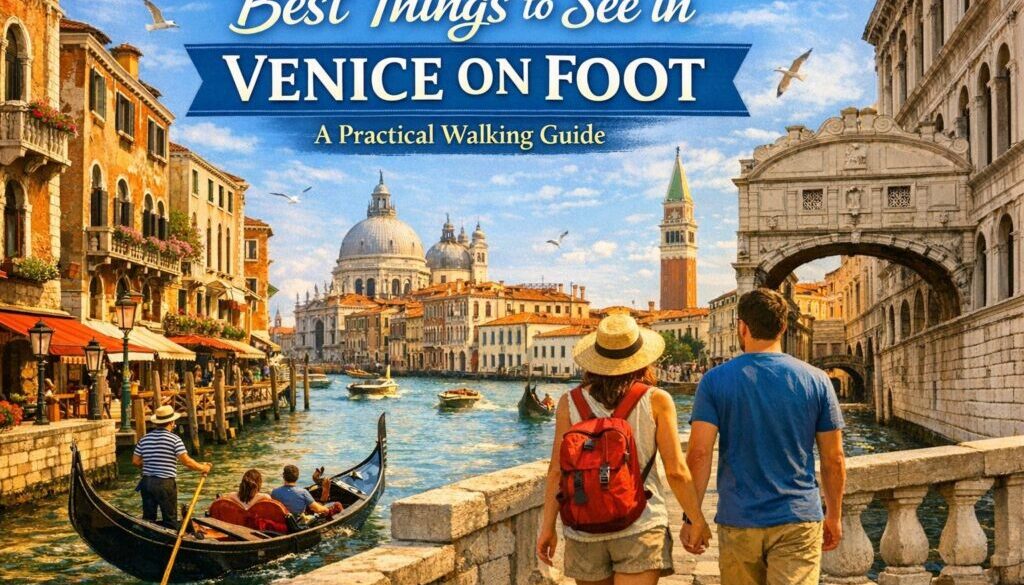
Venice is one of those cities that makes the case for walking almost immediately. The best things to see in Venice on foot are not separated by long distances so much as connected by bridges, lanes, courtyards, and waterfront paths that turn every short transfer into part of the experience. If you plan it well, you can see the city’s essential sights without feeling rushed or stuck in transit.
The trick is to think in walking loops rather than point-to-point sightseeing. Venice rewards a slower pace, especially for first-time visitors and anyone arriving from Australia after a long-haul flight. You will cover less ground than you would in a typical city, but you will see more of what makes Venice distinctive: the scale of the lanes, the sudden opening of a campo, the constant presence of water, and the way the city’s famous landmarks reveal themselves gradually.
null
This guide focuses on the best things to see in Venice on foot, how to link them into a sensible route, and what to keep in mind so you do not waste time doubling back or getting caught out by bridges, crowds, or navigation quirks.
Quick Answer
The best things to see in Venice on foot are the classic historic-centre highlights: St Mark’s Square, St Mark’s Basilica, Doge’s Palace, the Rialto Bridge area, and stretches of the Grand Canal and quieter neighbourhood lanes. Venice is best experienced as a walking city, but you should plan around bridges, occasional detours, and the possibility of using a vaporetto for longer hops.
Best things to see in Venice on foot
If you only have a short stay, focus on a route that gives you a strong sense of Venice rather than trying to tick off too many separate stops. The best things to see in Venice on foot are the places that sit naturally along the city’s most walkable historic core.
St Mark’s Square
St Mark’s Square is the obvious starting point, but it earns that status. It is where many first-time visitors get their first full impression of Venice’s scale and atmosphere. Arrive early if you want the cleanest views and the easiest movement through the square. Later in the day, this area becomes one of the busiest places in the city.
For a sense of the area before you go, you can view the location on Google Maps.
St Mark’s Basilica
St Mark’s Basilica is one of the city’s most important sights and a natural part of any walk through the historic centre. Because opening arrangements can change, check the official basilica website before you visit: the Basilica di San Marco official site. That is especially useful if you want to avoid arriving when the queues are at their longest.
Doge’s Palace
Just beside the basilica, Doge’s Palace is another core stop on a Venice walking route. It is one of the clearest examples of why Venice works so well on foot: you can move from square to palace to canal edge in a matter of minutes, with the city’s layers unfolding as you go. For current visiting details, use the official site for the palace: Palazzo Ducale.
Rialto Bridge and the surrounding lanes
The Rialto Bridge is one of the most recognisable crossings in Venice, and the surrounding streets and lanes are just as rewarding as the bridge itself. This is a good area for walking because it links commerce, history, and movement across the Grand Canal in a compact space. It is also an area where the route can feel more organic: you may not have a perfect straight line, but that is part of the point.
Grand Canal viewpoints
You do not need to take a long boat ride to appreciate the Grand Canal. Some of the best moments happen from bridges, small waterfront edges, and places where the canal suddenly opens into view. In a city built on water, these pauses matter. They help you understand Venice spatially, not just visually.
Quieter sestieri and side lanes
Some of the best things to see in Venice on foot are not single landmarks at all. They are the calmer neighbourhood streets, smaller squares, and laneways where the city feels less staged. These areas are where you notice shopfront details, laundry lines, quiet canals, and everyday Venice. For travellers who prefer discovery over checklist tourism, this is where the city becomes most memorable.
Waterfront paths and riva promenades
Venice’s waterfront walks add breathing room to the denser central areas. A riva promenade or canal-side stretch gives you a break from the narrow lanes and a better sense of the city’s relationship with the water. They are also practical because they help reset your bearings when the internal street pattern starts to feel confusing.
Ready to Explore Venice?
Discover Venice at your own pace with a Walkables self-guided audio walking tour.
How to plan a walking route in Venice
The best way to enjoy the best things to see in Venice on foot is to treat the city like a sequence of compact walking sections. That means grouping sights by area and accepting that Venice does not always reward directness. A route that looks short on a map can take longer than expected once you factor in bridges, narrow passages, and occasional dead ends.
Expect bridges, detours, and slower progress
Venice is pedestrian-oriented, but it is not barrier-free. Some routes involve steps and bridges, which can be awkward if you are travelling with luggage, a stroller, or limited mobility. Plan conservatively and leave more time than you would in a conventional city. That advice is especially important if you are arriving tired and trying to cram in too much on day one.
Use live maps and offline backups
Mobile navigation is extremely useful in Venice because lane names, waterways, and crossings can be hard to read at speed. Even with strong map apps, downloading offline maps before you go is a smart backup. If you are travelling from Australia and want less friction on the ground, this is where a travel data plan or eSIM can be genuinely useful.
If you are comparing travel connectivity options for Europe, you may also want to learn more about Wise for international spending and budgeting while abroad. Walkables may receive a commission if you use the referral link.
When a vaporetto makes sense
Walking should remain the default, but Venice’s waterbuses still have a place. If you are heading further afield, crossing the city in poor weather, or saving energy for a longer day, a vaporetto can make the whole itinerary more efficient. That is especially true if you are combining the central sights with island visits or a return across the Grand Canal later in the day.
💡 Walkables Travel Tip
In Venice, the most useful habit is to walk with a flexible route in mind. Start with one or two anchors, then allow room for detours, pauses, and occasional wrong turns. That is often how the city becomes more enjoyable, not less.
How long to spend on the best things to see in Venice on foot
If you only have a half-day, focus on one compact walking loop around St Mark’s Square and the Rialto area. That gives you a strong introduction without overextending yourself. A full day allows a more relaxed pace, time for a proper break, and the chance to wander some quieter lanes between the headline sights.
For most visitors, the biggest mistake is trying to do too much. Venice is not a city where the number of landmarks matters as much as the quality of the route between them. It is better to see fewer places properly than to spend the day rushing from one crowded point to another.
First-day pacing after a long-haul flight
Australian travellers often arrive after a long journey, and that can change how much walking feels comfortable. On your first day, keep the route simple. Choose a central loop, take breaks often, and save the longest walking day for when you are more rested. Venice is beautiful even when you are moving slowly.
Short loop or longer sightseeing day
A short loop works well if you want the city’s essentials and a relaxed lunch. A longer day makes sense if you want to include more neighbourhood wandering and canal-side exploring. In either case, the best things to see in Venice on foot are the ones that fit naturally together rather than the ones that require repeated cross-city backtracking.
Want to Discover More on Foot?
Explore Walkables self-guided audio experiences and discover destinations at your own pace.
Practical tips for walking Venice comfortably
Venice is rewarding, but it is not a city where you want to improvise every detail. A few practical habits make a big difference, particularly for travellers who want to see the best things to see in Venice on foot without unnecessary stress.
Accessibility and bridge crossings
Bridges are part of Venice’s character, but they also shape your route. If stairs are a concern, build in more time and check likely crossing points in advance. The city’s pedestrian streets can feel deceptively straightforward on a map, so it helps to look at the broader route rather than assuming every connection will be easy.
Water, toilets, and shade
On warmer days, walking Venice can become tiring faster than expected because you are often moving through narrow lanes with limited shade. Carry water, stop regularly, and do not leave every break until the end of the route. Toilets and rest stops are not always where you want them to be, so plan around longer sections rather than hoping to find everything on the fly.
Payments and backups
Card payments are widely used in tourist areas, but it is still wise to carry a backup card and some cash. That matters for small purchases, quick stops, and any unexpected need while moving between sights. A little preparation goes a long way in a city where you may not want to stop and search for services in the middle of a crowded route.
Why mobile data helps in Venice
Mobile connectivity is more than a convenience in Venice; it is a practical navigation tool. The city’s layout makes live maps useful, and digital tickets or booking confirmations are easier to manage if you can access them on the move. If you are considering connectivity options for your Italy trip, it is worth planning before you fly rather than trying to sort it out after arrival.
For Australian travellers, an eSIM can be especially helpful because it avoids the need to locate a shop on arrival and can be activated more easily before or during the trip, depending on your setup. The main things to compare are data allowance, hotspot support, compatibility, and how much coverage you will need for navigation-heavy days.
It also helps to keep screenshots of any important bookings, because even in a major tourist city, you do not want to depend entirely on live connectivity in the middle of a route.
Before you go
Venice is a live city, not a static museum set, so it is worth checking the current official information before you travel. Attraction hours, access rules, and city policies can change, and some of the most useful planning decisions happen before you arrive rather than once you are already in the lanes.
For official city updates, use the Comune di Venezia and visitor resources such as the official Venice city site and Venezia Unica. If you are concerned about current entry or travel requirements for Italy, also check Australia’s travel advice at Smartraveller’s Italy page and the EU’s official ETIAS information at the European Union ETIAS page.
Venice has also had experimental day-visitor access arrangements in recent years, so do not assume the rules are unchanged. Verify the current policy before you travel, especially if you are planning a short stop or a day trip.
⚠️ Important
Do not rely on old screenshots or old blog posts for Venice access rules, opening hours, or booking conditions. Check official sources close to departure, especially for St Mark’s Basilica, Doge’s Palace, and any day-visit requirements that may apply.
If you want to add more sightseeing around the city after the core walking route, you can also browse tours and activities for additional Venice experiences. Walkables may receive a commission if you book through the affiliate link.
Make the most of Venice at your own pace
The best things to see in Venice on foot are best approached as a sequence, not a checklist. Start with the city’s essential centre, keep your route simple, and leave space for the moments that do not appear on any itinerary: a quiet canal view, a bridge with no crowd on it, a small square you did not expect to find. That is where Venice becomes more than a set of famous sights.
For travellers who like structure without losing flexibility, a self-guided audio format can be a strong fit. It lets you keep moving, understand what you are seeing, and experience the city at your own pace. In Venice, that balance is often exactly what the day needs.